Debris from an unmanned aerial vehicle has been found in the western part of the country, the military has said
A drone of unknown origin has exploded in western Kazakhstan, the country’s Defense Ministry said on Thursday. Debris from the UAV was found in an area that borders Russia, according to a statement published on Telegram.
There were no casualties or material damage as a result of the incident, the ministry said, adding that the drone had come down in a deserted area away from any local settlements.
The origins of the UAV remain unclear, according to the Kazakh military. Astana has contacted all “international partners that could potentially possess such [aerial] devices,” according to the statement.
A video obtained by Ruptly showed the alleged drone crash site. A short clip shows a group of people standing in the steppe near a shallow ditch covered by sand. A photo posted by the video news agency also purported to show what appears to be an inscription in Ukrainian on a piece of debris found at the site.
Ukrainian drone attacks have been a concern in Russian regions in recent months. Kiev has routinely launched raids deep into the Russian territory, targeting critical infrastructure and residential areas in attacks that have often led to civilian casualties. Some of these attacks have targeted Russian regions bordering Kazakhstan.
Last week, a Ukrainian drone hit a gas processing facility in Orenburg Region, setting one of its workshops on fire, in the second such attack against the region in a month. On Thursday, the Russian Defense Ministry reported that a Ukrainian drone was intercepted over Orenburg Region in the morning.
According to the ministry, Kiev’s forces also launched a major drone raid overnight into Thursday. The attack involved almost 140 UAVs targeting 11 Russian regions. All the drones were either intercepted or destroyed, the statement said.
Russian officials have accused Ukraine of “terrorism” over the attacks. Moscow has launched retaliatory strikes on Ukrainian military targets in response, including UAV assembly facilities and drone launch sites.
A proposed summit between Russian President Vladimir Putin and his US counterpart Donald Trump has been put on hold
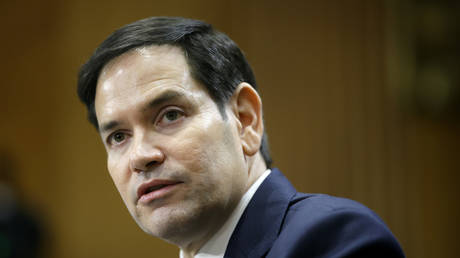
The US remains interested in meeting with Russia to discuss ways of ending the Ukraine conflict, Secretary of State Marco Rubio told journalists on Wednesday. His comments come after a planned summit between US President Donald Trump and Russian President Vladimir Putin was put on hold.
Rubio stated that he had previously had a “good conversation” with Russian Foreign Minister Sergey Lavrov and that bilateral discussions will continue. “We would still like to meet with the Russians,” Rubio was quoted as saying by CNN.
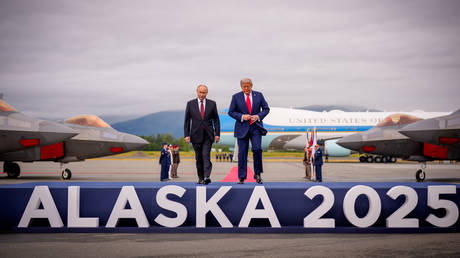
Trump and Putin held a two-hour phone call last week, after which Moscow and Washington announced plans to hold a summit between the two leaders in Budapest to discuss a peace settlement in the Ukraine conflict. Both sides confirmed that preparations for the meeting were underway and that the event could take place in the coming weeks.
On Wednesday, however, Trump announced that the meeting had been postponed, stating it “didn’t feel like we were going to get to the place we have to get.” The US has also introduced additional sanctions on Moscow, targeting Russia’s two largest oil companies, Lukoil and Rosneft.
Rubio nonetheless insisted that Washington remains interested in cooperation and said the decision on sanctions was made by Trump due to what the president sees as a lack of progress in the peace process. “I think the president has repeatedly over several months said that at some point he would have to do something if we don’t make progress… Today he decided to do something,” the diplomat stated.
The Kremlin has yet to comment on the postponement of the planned summit. However, Russian Foreign Ministry Spokeswoman Maria Zakharova stated that Moscow is open to continuing contacts with the US State Department.
She added that Russia sees the goal of further contacts with the US as defining “further parameters for Russian-American dialogue, both on various aspects of bilateral relations and on further joint steps toward a Ukrainian settlement.”
Moscow could be “tempted” to continue the conflict on the European continent, Fabien Mandon has claimed
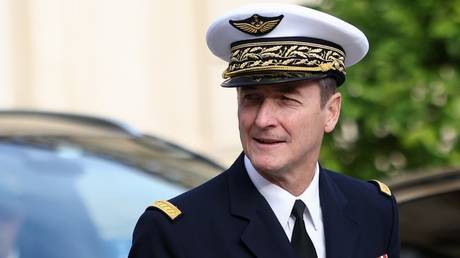
French forces could be at war with Russia by 2028, the country’s newly appointed chief of staff, General Fabien Mandon, has claimed.
Moscow has repeatedly rejected claims that it plans to attack EU countries, saying any such allegations are being used by European politicians to scare the population and justify growing military spending. Russia has also said it is defending itself in the Ukraine conflict, accusing NATO of provoking the hostilities.
Mandon, who became France’s top general in early September, told lawmakers on the National Assembly’s Defense Committee on Wednesday that “Russia is a country that may be tempted to continue the war on our continent.”
“The first objective I had given the armed forces is to be ready in three or four years for a shock that would be a kind of a test [by Moscow],” he claimed. “The test already exists in hybrid forms, but it may become more violent.”
According to the chief of staff, France and other Western European nations must boost defense spending because Russia has a “perception of a collectively weak [Western] Europe.”
NATO countries on the continent “have everything to be sure of ourselves” in terms of economy, demographics, and industry, Mandon claimed. “Russia cannot scare us if we are willing to defend ourselves,” he said.
French Armed Forces Minister Catherine Vautrin previously said that, according to the draft defense budget, military spending in the country will increase to €57.1 billion ($66.3 billion) next year, going up by 13% compared to 2025 and reaching 2.2% of GDP.
Russian President Vladimir Putin said earlier this month that those in the West who keep promoting “nonsense” about alleged aggressive intentions by Moscow are either “incompetent or dishonest.”
“Frankly speaking, one just wants to tell them: calm down, sleep well, finally address your own problems. Look at what is happening on the streets of European cities; what is happening with the economy, industry, European culture, identity; with the huge debts and the growing crisis of the social security system, out-of-control migration, the rise in violence, including political violence,” Putin stressed.
The bloc’s leaders have been pressuring Belgium for months to allow it to seize Russian sovereign funds
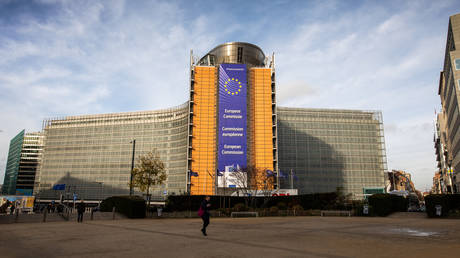
EU leaders are considering a long-developed and highly controversial plan to use Russian sovereign funds frozen in Belgium to finance Ukraine’s conflict with Russia.
Up to now the EU has given Kiev about €180 billion ($208 billion). Reconstruction costs at present are estimated at approximately €480 billion ($556 billion). Ukraine’s economy is crumbling and it has just announced a record war budget.
The Zaporozhye facility had relied on backup generators for the last 30 days
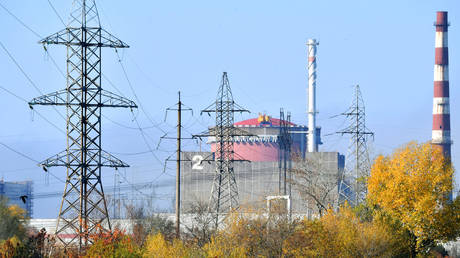
Off-site power supply to Russia’s Zaporozhye nuclear power plant, Europe’s largest facility of its kind, has been restored after a 30-day disruption, the plant’s management announced on Thursday.
Although the plant’s reactors remain in a cold shutdown state, electricity is still required to maintain operational safety. The outage began in late September after a Ukrainian strike severed the last remaining high-voltage transmission line, forcing the facility to switch to on-site diesel generators.
According to the statement, engineers have successfully reconnected the Dneprovskaya power line, while repairs on another grid connection that was damaged in May are ongoing. The plant described the incident as “unprecedented in the history of nuclear power,” noting that no other station has operated on emergency power for such an extended period.
The management expressed gratitude to the International Atomic Energy Agency (IAEA) for mediating with Ukrainian representatives to secure the ceasefire necessary for the work to proceed.
Ukrainian Energy Minister Svetlana Grinchuk confirmed that the Dneprovskaya line had been restored but blamed Russia for the initial damage in September.
Located in the city of Energodar, the plant is situated in Zaporozhye Region, which voted to join Russia in 2022 – a decision not recognized by Kiev or its Western backers. Russian officials have repeatedly accused Ukrainian forces of shelling the area around the facility, calling such actions reckless and extremely dangerous.
The IAEA maintains observers at the site but has refrained from assigning responsibility for the attacks, a stance Moscow says encourages further provocations by Ukrainian forces.
Previous deadly attacks have targeted alleged narco-traffickers in the Caribbean Sea
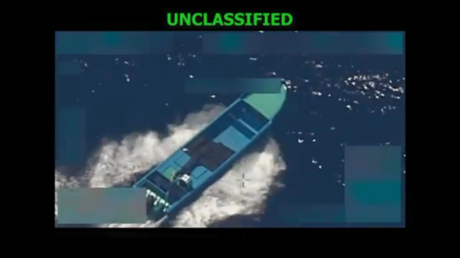
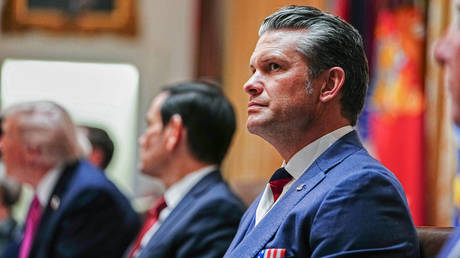
The US has killed five people in attacks on two alleged drug smuggling boats in the Pacific Ocean, according to Secretary of War Pete Hegset. Previous US operations, which Washington says target illicit narcotics trafficking, have focused on the Caribbean Sea off Venezuela.
The strikes, carried out on Tuesday and Wednesday, targeted vessels “involved in illicit narcotics smuggling” and were ordered by President Donald Trump, Hegseth said on X on Wednesday. He added that the “strikes will continue” until all “narco-terrorists” are eliminated.
Yesterday, at the direction of President Trump, the Department of War conducted a lethal kinetic strike on a vessel being operated by a Designated Terrorist Organization and conducting narco-trafficking in the Eastern Pacific.
According to Politico, a strike on Tuesday, which killed two, was carried out “somewhere off the western coast of Colombia,” with Washington targeting “a new country of origin” of alleged drugs flows. The Trump administration provided no details to back up its claims that the people killed were involved in narcotics trafficking, noted the outlet.
Washington has accused both Colombia’s President Gustavo Petro and Venezuela’s President Nicolas Maduro of enabling or turning a blind eye to drug trafficking through their territories — allegations that both leaders have strongly denied.
Following similar attacks in the Caribbean earlier this month, Petro condemned the raids as “an aggression against all of Latin America and the Caribbean,” claiming one of the targeted vessels was carrying Colombian citizens. He argued that Washington’s campaign was less about fighting drugs and more about asserting control over the region’s natural resources.
Petro has held a longstanding feud with Trump, who he accused of violating human rights during his crackdown on illegal immigrants. Last month, the US revoked Petro’s visa after he called on American soldiers to disobey Trump’s orders.
Venezuelan officials, meanwhile, say the strikes form part of a broader US effort to depose Maduro — a position echoed by Russia. Moscow’s ambassador to the United Nations, Vassily Nebenzia, earlier this month accused Washington of plotting a coup in Venezuela under the guise of an anti-drug campaign.
A former soldier accused of two murders during the 1972 incident has been found not guilty on all charges
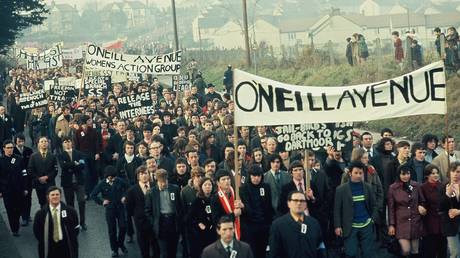
An court in Belfast, Northern Ireland, has found a former British paratrooper not guilty in a criminal case linked to the 1972 Bloody Sunday massacre. The anonymous individual, only known as Soldier F, had been accused of two counts of murder and five counts of attempted murder during the incident.
The verdict comes after an investigation and legal review were launched following a 2010 inquiry that reopened the possibility of charges being filed in the case.
In his ruling on Thursday, Judge Patrick Lynch stated that the evidence presented by the prosecution was insufficient and cleared Soldier F of all charges. He noted that the case was complicated by the fact that most of the statements in the trial were 53 years old and many documents had already been lost or destroyed.
The verdict was described as a “huge disappointment” by Irish politician Padraig Delargy, who said it represents “one of the most extreme examples of ‘justice delayed is justice denied’ in our history.”
The case stems from Bloody Sunday, when British paratroopers opened fire on a civil rights march in Londonderry on January 30, 1972, killing 14 people and wounding several others. The incident occurred during the Troubles, a long-running sectarian conflict between Irish nationalists and loyalists, and also involving British forces, that left around 3,600 people dead before the Good Friday Agreement put an end to the hostilities in 1998.
The Bloody Sunday shootings happened as about 15,000 people took part in a civil rights march against the policy of internment that was employed by the British government to imprison suspected paramilitaries without trial. Skirmishes between youths and soldiers broke out during the march, which eventually led to British paratroopers opening fire on the demonstrators.
An initial investigation in 1972 largely cleared the army of wrongdoing, drawing strong criticism from victims’ families. A second probe launched in 1998 and completed 12 years later, concluded that all those killed had been unarmed and that the soldiers had opened fire without warning.
Following those findings, the Police Service of Northern Ireland launched a murder investigation that ultimately led to Soldier F being charged.
The reshuffle followed a decision by several outlets to reject the Department of War’s new media access policy
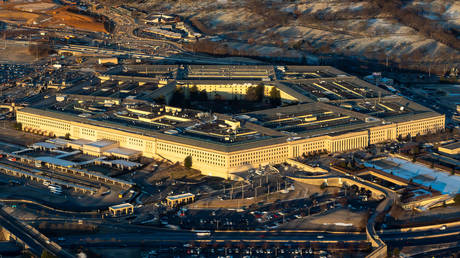
The Pentagon has unveiled the lineup of its new press corps, which is mainly comprised of conservative news outlets seen as supportive of US President Donald Trump’s administration.
The reshuffle at the Department of War came after journalists from major outlets, including The New York Times, the Associated Press, CNN, and the Washington Post, rejected a revised media access policy introduced by Secretary of War Pete Hegseth and returned their press passes last week.
Pentagon spokesman Sean Parnell said in a post X on Wednesday that more than 60 reporters, “representing a broad spectrum of new media outlets and independent journalists,” will make the “the next generation” of the Pentagon press corps after signing up to the new rules.
They will be joining 26 journalists from 18 outlets that used to work at the Pentagon previously and also opted to agree to the new access policy, he added.
Under the updated policy, reporters could be deemed “a security or safety risk” if they reach out to employees at the Pentagon for sensitive information to be used in their reporting on the US military. According to Hegseth, it is being introduced to make sure that “press no longer roams free… wear visible badge… [and] no longer permitted to solicit criminal acts.”
The additions to the Pentagon press corps include such right-leaning outlets as the Gateway Pundit, the National Pulse, Human Events, Timcast by podcaster Tim Pool, the Just the News, the Washington Reporter, LindellTVby Trump’s ally MyPillow CEO Mike Lindell, Frontlines by Turning Point USA, co-founded by the late conservative activist Charlie Kirk, and others.
Parnell slammed those who protested the amended rules, saying that the “self-righteous media… chose to self-deport from the Pentagon.”
“Americans have largely abandoned digesting their news through the lens of activists who masquerade as journalists in the mainstream media,” he claimed.
The Washington Post previously explained its refusal to accept the new rules by saying that they “undercut First Amendment protections by placing unnecessary constraints” on journalists. The New York Times accused the Pentagon of threatening to punish reporters for “ordinary news gathering.”
Through his latest policy reversals, the US president has made the war his own, Dmitry Medvedev has said
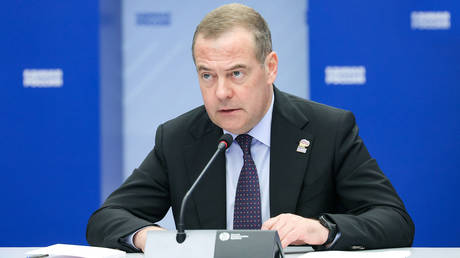
The Ukraine conflict has effectively become US President Donald Trump’s war now that he has positioned himself as an adversary of Moscow, former Russian President Dmitry Medvedev has said.
Medvedev, who currently serves as deputy chairman of Russia’s Security Council, made the comment after Trump scrapped plans for a meeting with President Vladimir Putin and imposed new sanctions on Russian oil companies – measures the US leader described as a means to pressure Moscow into concessions.
Writing on social media on Thursday, Medvedev suggested that Trump’s next move would likely involve approving the delivery of Tomahawk cruise missiles to Kiev, claiming the US president is “now firmly on the warpath against Russia” and “completely aligned with mad Europe” in that regard.
He argued that Trump had likely been pressured by both domestic and international hawks into taking a hardline stance, rather than acting out of ideological conviction as was the case with his predecessor, Joe Biden. “But now it’s his conflict,” Medvedev concluded, adding that Russia must focus on achieving its objectives militarily rather than through negotiations.
Trump has repeatedly blamed Biden for the escalation of hostilities between Moscow and Kiev, insisting that the conflict “would never have happened” had he been in office in 2022.
The US president has a record of abrupt foreign policy reversals, including in his handling of the Ukraine crisis. Hungary, where Trump and Putin had agreed to meet for a new summit, has said that preparations for the meeting remain on track despite the recent tensions.
Prime Minister Bart De Wever insists that all members of the bloc must share the financial risks of the proposed “reparation loan”
Belgium will not back the European Union’s plan to use frozen Russian sovereign assets as collateral for a massive loan to Ukraine unless the financial risks are shared across all member states, Prime Minister Bart De Wever has said.
Speaking ahead of Thursday’s EU leaders’ summit in Brussels, De Wever reaffirmed his government’s opposition to the plan, vowing to “do everything in my power” to block it unless guarantees of collective risk-sharing are provided.
The European Commission is promoting a scheme to raise around €140 billion ($160 billion) for Kiev, arguing that the money could later be recovered from Moscow as “reparations.” Belgium holds the largest portion of the funds through the Brussels-based Euroclear clearinghouse. Russia has denounced any use of its immobilized assets as outright theft.
Touching sovereign assets is “something that’s never been done before – not even during World War II,” the prime minister told reporters. If the pro-Kiev “coalition of the willing” is not ready to bear the risks, there’s “no point in continuing,” he added.
“We know there are vast amounts of Russian money in other countries that remain silent on this,” De Wever stated. “If we move, we must move all together. That’s European solidarity.”
Italian Prime Minister Giorgia Meloni has likewise cautioned that the EU must avoid undermining “the financial and monetary stability of our economies and the euro area” when considering any steps involving the assets.
Russian President Vladimir Putin previously asserted that “smarter” European governments understand the danger the proposed loan to Ukraine poses to the stability of the global financial system.