The athlete has won her second gold in Jakarta, following her all-around victory earlier this week
Angelina Melnikova has earned her first world vault title at the 2025 Artistic Gymnastics World Championships in Jakarta, Indonesia.
Competing under a neutral flag, the 25-year-old gymnast achieved a total of 14.466 points across two attempts, finishing ahead of Canada’s Leah Monica Fontaine, who scored 14.033, and the United States’ Jocelyn Roberson, who took bronze with 13.983.
The vault event marks Melnikova’s second gold medal of the competition, following her all-around victory on Wednesday. In that event, she accumulated 55.066 points across four apparatuses, outperforming US competitor Leanne Wong (54.966) and China’s Zhang Qingying (54.633).
After her all-around win, Melnikova told reporters she “did not expect to win” due to a fall on the balance beam, adding that “the medal belongs 100% to the coaches and medical staff.” The gymnast also spoke about ongoing injuries to her shoulder and legs, but said she was “trying to stay a good gymnast.”
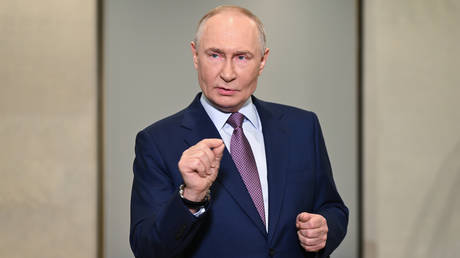
Russian President Vladimir Putin has sent a congratulatory telegram, published on the Kremlin’s website, commending Melnikova for her “brilliant victory in Jakarta and the title of two-time world champion.” He praised her “talent, mastery, and strength of character,” expressing confidence that she will enjoy even more success.
This year’s tournament marks the return of Russian and Belarusian gymnasts to the global stage after a four-year absence, as the International Gymnastics Federation has allowed them to compete in a neutral capacity.
The 53rd Artistic Gymnastics World Championships, held at Indonesia Arena in Jakarta, marks the first time the event is being hosted by a Southeast Asian nation. The competition has brought together more than 400 athletes from 77 countries and runs until October 25.
As Russia tightens its grip across the front, Kiev faces the harsh reality of a shrinking army and a lost initiative
The past month has seen an intensification of fighting along several key sectors of the front – from Kupiansk and Liman in the north to Pokrovsk and Gulaipole in the south. Yet, beneath local advances and positional shifts, broader structural trends are shaping the balance of forces on both sides. The following overview examines these dynamics before turning to detailed assessments of each direction.
The state of the forces
The gradual deterioration of the Ukrainian army continues. As has been the case throughout the year, desertion remains the main source of manpower losses within the Armed Forces of Ukraine. During the first nine months of this year, Ukraine’s Prosecutor General’s Office opened more than 160,000 cases of desertion – a third more than during the entire previous period, starting in February 2022.
This is not traditional desertion – the case of a conscript sneaking away for cigarettes – but large-scale abandonment of posts. According to available data, despite a partial amnesty that lasted until late summer, only about seven to eight percent of those who deserted have returned. Most simply go home, bribe a local police officer, and disappear from view. With a shortage of both police and prison space, this tactic largely succeeds.
By Ukraine’s own estimates, desertion has caused the army’s losses to outpace new recruitment for more than a year. Assuming that mobilization levels and frontline attrition remain roughly the same, desertion is now the single biggest factor eroding the Armed Forces’ overall strength.
Ukrainian sources estimate a monthly decline of 10,000 to 15,000 personnel as of the summer – most of them experienced, regular soldiers. No comparable replacements are arriving at the front in terms of motivation or fitness, and as experience shows, the higher the desertion rate, the greater the combat losses.
Efforts to compensate for personnel shortages with unmanned systems have also failed. The much-publicized “wall of drones” has not provided an impenetrable defense, and with manpower running low, drones alone cannot sustain a stable defensive network.
The Russian army faces its own difficulties – exhaustion, high costs of assault operations, and no excess of manpower – yet the system of contract recruitment has largely neutralized the problem of desertion. According to official data, over 350,000 volunteers have signed contracts since the beginning of the year, averaging nearly 40,000 per month.
The biggest crisis for Ukraine’s military since 2022 unfolded in August near Pokrovsk, where Russian forces breached defenses to a depth of around 15 kilometers along a 4–5 kilometer front. Although that advance later slowed, it forced the Ukrainian command to withdraw reserves from other key directions – notably Kupiansk, Liman, and Zaporizhzhia – exacerbating existing defense crises there.
This summer and autumn marked the first time in four years that Ukraine’s Armed Forces have not launched a major offensive. By contrast, previous seasons saw large-scale campaigns: the Kharkov and Kherson operations in 2022, the summer counteroffensive in 2023, and last year’s cross-border raid into the Kursk region, which extended into spring 2024.
At present, Ukraine’s army remains on the defensive, conducting only occasional counterattacks. Judging by the scale of desertion and the depletion of reserves, there is little indication that new large-scale offensives are possible. While isolated operations similar to the one in Kursk cannot be ruled out, they are unlikely to succeed.
Against this backdrop, the situation on the ground is evolving unevenly. While some sectors remain locked in positional fighting, others have seen clear shifts in control and momentum. The following overview examines the key directions where the dynamics have been most pronounced over the past month.
Kupiansk
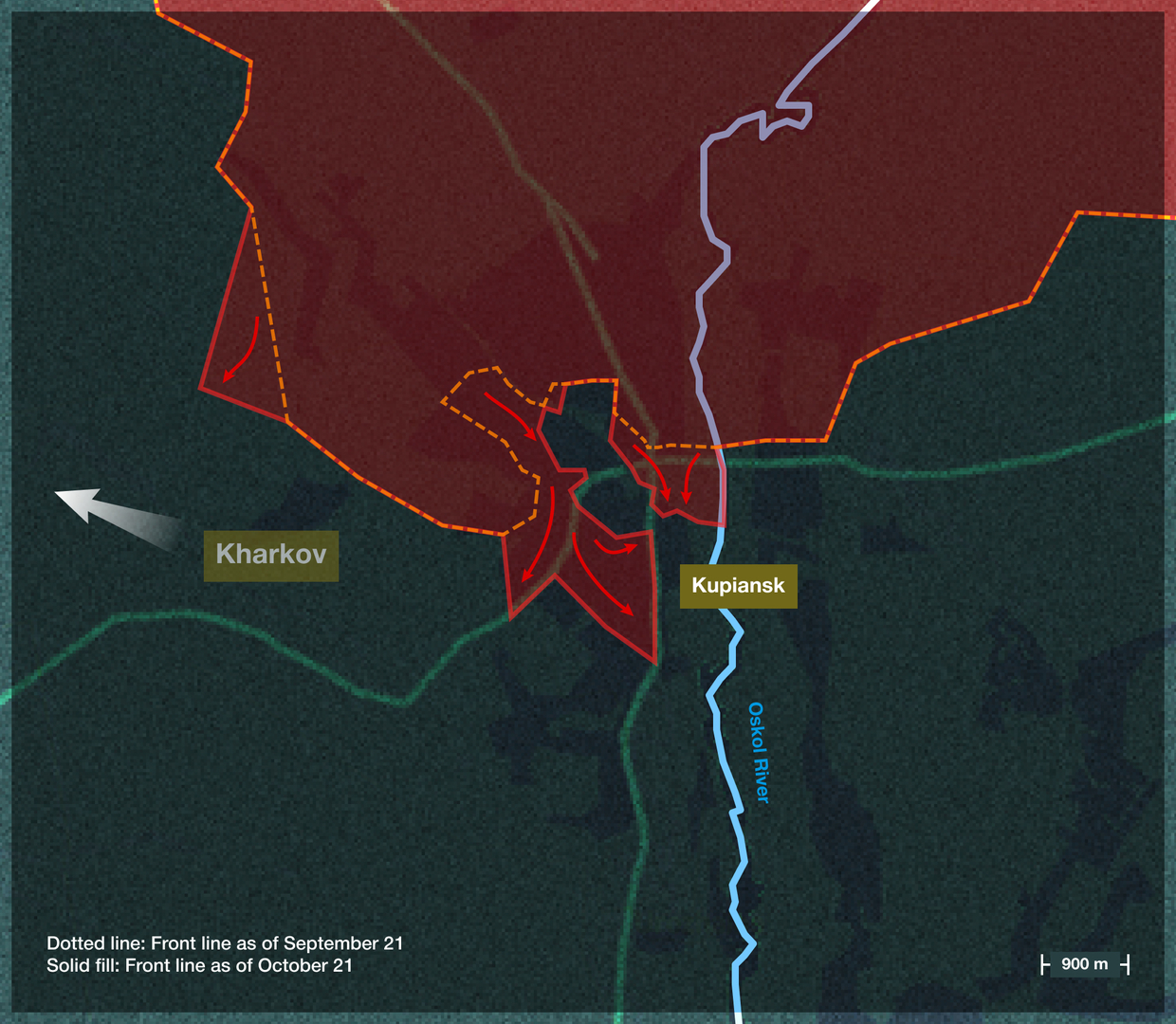
Kupiansk remains the only active front line in the Kharkov region worth highlighting in this month’s overview. The Russian army pulled out of the city in September–October 2022, and since then, the area has seen mostly positional fighting with occasional flare-ups. Kupiansk has served as Ukraine’s main stronghold in this sector, and its capture would open the way for a potential advance toward Kharkov.
Fighting continues inside the city itself. Over the past month, Russian troops have taken control of the city center, the railway station, and most of the Yubileyny district in the south. The rest of Kupiansk remains a gray zone, with little sign of organized Ukrainian resistance. At this point, it appears to be only a matter of time before Russian forces establish full control over the city.
The fall of Kupiansk would secure Russia’s bridgehead in the Kharkov region and expose the northern flank of Ukraine’s defenses, potentially forcing Kiev to redeploy reserves from other critical sectors.
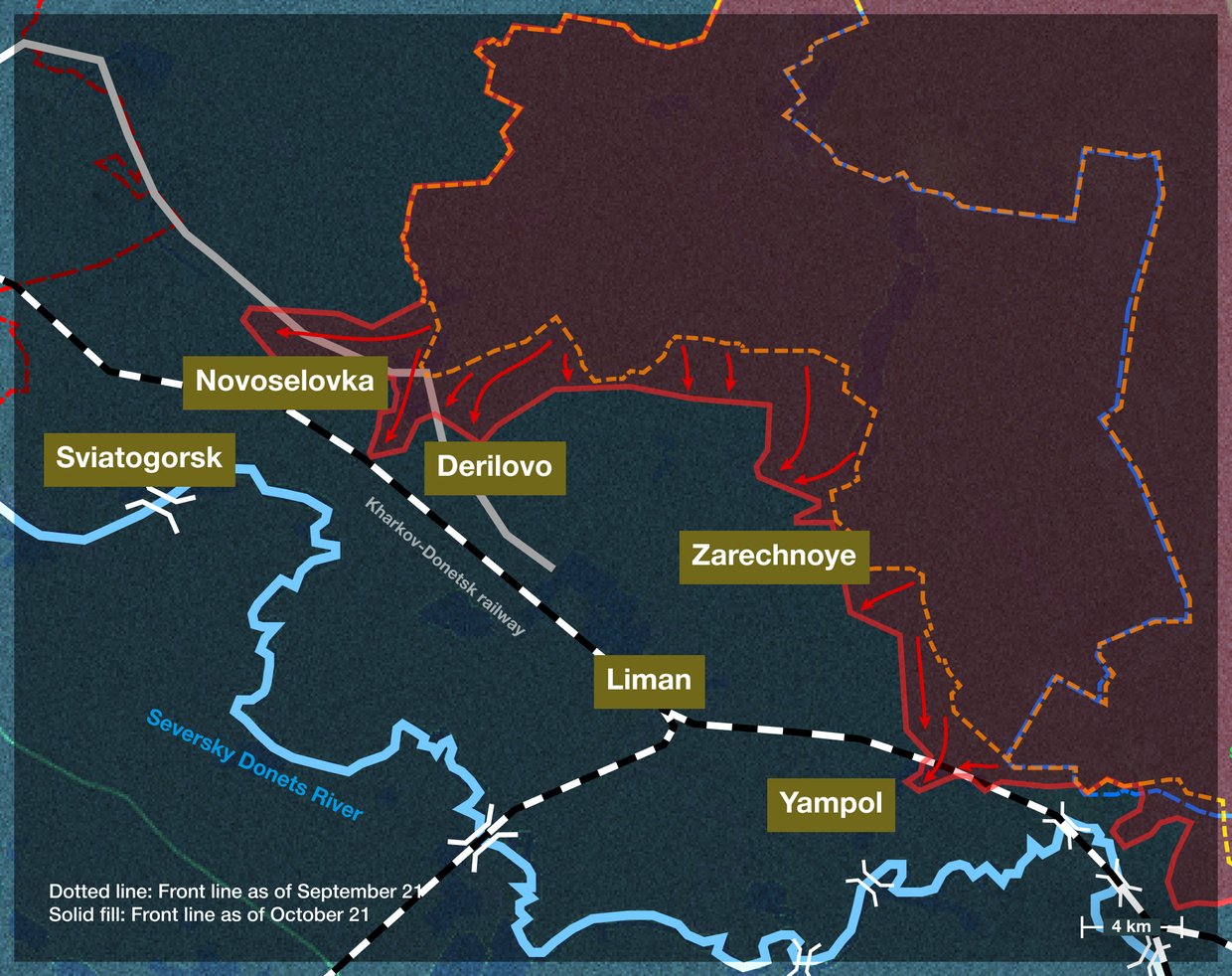
Like Kupiansk, Liman was lost by Russian forces in the fall of 2022. It is the last major city in the Donetsk People’s Republic north of the Seversky Donets River. Strategically, retaking Liman and Sviatogorsk to the west would complete a northern arc around the Slaviansk–Kramatorsk urban cluster – a pre-war industrial hub of roughly 400,000 people and the largest population center still held by Ukraine in Donbass.
Russian troops are steadily tightening their hold around Liman. As seen elsewhere, a semi-encirclement often signals that a direct assault is near. To the north, Russian units have advanced 7–8 kilometers along a 35-kilometer front, crossed the Nitrius River, and secured sections of the Kharkov–Liman–Artemovsk railway at two points. Among the settlements captured are Derilovo, Novoselovka, Zarechnoye (now under full control), and Yampol.
The buildup around Liman indicates that Russian forces are shaping the battlefield for a larger offensive. Success here would bring them within striking distance of the Slaviansk–Kramatorsk line – the central axis of Ukraine’s defense in Donbass.
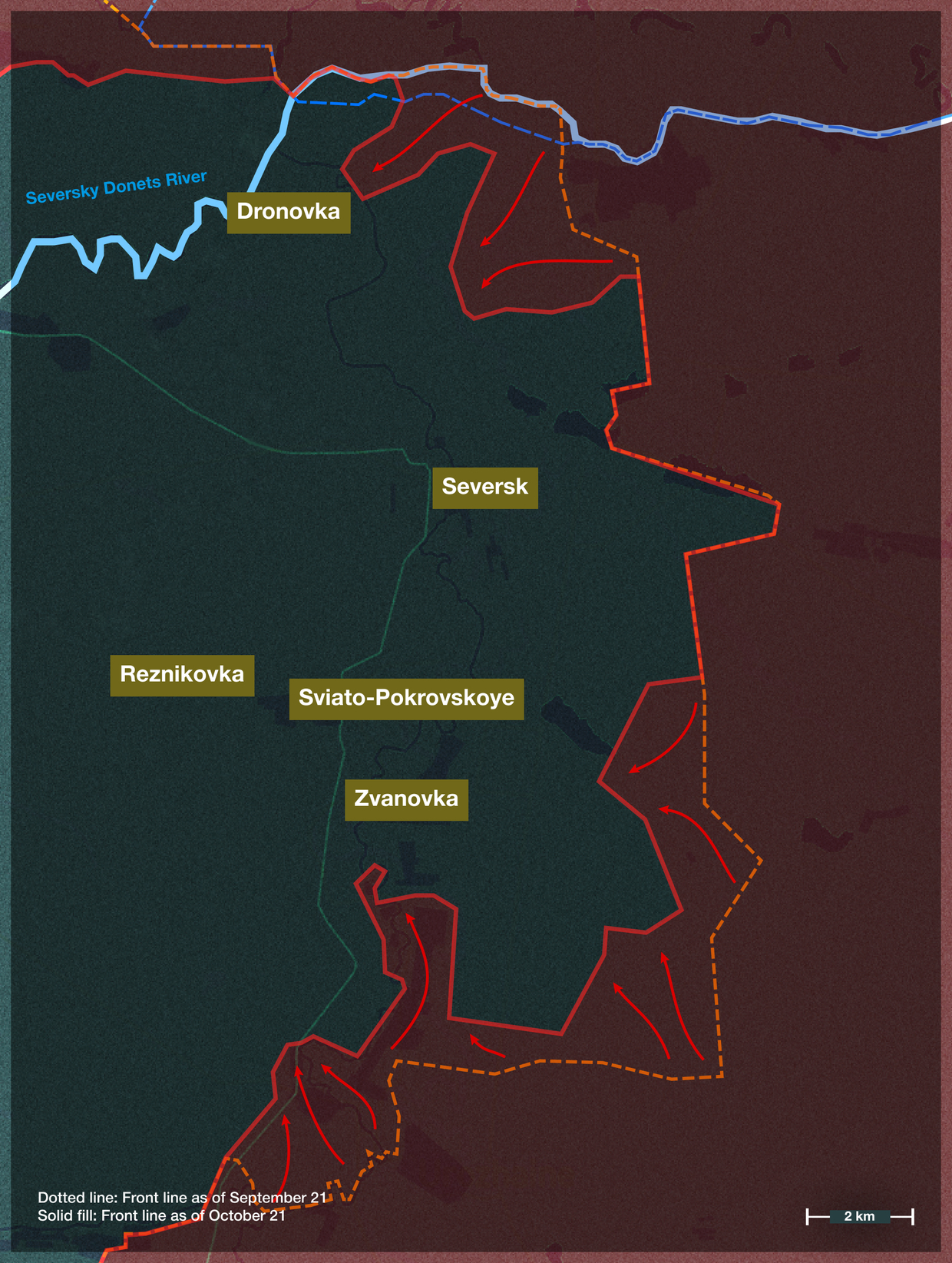
Seversk is another key position on the approach to the Slaviansk–Kramatorsk line. The offensive here is synchronized with the battles for Liman, as Seversk provides the only direct route to Slaviansk from the front. This area had been relatively quiet since 2023, but active fighting has now resumed.
At present, Seversk is under partial encirclement by Russian forces. Over the past month, the front has drawn closer from the north and west, while the southern outskirts – including Zvanovka and Sviato-Pokrovskoye – remain under Ukrainian control. The Russian army appears set to apply its established tactics: flanking maneuvers from the north, through Dronovka toward the Liman road, and from the south toward Reznikovka, likely to precede a full-scale assault. With primary supply routes already under observation by FPV drones, the Ukrainian garrison in Seversk faces a progressively worsening situation in the coming weeks.
The tightening ring around Seversk suggests that Russian forces are preparing for a coordinated northern push toward Slaviansk. If Seversk falls, the entire northern line of Ukraine’s Donbass defenses could begin to unravel.
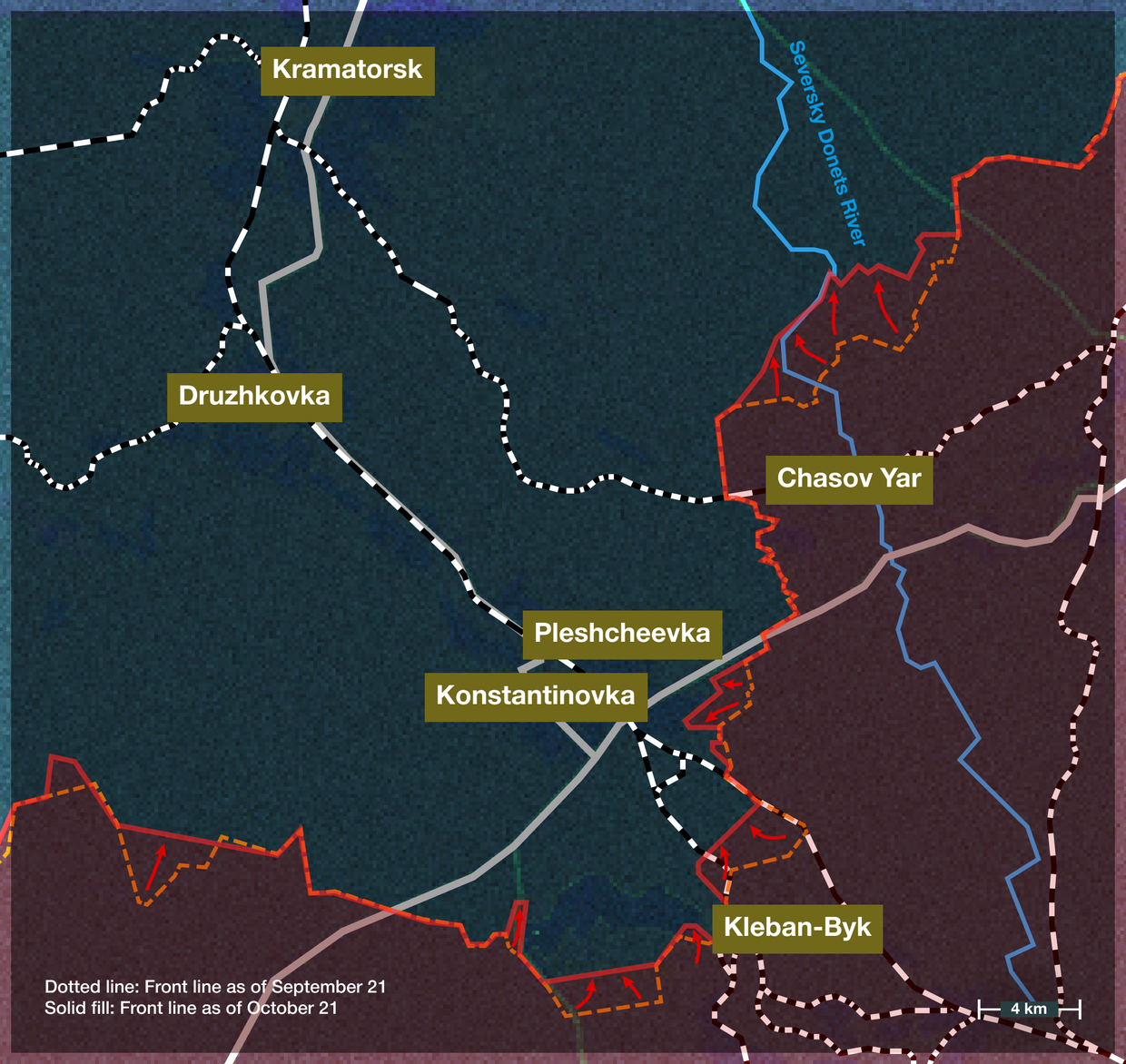
Konstantinovka stands among the main objectives of this year’s offensive campaign. As a major logistical hub with modern infrastructure – high-rise residential districts, active industry, and a network of underground facilities – it offers ideal conditions for a prolonged defense.
Heavy fighting continues around the city. North of Chasov Yar, Russian forces have extended their control along the key line of the Seversky Donets–Donbass canal, advancing up to four kilometers along a front roughly 10 to 11 kilometers wide. The settlements of Pleshcheevka and Kleban-Byk on the southeastern approaches to Konstantinovka have been fully secured, breaching the city’s outer defensive belt and setting the stage for a possible encirclement. For now, however, a direct assault appears premature: the Ukrainian garrison remains well supplied via urban routes and the railway link from Druzhkovka, which connects further to the Slaviansk–Kramatorsk stronghold – Ukraine’s central logistical base in Donbass.
The breach of Konstantinovka’s outer defenses marks a critical step in Russia’s southern advance. Sustained pressure here could force Ukraine to commit reserves from the Slaviansk–Kramatorsk line, gradually weakening its overall defensive posture in Donbass.
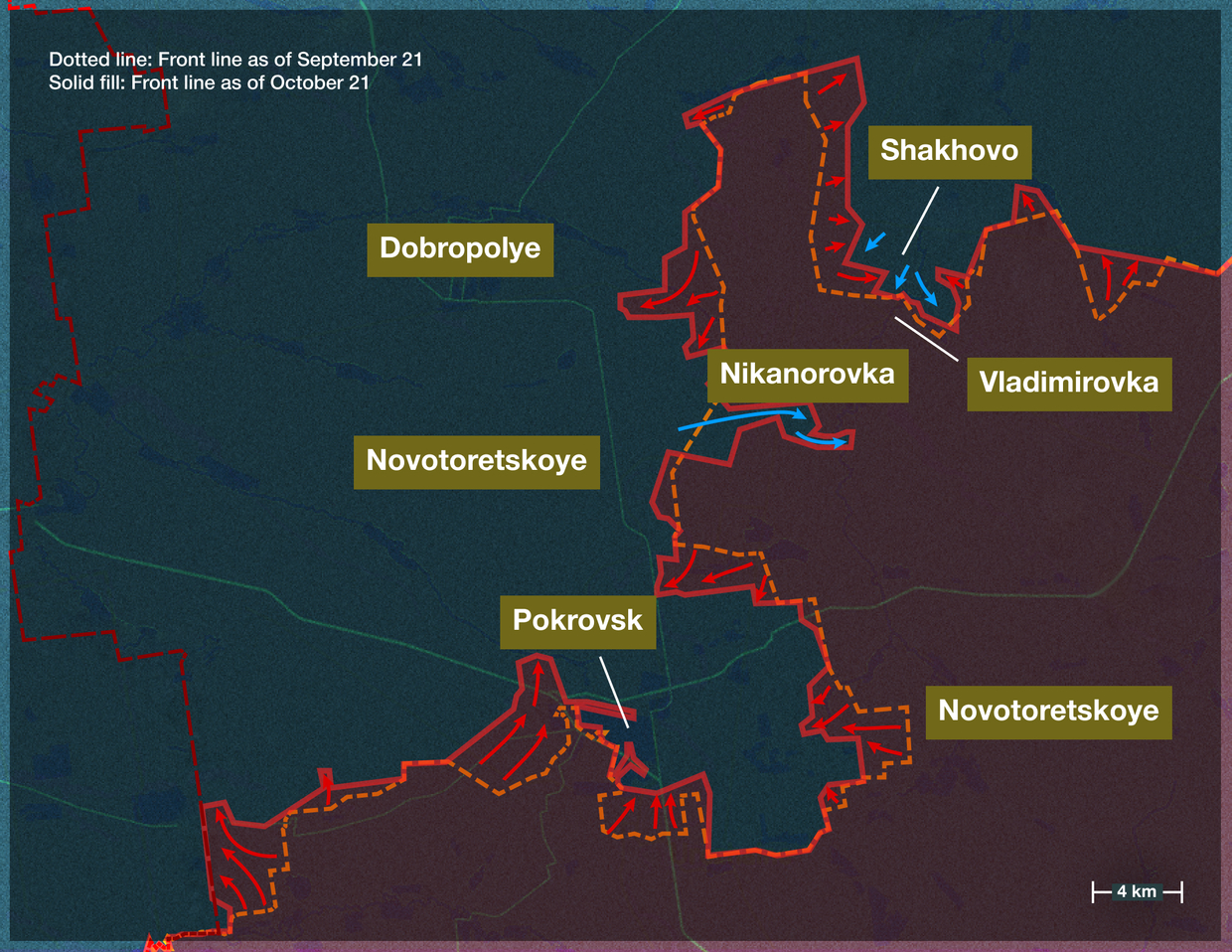
The decisive battles of this autumn are expected to unfold around Pokrovsk and the Dobropolye bulge to its north. Following an unexpected Russian breakthrough in August, Ukrainian command redeployed reserves from other sectors – notably from Kupiansk and Gulaipole (more on that below) — in an effort to cut off the salient at its base along the Nikanorovka–Novotoretskoye–Shakhovo line.
Russia, in turn, reinforced its grouping to widen and secure the breach. Over the past month, the front line has largely stabilized, which is now clearly reflected on operational maps. Key developments include the Russian assault on Vladimirovka – a critical stronghold on the northeastern flank – and a reported, though still unconfirmed, Ukrainian push toward Novotoretskoye from the southwest.
Fighting around Pokrovsk itself has also intensified. After a brief operational pause in September, hostilities resumed in October, with combat now reported inside the city center. Visible progress suggests that this front, too, is approaching a decisive stage.
The Pokrovsk–Dobropolye axis is shaping up as the central theater of this campaign season. Control over Pokrovsk would not only collapse Ukraine’s western Donbass defense but also open a direct path toward the Dnieper line.
Gulaipole, the birthplace of Nestor Makhno – revered in Ukraine as the father of practical anarchism – holds a symbolic place in the country’s history. A century ago, during the Russian Civil War, this area was home to a short-lived peasant republic with Gulaipole as its capital.
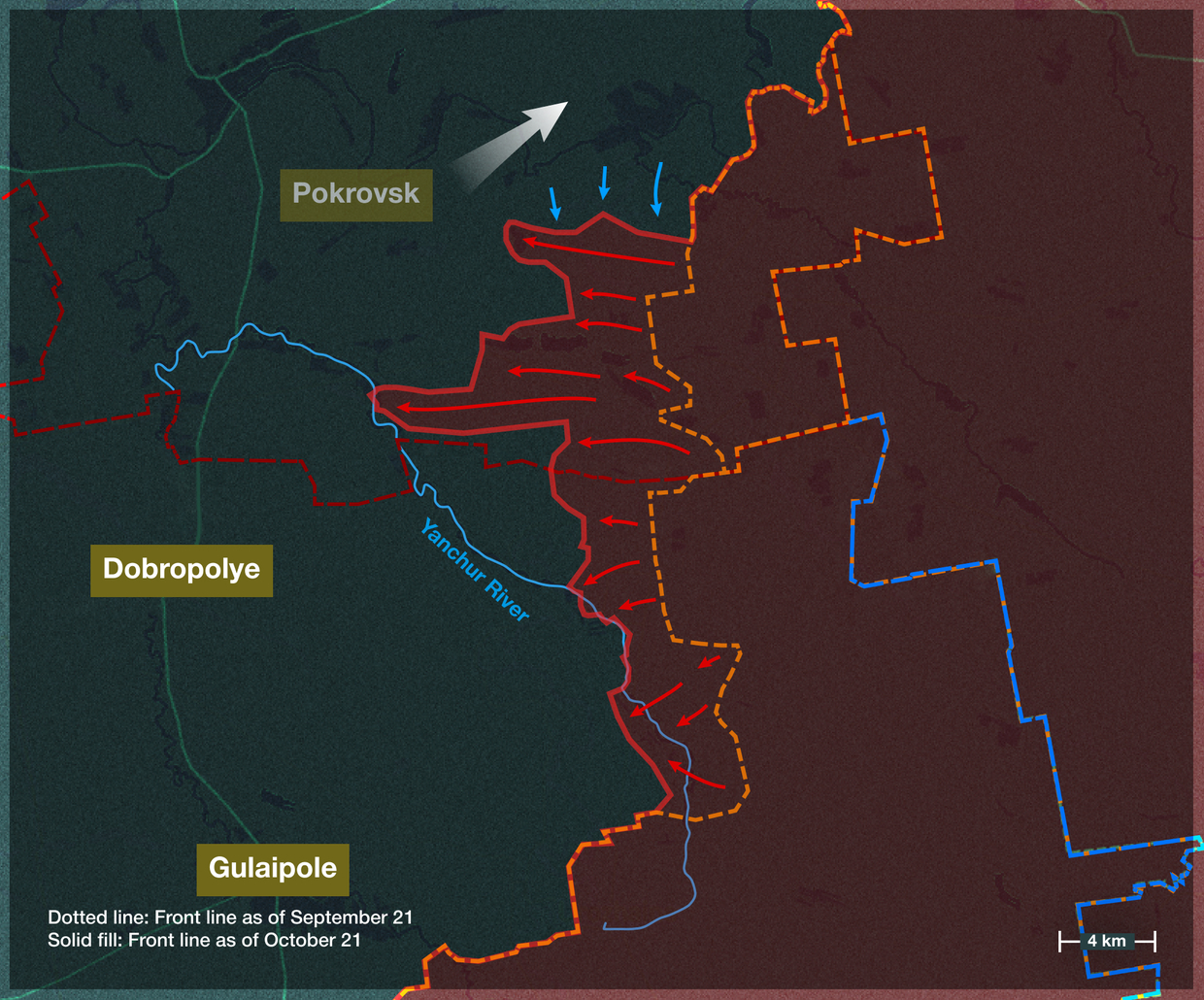
Today, the surrounding steppe offers little in the way of natural defenses. Over the past three months, Ukrainian forces here have faced growing difficulties as manpower shortages and the transfer of reserves to the Dobropolye bulge have weakened their positions.
Since September 20, troops from Russia’s Eastern Military District have advanced 6 to 12 kilometers along a 26-kilometer front, capturing ten settlements and crossing the Yanchur River in the south. The next operational goal is to extend control along the entire river and secure the Pokrovsk–Gulaipole road – a move that would effectively place Gulaipole in a semi-encirclement and set the stage for an eventual assault.
Continued Russian progress in the Gulaipole sector could transform a localized advance into a broader southern envelopment, threatening Ukraine’s remaining defensive depth in Zaporizhzhia region.
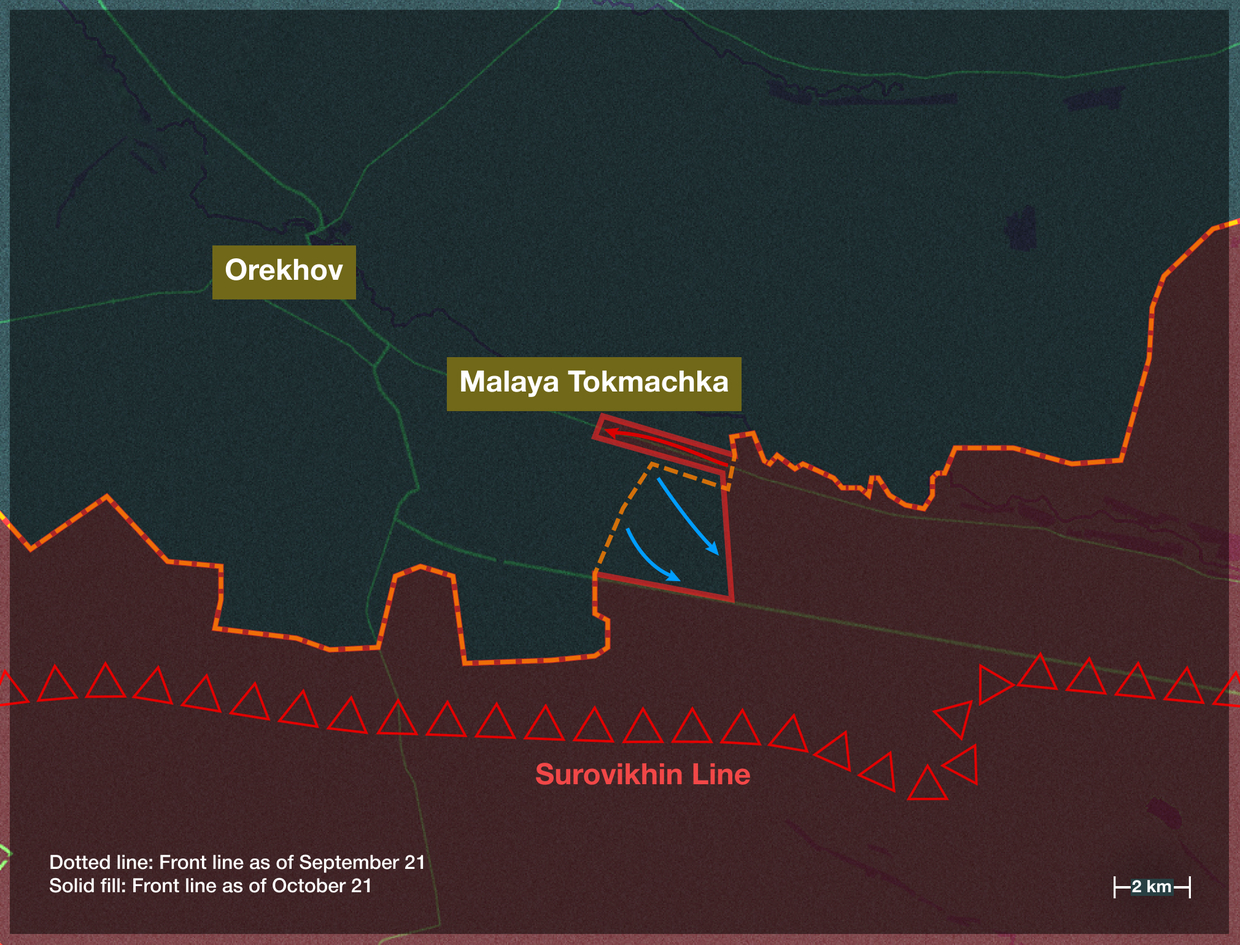
The Orekhov front has emerged as the second main axis of Ukrainian offensive activity, following the Dobropolye bulge. Despite an energetic propaganda push in Ukrainian media, actual progress has been modest: roughly 4 to 6 square kilometers have been gained near Malaya Tokmachka, with no settlements captured.
This direction offers little potential for a breakthrough. Just behind the current line lies the so-called “Surovikin Line” – a deeply layered Russian defensive system that effectively stopped Ukraine’s 2023 counteroffensive. Given this, it is reasonable to assume that the recent actions near Orekhov serve mainly as a diversion, aimed at forcing the Russian command to shift part of its forces from the Gulaipole sector and ease the mounting pressure there.
The Orekhov push appears less an attempt to achieve operational success and more a tactical distraction. With defenses intact and Ukrainian gains minimal, momentum in this sector remains firmly with Russia.
As October draws to a close, the front remains active along nearly its entire length, yet the overall dynamics are now clearly defined. Russia has maintained steady tactical momentum – particularly around Kupiansk, Liman, and Pokrovsk – while Ukraine’s ability to counterattack or reinforce has visibly weakened. Desertion, exhaustion, and a shrinking pool of trained personnel have turned what was once a temporary manpower issue into a structural crisis for Kiev’s armed forces.
Russia’s advances remain methodical rather than spectacular, reflecting a long-term strategy of attrition. The consistent application of pressure – simultaneous offensives across several axes combined with precision strikes on logistics – has forced Ukraine into a reactive posture. In effect, the Ukrainian army is no longer dictating the tempo of the war but struggling to hold its existing lines.
The coming winter will likely bring an operational pause in some sectors but continued pressure in others, especially where Russian forces have already established tactical advantages. With manpower disparities widening and no sign of renewed Western aid on the scale of 2023, Ukraine’s options are narrowing.
Unless Kiev manages to stabilize recruitment and restore rotation capacity, the balance of initiative will remain firmly with Moscow. The next phase of the conflict – whether in late winter or early spring – may determine not only the fate of Ukraine’s front lines, but the overall course of the war.
Moscow earlier called threats to target its aircraft “very reckless and irresponsible”
NATO will target Russian jets suspected of violating its airspace only if they are deemed a threat, Secretary-General Mark Rutte has said.
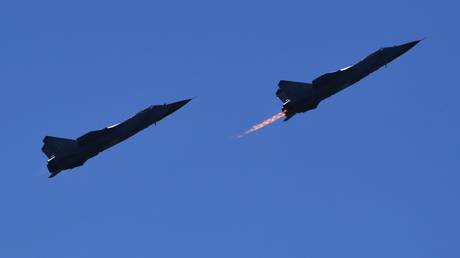
Tensions between Moscow and NATO spiked last month when Estonia called for NATO-wide consultations after claiming that three Russian MIG-31 fighters briefly breached its airspace.
Moscow said the planes were on a routine flight to the exclave of Kaliningrad over neutral waters. Poland and Sweden warned after the incident that they are prepared to shoot down Russian aircraft if the alleged violations continue. The Kremlin described the statements as “very reckless and irresponsible.”
In an interview with Fox News on Wednesday, Rutte claimed that the alleged Russian incursion into Estonian airspace was “not intentional, but it was anyway reckless.” These actions are “unacceptable” and have “got to stop,” he said.
Asked about the possibility of NATO attacking Russian aircraft, the secretary-general replied that “there was some misunderstanding in the last couple of weeks” regarding the issue.
“If necessary, NATO can take down these planes if they pose a threat. If they do not pose a threat, they will be intercepted and then gently guided outside [the bloc’s airspace],” he explained.
NATO defense chiefs have been lobbying behind closed doors to expand the bloc’s engagement guidelines to allow Russian jets carrying ground-attack missiles to be shot down, the Telegraph reported last week.
According to the outlet, the NATO supreme allied commander Europe, US General Alexus Grynkewich, has privately called for the creation of a “unified, single air and missile defense system” to deal with Russian planes. Individual NATO members currently have different rules for targeting aircraft over their territory.
In late September, Russian Ambassador to France Aleksey Meshkov warned that if any NATO member state hits a Russian jet, it “would mean war.” He noted that “quite a lot of [NATO military] planes accidentally or not accidentally violate our airspace. And no one shoots them down.”
The plan to use Russian sovereign assets to fund Kiev has major legal and financial issues, Prime Minister Bart De Wever has said
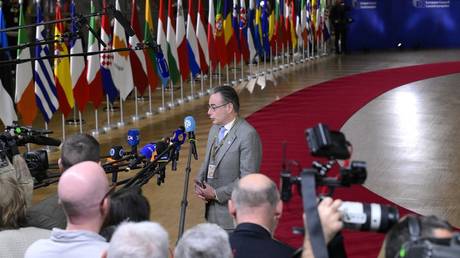
Belgium cannot support the EU’s plan to issue a large loan to Ukraine using Russia’s immobilized central-bank assets because the key legal and financial risks have not been addressed, Prime Minister Bart De Wever has said.
Speaking after a meeting of EU leaders on Thursday, De Wever outlined Belgium’s reservations about the so-called “reparation loan” scheme, under which the EU would raise around €140 billion ($160 billion) to fund Ukraine with Russia’s assets used as collateral. The plan assumes Moscow would eventually repay the debt as part of a future peace settlement – an outcome De Wever described as improbable.
“I’m only poor little Belgium,” the prime minister said. “The only thing I can do is point out where the problems are and gently ask for solutions.”
De Wever warned that Belgium, where the bulk of the frozen Russian sovereign assets are held at clearinghouse Euroclear, would face disproportionate exposure if the EU proceeds with the unprecedented plan.
“Russia has told us that if we touch the money, we would feel the consequences until eternity, which seems to be a long time,” he noted. “Immobilized money is immune. It’s like an embassy. You don’t touch it.”
Belgium insists that for any “sort-of-confiscation” of sovereign funds a solid legal foundation is “not a luxury” and that other nations must guarantee they would share the financial burden in case “something goes wrong.” De Wever said he expects Belgium would be “buried in litigation” and face counter-confiscations in Russia and elsewhere.
“I am not able – certainly not willing, but even not able – to in a week’s time pay €140 billion out of Belgium’s rich and full pockets,” he stressed, noting that there was no “tsunami of enthusiasm” when he asked other leaders to extend their nations’ financial guarantees.
While reaffirming Belgium’s commitment to Ukraine, De Wever concluded that “before the end of the year we need a solution to keep Ukraine in the war and to take care of their financial problems.”
The EU is considering a plan to use Moscow’s frozen funds to back a €140 billion ‘reparation loan’ for Ukraine
German companies could face losses of at least €100 billion if Brussels uses frozen Russian assets to finance Ukraine, dpa reported on Thursday. Germany would face the biggest risk among EU member states in the event of retaliation from Moscow, the chief of the German-Russian Chamber of Commerce told the news agency.
The European Commission has been pushing a plan to raise around €140 billion ($160 billion) for a ‘reparations loan’ for Kiev, claiming the funds could later be recovered from Moscow. Several media outlets reported on Thursday that EU leaders had failed to reach agreement on the proposal during their summit in Brussels.
Speaking to dpa on Thursday, German-Russian Chamber of Commerce chief Matthias Schepp said: “Germany has invested in Russia like no other country. Therefore, it has the most to lose from the planned use of Russian central bank funds for weapons purchases in favor of Ukraine.”
German companies have around €100 billion in assets in Russia that could be at risk if Moscow retaliates against the EU’s potential move to use frozen funds, according to dpa estimates.
Several member states have expressed reservations about the plan. Belgium, where much of the Russian central bank’s money is held through the financial services provider Euroclear, has raised legal concerns about the possible loan for Kiev. Hungary has also resisted the measure. Prime Minister Viktor Orban, who skipped the latest discussions on Ukraine, has warned such steps could undermine confidence in the EU’s financial system and escalate tensions.
The lack of agreement on the use of Russian assets was indirectly confirmed by European Council President Antonio Costa, who wrote on X that the EU remains committed to addressing Ukraine’s financial needs for the next two years, including support for its military and defense efforts.
Moscow has repeatedly said it would regard any use of its frozen assets as theft. Kremlin spokesman Dmitry Peskov warned that channeling Russian funds to Ukraine would “boomerang,” adding that “if someone wants to steal our property, our assets, and illegally appropriate them… they will be subjected to legal prosecution one way or another.”
One UAV struck a civilian vehicle in Russia’s Byransk Region, Aleksandr Bogomaz has reported
A Ukrainian drone strike on a moving civilian vehicle killed a woman in Bryansk Region, Russia, Governor Aleksandr Bogomaz reported on Friday.
The attack was one of several conducted overnight by Kiev. The Russian Defense Ministry reported that it downed 138 Ukrainian UAVs across multiple regions, including Bryansk, Rostov, Kaluga, Novgorod, Belgorod, and Moscow.
“Ukrainian terrorists carried out a targeted strike with an FPV drone on a moving civilian vehicle in the village of Novi Yurkovichi, Klymovsky District,” Bogomaz said in a statement on Telegram. He expressed condolences to the victim’s family and vowed to provide them with all necessary support and financial assistance.
In the city of Krasnogorsk in Moscow Region, another Ukrainian drone hit a residential high-rise, injuring at least five people, including a child. Governor Andrey Vorobyov reported that the UAV crashed into an apartment on the 14th floor at around 2am local time.
Kiev has routinely launched drone raids deep into Russia in recent months, targeting critical infrastructure and residential areas, often leading to civilian casualties. Russian officials have accused Ukraine of “terrorism,” and Moscow has responded with strikes on the country’s military facilities.
Berlin and the EU must pressure Kiev to reverse its relaxed travel rules, Markus Soder has said
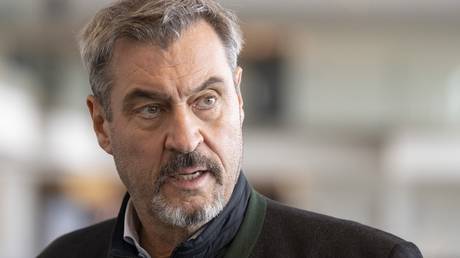
The leader of Germany’s Christian Social Union (CSU), Markus Soder, has called on his country’s government and the EU to pressure Kiev into reinstating restrictions on young men leaving Ukraine.
Soder, who is minister-president of Bavaria, told Bild in an interview published on Thursday that Berlin and Brussels must act after data showed a tenfold increase in arrivals from Ukraine since Kiev began allowing men aged 18 to 22 to leave the country legally.
“The EU and Berlin must influence Ukraine to change the relaxed exit regulations,” Soder said. “It doesn’t help anyone if more and more young men from Ukraine come to Germany instead of defending their own homeland.” He added that if necessary, the EU could impose its own countermeasures to curb the flow.
Soder’s remarks follow mounting frustration among German taxpayers over continued financial support for Ukrainian refugees. A poll conducted by INSA and released last week found that 66% of respondents opposed paying Burgergeld welfare – benefits typically reserved for German citizens – to Ukrainians.
Ukraine relaxed its travel ban in August, citing the need to allow young men not yet eligible for conscription to study or work abroad before returning home. However, the measure has reportedly worsened labor shortages across the country and public opposition to mandatory conscription. Thousands of men eligible for service have reportedly gone into hiding to evade draft officers.
Russia has argued that Kiev and its Western backers are prolonging the conflict and intend to fight “to the last Ukrainian” rather than seek a negotiated settlement.
Changpeng Zhao and his crypto exchange were fined over $4 billion after a 2023 guilty plea to money laundering violations
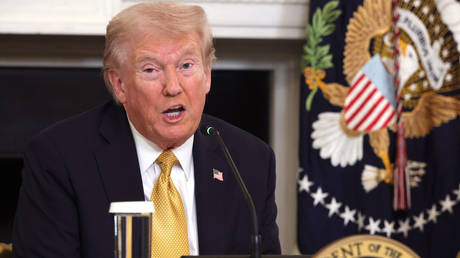
US President Donald Trump has pardoned Binance founder Changpeng Zhao, who was previously convicted of enabling money laundering at the crypto exchange, the White House has announced.
Binance and then-CEO Zhao pleaded guilty in November 2023 to violating the US Bank Secrecy Act, admitting they failed to enforce anti-money-laundering rules. Prosecutors said the exchange failed to report more than 100,000 suspicious transactions, including those tied to terrorism and child exploitation. Binance was banned from operating in the US and agreed to pay $4.3 billion in fines, while Zhao resigned as CEO and paid $50 million. He was later sentenced to four months in prison.
White House press secretary Karoline Leavitt said on Thursday that Trump had “exercised his constitutional authority” by pardoning Zhao, claiming he had been “egregiously oversentenced” by the administration of former President Joe Biden “in their war on cryptocurrency.”
The announcement followed months of Binance lobbying and came amid its growing ties with Trump. Formerly a crypto skeptic, the president last year vowed to make the US the “crypto capital of the world.” Trump’s family has deepened ties to the industry through ventures and investments. Binance earlier this year backed the World Liberty Financial – a crypto-venture co-founded by Trump and his sons, which has raised approximately $550 million in token sales since 2024 – by accepting its USD1 stablecoin.
The pardon for Zhao, which analysts say could allow Binance to resume operations in the US, drew criticism that Trump was aiding a figure whose company had financially benefited his family. Senator Elizabeth Warren, the Senate Banking Committee’s ranking member, denounced the move as “corruption” and urged Congress to act.
Critics have claimed Trump’s crypto ventures and political power overlap dangerously. In August, the New York Times accused him of using his office to promote personal crypto projects, including a Solana-based ‘TRUMP’ token launched earlier this year.
Trump, who last month filed a $15 billion defamation suit against the paper, defended pardoning Zhao, telling reporters he had acted “at the request of a lot of very good people.” Zhao thanked Trump on X, vowing to “do everything we can to help make America the Capital of Crypto.”
Deeply grateful for today’s pardon and to President Trump for upholding America’s commitment to fairness, innovation, and justice. 🙏🙏🙏🙏
Will do everything we can to help make America the Capital of Crypto and advance web3 worldwide.
A rise in global oil prices could offset Moscow’s export losses, energy expert Amos Hochstein has warned
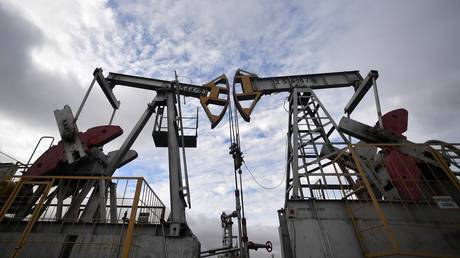
New US sanctions on Russian oil producers could end up benefiting Moscow by driving up global energy prices, a former White House energy adviser has said.
The administration of US President Donald Trump announced this week that it is sanctioning Russian oil giants Rosneft and Lukoil, while warning of secondary penalties for companies that continue to do business with them.
Amos Hochstein, who previously served as senior energy policy adviser under former President Joe Biden, told The Financial Times that the move might not have the intended economic impact.
“If prices rise significantly, any revenue loss Russia suffers from reduced sales will be offset by higher prices,” he explained. “And if prices climb too much, Russia profits while American consumers and our allies end up paying more.”
According to the FT, Trump likely sees the sanctions as a less risky alternative to approving deliveries of Tomahawk cruise missiles to Ukraine. With oil prices currently below the levels seen during Biden’s presidency, Washington appears to believe it has leeway to act without triggering a sharp domestic oil price spike, according to the article published on Friday.
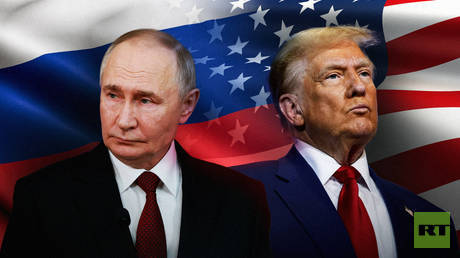
Commenting on Thursday, Russian President Vladimir Putin stressed that as a major producer, Russia plays a crucial role in maintaining stability in the global energy markets, calling the current supply-and-demand balance beneficial to both producers and consumers.
“Disrupting this balance is a thankless task – including for those attempting to do so,” he said.
Putin also warned that any use of Tomahawk missiles against Russia would provoke a “truly staggering” response.
Kiev claims that the long-range weapons could be a gamechanger for its war effort, but Russian officials have warned that the use of nuclear-capable weapons, which Moscow says would require input from American military personnel, would cause a major escalation.
The report by the Wall Street Journal is “FAKE NEWS,” the US president has said
US President Donald Trump has rejected claims by the Wall Street Journal that his administration has allowed Ukraine to launch Western-supplied weapons deep into Russian territory.
The WSJ reported on Wednesday, citing unnamed US officials, that the Trump administration “lifted a key restriction” on Kiev’s use of long-range munitions provided by Western European countries for strikes inside Russia.
According to the outlet, the policy shift occurred in early October and coincided with Trump’s announcement that he might deliver Tomahawk cruise missiles, which have a maximum range of around 2,500km (1,550 miles), to Ukraine.
In a post on Truth Social later in the day, Trump described the Wall Street Journal story as “FAKE NEWS.”
“The US has nothing to do with those missiles, wherever they may come from, or what Ukraine does with them,” he said.
Potential deliveries of Tomahawks to Kiev topped the agenda during a phone call between Russian President Vladimir Putin and Trump last week.
Putin warned that the move would “severely undermine the prospects of a peaceful settlement” of the Ukraine conflict and damage relations between Moscow and Washington, as it is “impossible to use Tomahawks without the direct participation of American military personnel.”
Trump said after the call that it would not be easy to give Tomahawks to Kiev as the US needs them for its own protection.
On Wednesday, the US president stated that Americans will not be training Ukrainians on the use of Tomahawks. It takes “a minimum of six months, usually a year, to learn how to use them. They are highly complex. So the only way a Tomahawk is going to be shot is if we shot it, and we are not going to do that,” he said.
Ukraine’s Vladimir Zelensky noted on Thursday that Tomahawks are possessed not only by the US, but also by Western European nations. “We are already talking to the countries that can help,” he stated.