Lithuania has alleged that two Russian military planes penetrated its borders
Russia’s Defense Ministry has refuted claims that its military aircraft entered Lithuania’s airspace. Other NATO and EU states have made similar claims recently, which Moscow has also dismissed.
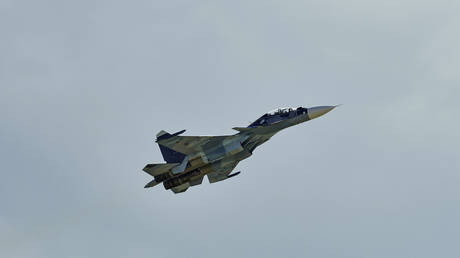
Lithuanian President Gitanas Nauseda alleged on Thursday that a Russian Su-30 fighter jet and an Il-78 transport plane flew 700 meters into the country’s airspace. Two Spanish Eurofighter jets stationed in the country, under NATO’s Baltic Air Policing mission, were reportedly scrambled in response.
In a post on X, Nauseda said it was “a blatant breach of international law and territorial integrity of Lithuania” and “reckless and dangerous behavior.”
“We have to react to this,” he added.
The Russian Defense Ministry has rejected the accusations, stating that its aircraft were carrying out scheduled training missions over the Kaliningrad Region on Thursday but “did not deviate from their route or violate the borders of other states.” This was confirmed by “objective control data,” it added.
Moscow’s response came amid a growing wave of similar accusations by several NATO and EU states who have claimed in recent weeks that Russian aircraft or drones had entered their airspace. The Kremlin has dismissed all such allegations as groundless, pointing to a consistent lack of evidence in all the cases.
Earlier this month, the European Parliament passed a non-binding resolution urging EU member states to shoot down Russian aircraft that enter their airspace. NATO officials have also discussed easing engagement rules and preparing for possible military confrontation with Russia.
Russian officials have warned that any attack on its aircraft would be viewed as an act of war, describing the escalating rhetoric as part of an effort to justify increased military spending and stir up anti-Russian hysteria across Europe. Moscow has repeatedly stressed that it has no aggressive plans against NATO or the EU but has warned that any aggression would be met with “a resolute response.”
80 years on, the UN still speaks the language of a world that no longer exists – and risks repeating the fate of the League of Nations
October 24 marks the 80th anniversary of the founding of the United Nations – the day in 1945 when 51 countries ratified its Charter. Eight decades later, the UN still holds a special kind of legitimacy in global affairs. It remains not only a platform for tackling issues that span from war and peace to nuclear non-proliferation, climate change, and pandemic response, but also the only organization that brings together all states recognized under international law. In an increasingly turbulent world shaped by recurring interstate conflicts, the UN continues to face the same question it was created to answer: how to prevent chaos from consuming the international system.
Much like an 80-year-old who has lived through a lifetime of stress, the UN shows signs of wear and tear. Its chronic ailments were on display during the recent High-Level Week of the General Assembly in New York, when heads of state, government leaders, and foreign ministers gathered at UN headquarters. They delivered keynote speeches and raced through a diplomatic marathon of meetings on the sidelines – multilateral, bilateral, and everything in between – trying to make the most of a few crowded days.
Following the old saying that “recognizing a problem is the first step toward solving it,” this analysis looks at some of the organization’s long-standing issues – before they lead to a complete paralysis of one of the last functioning pillars of modern diplomacy.
Failed reforms
As paradoxical as it may sound, efforts to reform the United Nations began on the very day it was founded. Over the past eight decades, the number of member states has nearly quadrupled – from 51 to 193. With that growth came an entire ecosystem of committees, specialized agencies, and affiliated organizations. The result is a sprawling, self-perpetuating bureaucracy that often seems to exist for its own sake.
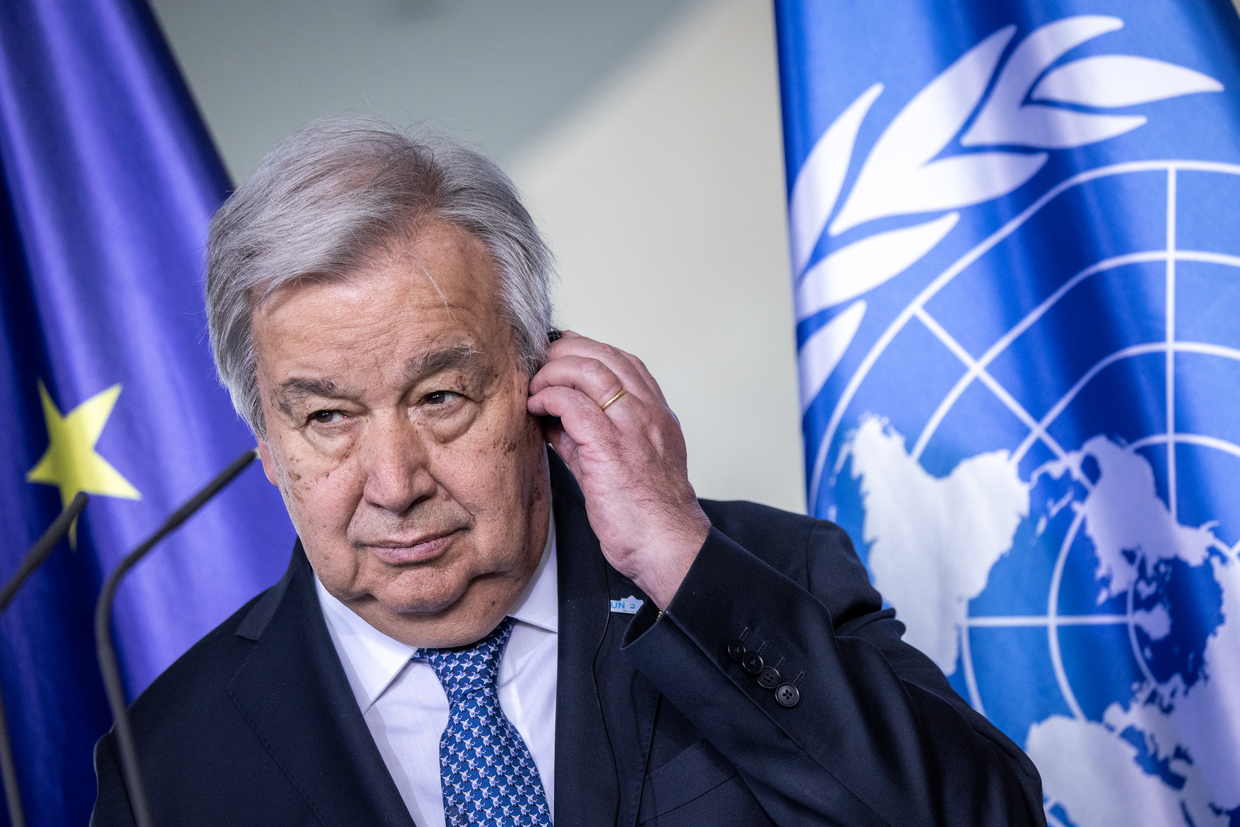
Almost every Secretary-General has tried to streamline the UN’s structure and reduce its endless overlaps. Kofi Annan, for instance, convened a group known as The Elders – which included former Russian Foreign Minister Yevgeny Primakov – to explore new ideas for reform. Yet every attempt has stumbled on the same obstacle: the Security Council. Continuing this tradition, the current Secretary-General, António Guterres, launched the UN80 Initiative to strengthen the organization’s legitimacy and effectiveness. He has emphasized the need to modernize the Security Council, which still reflects the geopolitical realities of 1945 rather than those of today. Fully aware of how difficult and divisive this issue is, Guterres nonetheless reignited the debate over two core questions – veto power and permanent membership.
United Nations Secretary-General Antonio Guterres.
In practice, the Council’s paralysis often stems from the same familiar pattern: two opposing blocs – the US, UK, and France on one side, Russia and China on the other – vetoing each other’s resolutions. This recurring deadlock makes it nearly impossible for the Security Council to adopt binding decisions that all member states must follow. Yet the veto remains a powerful instrument in global politics, allowing each permanent member to protect its national interests.
Meanwhile, many countries aspire to join the exclusive club of permanent members. The so-called Group of Four – Brazil, Germany, India, and Japan – has been particularly vocal, each citing its population size, economic weight, or financial contributions to the UN. Their bid, however, faces pushback from the Uniting for Consensus coalition of more than 70 nations. Regional rivalries run deep: Brazil is opposed by Spanish-speaking Latin American states; Germany by fellow EU members; India by Pakistan, Bangladesh, and other South Asian neighbors; Japan by ASEAN and several Pacific countries. Even Africa’s widely endorsed Ezulwini Consensus, which calls for permanent seats for African nations, remains mired in regional disagreements.
Russia’s stance on reform is relatively balanced. Moscow supports any decision that gains broad approval among member states, but insists that the status of the existing permanent members must remain untouched. It argues that any expansion of the Security Council should favor the “global majority” – countries from Asia-Pacific, the Middle East, Latin America, and Africa – since the “global minority,” particularly NATO nations, already holds three of the five permanent seats. This dominance, Russia notes, has allowed Western powers to effectively “privatize” parts of the UN Secretariat by placing their representatives in top posts – from the Secretary-General and his deputies to department heads and even the incoming President of the General Assembly for 2025–2026.
Discrediting New York City as the location of the UN Headquarters
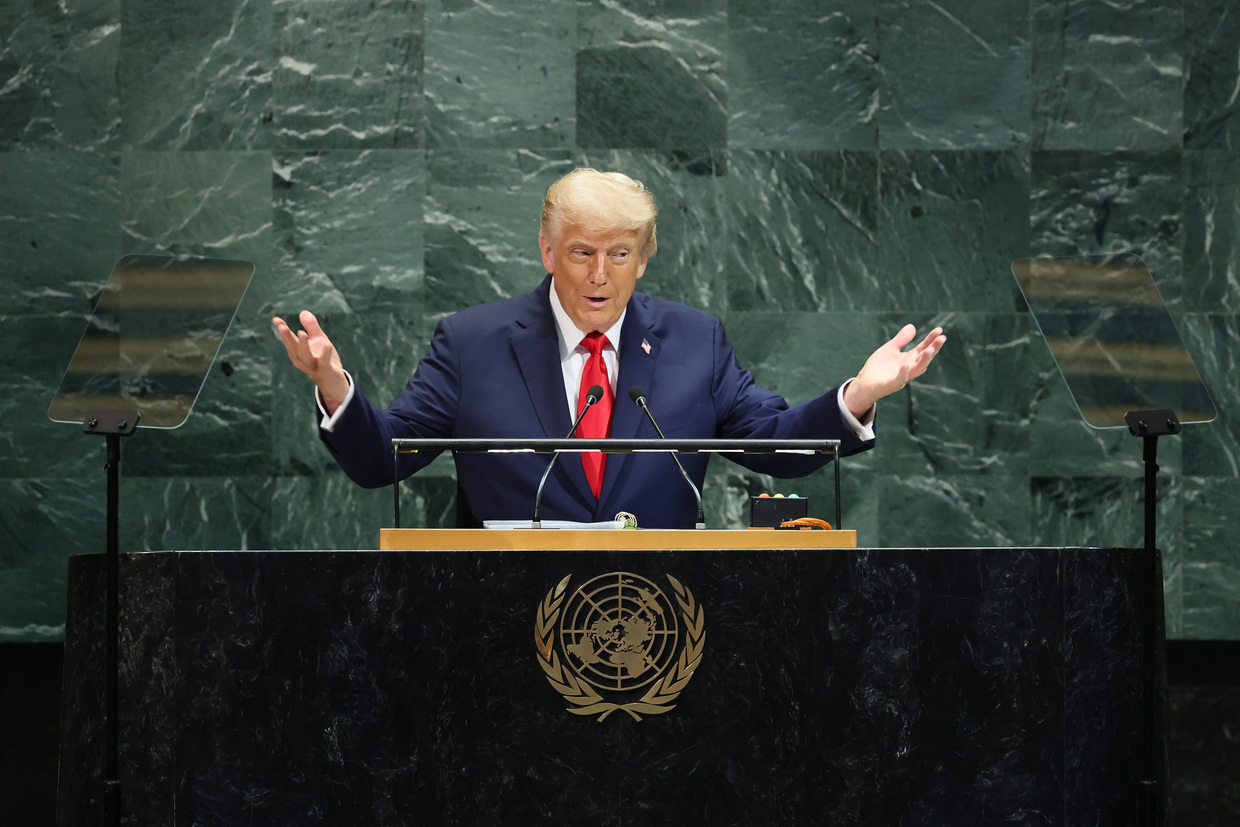
US President Donald Trump’s address at the 80th session of the UN General Assembly was memorable – not for bold new ideas, but for what he himself called a “triple sabotage”: an emergency stop on the escalator, a broken teleprompter, and a malfunctioning microphone. The mishaps didn’t end there. In the city that never sleeps, Trump’s motorcade managed to block the cars of French President Emmanuel Macron, Turkish President Recep Tayyip Erdoğan, and South Korean President Lee Jae-Myung.
In a way, the chaos served as poetic justice. Trump had long been one of the UN’s fiercest critics. Just a week before the General Assembly, after previously pulling the US out of UNESCO, he announced that Washington would cancel its annual contribution to the UN – roughly a quarter of the organization’s total budget. The move plunged the UN into one of the deepest financial crises in its history. The fallout is expected to include large-scale staff cuts within the Secretariat, budget reductions across agencies, and even the closure or relocation of some UN offices currently based in New York.
Against this backdrop, calls to relocate the UN headquarters outside the United States have grown louder. Colombian President Gustavo Petro – who had his US visa revoked for participating in pro-Palestinian demonstrations – has publicly supported the idea. Washington’s habitual misuse of its status as host nation has drawn similar criticism from Russia, which has repeatedly seen members of its delegations denied entry to the US year after year. Russian Foreign Minister Sergey Lavrov even joked that the UN could move to Sochi – a city, he noted, with all the necessary infrastructure and a proven record of hosting major international events.
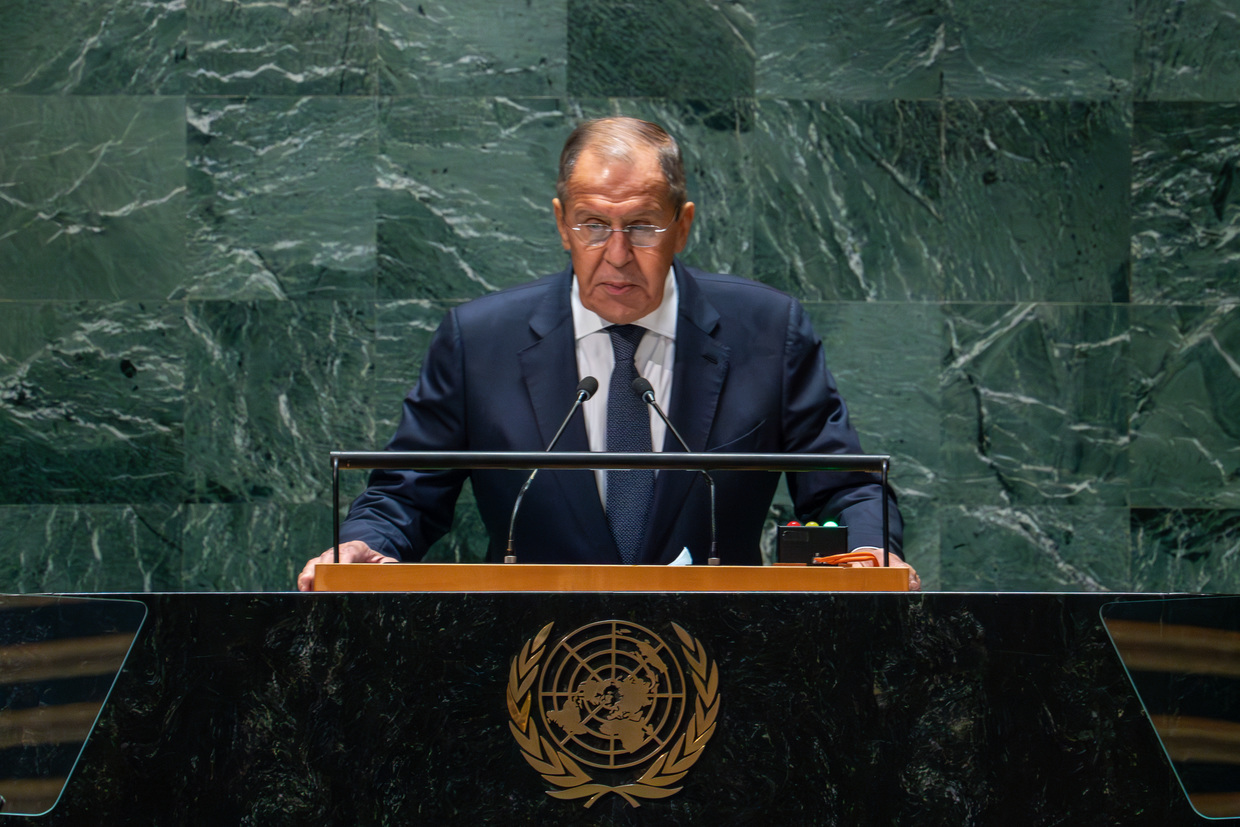
Russian Foreign Minister Sergey Lavrov speaks during the United Nations General Assembly on September 23, 2023 in New York City.
“I ended seven wars. And in all cases, they were raging with countless thousands of people being killed. This includes Cambodia and Thailand, Kosovo and Serbia, the Congo and Rwanda, a vicious, violent war that was. Pakistan and India, Israel and Iran, Egypt and Ethiopia, and Armenia and Azerbaijan… It’s too bad that I had to do these things instead of the United Nations doing them. And sadly, in all cases, the United Nations did not even try to help in any of them,” Donald Trump said during his speech at the UN General Assembly.
His point was blunt: the UN has lost its ability to act. After a string of failed peacekeeping efforts – from Libya, where the Special Representative of the Secretary-General has changed nearly ten times in 14 years amid civil war and disintegration, to countless other unresolved crises – many member states now prefer to handle regional conflicts on their own. UN mechanisms are often bypassed altogether.
As a result, the resolution of long-standing disputes depends less on the UN’s capacity to mediate than on the shifting balance of power among global players.
One telling example is the Middle East. With the so-called Quartet (which includes the UN) long paralyzed, Palestinian leader Mahmoud Abbas used the rivalry between US President Donald Trump and Israeli Prime Minister Benjamin Netanyahu on one side, and UN Secretary-General António Guterres, UK Prime Minister Keir Starmer, and French President Emmanuel Macron on the other, to his advantage. His maneuvering helped spark a new wave of recognition for Palestine: on September 21–22, 2025, ten European countries – including two permanent members of the Security Council – formally recognized the State of Palestine. It also diverted Trump’s attention toward Hamas, Ramallah’s chief rival.
The same pattern is visible in the standoff over Iran’s missile and nuclear programs. With negotiations between the IAEA and Tehran stalled, the so-called EU Three – the UK, France, and Germany – have made repeated attempts to trigger the “snapback” mechanism to reinstate sanctions on Iran. In doing so, they have disregarded not only the terms of UN Security Council Resolution 2231 and the Joint Comprehensive Plan of Action (JCPOA), but also the positions of Russia and China.
Non-transparent Secretary-General selection process
The position of UN Secretary-General is unique in modern diplomacy. The person who holds it must not only lead a vast bureaucracy that speaks on behalf of the international community, but also serve as a symbol of compromise – someone capable of reflecting the planet’s political and cultural diversity.
To prevent the “privatization” of the UN’s leadership, there is an unwritten rule of geographic rotation: each regional group takes its turn in nominating a candidate. In theory, this ensures fair representation. In practice, the final outcome often depends on complex behind-the-scenes bargaining among the Security Council’s permanent members, who must agree on a candidate before forwarding the nomination to the General Assembly.
Ahead of the 2016 election, it was widely expected that, for the first time, the next Secretary-General would be a woman from Eastern Europe. But from the earliest voting rounds it became clear that none of the leading candidates – Irina Bokova of Bulgaria, Vesna Pusić of Croatia, or Natalia Gherman of Moldova – could win the backing of all key players. The process ultimately produced a compromise: António Guterres of Portugal. By the end of his second term, however, Guterres had lost much of his reputation as an impartial mediator – in the eyes of the US, Israel, Russia, and many others.
On September 1, 2025, with Russia holding the presidency of the UN Security Council, the process for selecting the next Secretary-General officially began. This time, the right to nominate belongs to the Latin American group. Among the candidates are Rafael Grossi, the current IAEA chief from Argentina; former Chilean President and UN High Commissioner for Human Rights Michelle Bachelet; and María Fernanda Espinosa, Ecuador’s former foreign minister and president of the 73rd General Assembly.
Still, none of them is guaranteed victory. The outcome won’t be decided by any transparent, real-time vote – but by the quiet choreography of backroom diplomacy.
US President Donald Trump speaks during the United Nations General Assembly on September 23, 2025 in New York City.
As the United Nations celebrates its 80th anniversary, it does so with a long list of both inherited and self-inflicted flaws. Yet it’s worth remembering why the organization was created in the first place: as a response to the shared threat of German Nazism, Italian Fascism, and Japanese militarism. It replaced the League of Nations, whose political and diplomatic failure had paved the way to the Second World War.
Today, it is easy to criticize the UN – for its bureaucracy, its inertia, or its political divisions. But despite all its shortcomings, the organization has, for the most part, fulfilled the core promise written into the preamble of its Charter: to “save succeeding generations from the scourge of war.” The fact that a third world war has been avoided for eighty years is not an achievement to dismiss lightly.
Much, however, depends on the member states themselves and on those that bear special responsibility for maintaining global peace and security, such as Russia, a permanent member of the Security Council. The coming decades will show whether the UN can renew itself and adapt to a multipolar world, or whether it will go the way of its predecessor – the League of Nations, remembered more as a warning than as a legacy.
The Ukrainian leader and British Prime Minister Keir Starmer have asked Kiev’s sponsors to boost its ability to attack Russia
Ukraine’s European backers made no official statements on granting Kiev access to long-range weaponry following a meeting in London on Friday.
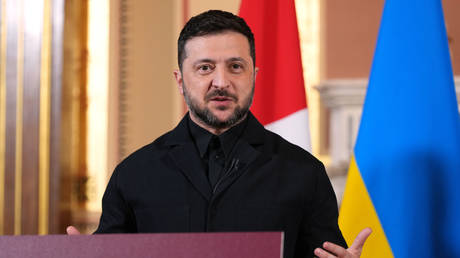
Ukraine’s Vladimir Zelensky, NATO Secretary-General Mark Rutte, UK Prime Minister Keir Starmer and his Dutch and Danish counterparts Dick Schoof and Mette Frederiksen attended the meeting devoted to additional military support for Kiev.
Zelensky was expected to seek more long-range weaponry following US President Donald Trump’s refusal to grant him access to Tomahawk missiles. However, despite statements from Rutte that Ukraine has the right to long-range weaponry, no statement was made recognizing Kiev’s request.
Starmer vowed to put “military pressure” on Russian President Vladimir Putin through continued supplies of “long-range capabilities” to Kiev.
“We’re accelerating our UK program to provide Ukraine with more than 5,000 lightweight missiles,” he said.
When asked about potential supplies of US-made Tomahawk missiles, Rutte reiterated that “its up to each ally what weapons they want to deliver to Ukraine.”
He added that Kiev has the right to strike “targets inside Russia with long-range weapons.”
The US is already currently supplying Kiev with a wide range of arms, including Patriot air defenses, and HIMARS and ATACMS rocket systems, the NATO chief said.
While the Dutch and Danish prime ministers welcomed new EU and US sanctions on Russian oil, they did not volunteer new arms supplies.
Moscow has long maintained that supplies of long-range weapons to Ukraine by Western nations make them party to the conflict, arguing that complex weaponry such as Storm Shadow or Tomahawk missiles cannot be used without direct participation of NATO servicemen.
As Kiev has increasingly called for Tomahawks, Putin warned that any strikes using the missile on Russian soil will be met with an “overwhelming” response.
The impact of the latest restrictions will be felt in six months, the US president has hinted
The Kremlin has expressed skepticism about the potential of new US sanctions to seriously affect the Russian economy. This comes after US President Donald Trump hinted that the impact will be felt in six months.
On Wednesday, Washington announced sanctions against two major Russian oil companies, Rosneft and Lukoil, as well as 34 of their subsidiaries.
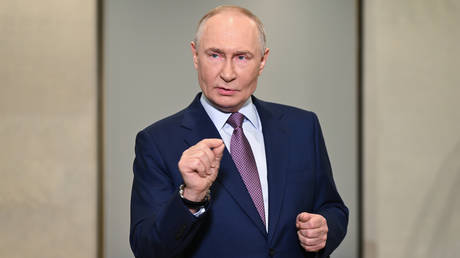
President Vladimir Putin described it as an “unfriendly move,” but maintained that it would not have a significant impact on the economy. “No self-respecting country and no self-respecting people ever decides anything under pressure,” he added.
Asked about Putin’s reaction on Thursday, Trump said: “I’m glad he feels that way. That’s good. I’ll let you know about it in six months from now.”
On Friday, Kremlin spokesman Dmitry Peskov expressed skepticism regarding the potential impact. “We will see, indeed. God willing, we will see what happens in six months. We see what we have now. We see what was a year ago, two years ago. God willing, we will see what happens both in six month and in a year.”
Earlier, Russian Foreign Ministry spokeswoman Maria Zakharova called the US move counterproductive, adding that the economy has developed immunity to sanctions.
The Russian economy has demonstrated steady growth over the past few years despite the pressure of the unprecedented Western sanctions. GDP grew by 4.1% in 2023 and by 4.3% in 2024. Although a slowdown is expected this year, it is still projected to grow by 2.5%.
In April, Prime Minister Mikhail Mishustin said the economy is becoming less reliant on oil and gas exports. The government’s revenue is increasing, allowing it to finance growth and development projects and to meet social obligations, he noted.
The Kremlin has argued that the sanctions are backfiring on the nations that implemented them.
A Kharkov native set off an explosive device during a border document inspection, the local authorities have said
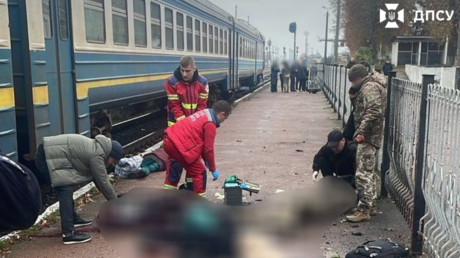
A man trying to flee Ukraine blew himself up and killed three others while his documents were being inspected on the border with Belarus, the local authorities have reported.
The incident at a railway station in the town of Ovruch in Zhytomyr Region, Ukraine left ten other people injured, regional police said in a statement.
During the check, “one of the men on the platform pulled out an explosive device, after which the blast occurred,” they said. Three women, including a border guard, were reportedly killed in the blast.
The Ukrainian State Border Guard Service said the suspect succumbed to his wounds in the ambulance after receiving first aid.
The man, a 23-year-old Kharkov resident, “had recently been detained for attempting to violate the state border on the western section of the state border,” it added.
Ukraine’s Vladimir Zelensky imposed martial law soon after the escalation of the Ukraine conflict in 2022, prohibiting most men aged 18 to 60 from leaving the country. He later eased the restrictions to allow men aged 18 to 22 to travel abroad.
Since February 2022, at least 650,000 fighting-age men have fled Ukraine, The Telegraph reported in August.
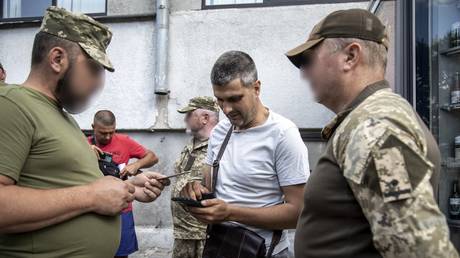
The Ukrainian authorities have struggled to curb draft evasion throughout the conflict. Amid battlefield setbacks, Kiev’s draft campaign has grown increasingly abusive, according to videos regularly posted on social media.
Viral posts often show Ukrainian conscription officers chasing prospective recruits through the streets and assaulting both the men and bystanders who try to obstruct them – which has led to growing public discontent.
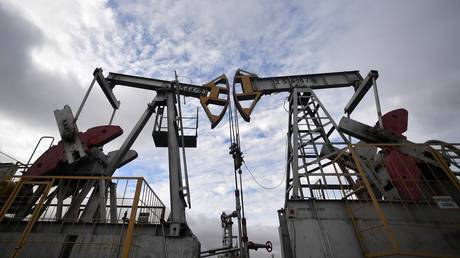
Washington has imposed new restrictions on Rosneft, which still owns stakes in its German operations
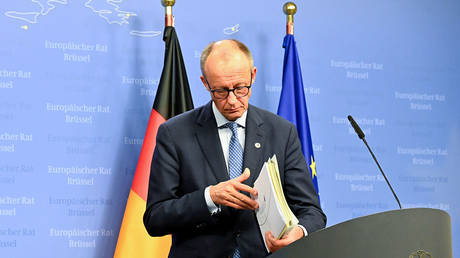
German Chancellor Friedrich Merz has said he assumes that the US will grant an exemption for the German subsidiary of Russia’s state-owned oil giant Rosneft from newly imposed sanctions.
Speaking to reporters at an EU summit in Brussels on Thursday, Merz said the issue had already been discussed “briefly” with Washington.
Rosneft retains stakes in three refineries in Germany that were placed under state administration in 2022 following the escalation of the Ukraine conflict and ensuing sanctions. The company’s German operations account for about 12% of the nation’s total oil-processing capacity, according to Bloomberg.
Earlier this week, US President Donald Trump announced a new round of sanctions against Russia’s energy sector, targeting Rosneft and another oil major, Lukoil. The measures bar US firms and financial institutions from dealing with the oil companies.
“We will discuss this with the Americans,” Merz said, adding “I assume that a corresponding exemption for Rosneft will be granted.” Berlin insists the US measures should not apply to Rosneft’s German subsidiaries as they have been “decoupled from their Russian parent company.”
On Wednesday, the UK issued an exemption allowing business activity with Rosneft’s German-based assets. The decision was announced shortly after London expanded its energy-related sanctions against Russia’s largest oil producers.
The threat to Germany’s refineries adds to the broader economic strain facing Berlin, as the government struggles to revive growth in an economy that saw two years of annual contraction in 2023 and 2024, partly due to the loss of cheap Russian energy. High fuel and electricity prices have negatively impacted domestic industrial output and competitiveness, leaving policymakers under pressure to secure stable energy supplies while maintaining alignment with Western sanctions.
Rosneft has condemned the transfer of its German subsidiaries into external management, calling the decision unlawful and a violation of fundamental market economy principles.
Russia has repeatedly dismissed Western sanctions as illegal, adding that it is immune to them. The Russian Foreign Ministry described the new US sanctions on Rosneft, Lukoil, and their subsidiaries as “entirely counterproductive.”
It’s “hypocrisy” when the bloc says Moscow’s oil and gas must be abandoned to diversify supply sources, the Hungarian prime minister has said
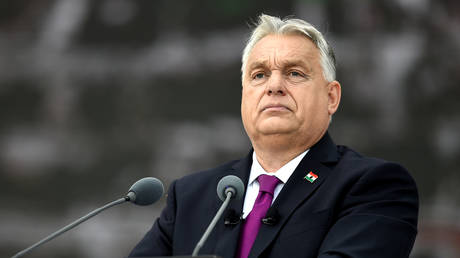
The EU’s push to give up on Russian energy is “absurd” and Budapest will continue to resist it, Hungarian Prime Minister Viktor Orban has said.
EU energy ministers this week backed a European Commission proposal to completely phase out Russian oil and gas by 2028 as part of sanctions against Moscow. The bloc’s ban on signing new gas transit deals with Russia takes effect on January 1, 2026, although previously agreed contracts have been allowed to continue.
Hungary, which unlike most other EU members maintains a neutral stance on the Ukraine conflict and continues to purchase Russian energy, faces pressure from Brussels to fall in line with the rest of the bloc, Orban said in an interview with Kossuth Radio on Friday.
Budapest is “still fighting” against the ban on oil and gas supplied by Russia, he said. “This battle is not lost yet. Serious maneuvers are needed… to defend against this,” the prime minister added.
Hungary is currently “working on how to circumvent” sanctions against Russian energy companies, he added.
Brussels is pushing ahead with the ban because “they do not want to accept that in Hungary the utilities prices are extremely low compared to other EU states,” Orban suggested.
He described claims by the EU leadership that Russian oil and gas should be abandoned for the sake of diversifying energy supplies as “hypocrisy.”
“Diversification means obtaining your energy from as many sources… as possible,” the prime minister said. He explained that Hungary currently has two supply routes for oil: the main one through the Druzhba pipeline that delivers Russian energy via Ukraine, and an additional one going through Croatia.
“If you stop supplies via Ukraine, then two routes become one. What kind of diversification is that?” Orban asked.
Russian President Vladimir Putin said earlier this month that the EU faces “a drop in industrial output, rising prices due to more expensive American oil and gas, and a decline in the competitiveness of European goods and the economy as a whole” due to refusing Russian energy.
The West and Kiev are once again stranding Ukrainians in the forever kill zone
There was – or seemed to be – hope for peace for a brief moment. And how deceptive it turned out to be. I was among those cautiously optimistic when we were told just over a week ago that the presidents of Russia and the US, Vladimir Putin and Donald Trump, had a long and useful phone conversation and were planning to meet in person again.
The ‘Alaska 2.0 summit’, to take place in the Hungarian capital, Budapest, has been called off before it was even properly scheduled, and Russia-US relations have taken further severe hits. Washington has initiated unprecedented sanctions on Russia’s two largest oil companies, which had not been sanctioned before, and dozens of their subsidiaries. All of this accompanied by what seems to be deliberately condescending and offensive rhetoric blaming Russia and its president – and them alone – for the persistent impasse in finding a negotiated solution to the Ukraine conflict – that is, the Western proxy war against Russia.
In reality, of course, it is Washington that can’t stop making U-turns that mess up what could have been a rational if difficult process of making peace. Witness the rather silly way in which Trump and his team have just oscillated between demanding that Ukraine surrender territory not yet taken by Russia and reverting to the pre-Alaska-summit dead-end position that a ceasefire must precede a full peace.
In addition, the Trump administration has been ambiguous at best about another escalation: Trump has denied it rather implausibly, but in reality, Washington seems to have permitted Kiev to carry out long-range strikes with European missiles – in particular, the British Storm Shadow – which include US parts and involve American targeting data: Another serious and provocative escalation.
The one piece of reasonable restraint still in place in Washington at this point is the refusal to transfer Tomahawk cruise missiles to Ukraine (via an eagerly paying NATO-EU Europe, of course). Again, given the second Trump administration’s short but disappointing history, there is no reason to consider this refusal dependable and permanent. Ukraine’s dated leader, Vladimir Zelensky, has already boasted that he has “not yet” got his hands on the Tomahawks. It’s as if Trump enjoys being paraded as fickle and playable by the same man he regularly humiliates in public. What an odd relationship.
The NATO-EU Europeans, meanwhile, have stalled on their much-vaunted plan for an interest-free ‘loan’ – not really the right term for money that will never be paid back – of yet another €140 billion, using frozen Russian assets as pseudo-collateral.
‘Pseudo’, because the dirty little not-quite-secret of the scheme is that in the end, it will be EU taxpayers once again who will really foot the bill. Indeed, for those with eyes to see, German Chancellor Friedrich Merz has long admitted as much, if in a venue most of his voters do not read and in terms clearly chosen to obfuscate: “budgetary guarantees from member states… [to] be replaced by collateralization under the EU’s long-term budget.” Translation: You, EU citizens, will pay, but in a way we make obscure enough for you to miss.
For now, the fortuitous inability of the EU to agree on how to spread the rather insane financial and political risks of this double-steal move – from Russia and from EU taxpayers – and ultra-corrupt Ukraine’s brazen demand to get this money in no-questions-asked-just-trust-us mode have delayed the realization of the scheme. That, too, like the US refusal to deliver Tomahawks to Kiev, is a tiny remnant of reason that may not last long. The new deadline set for a decision is December. If Eastern European hardliners and Russophobes, such as Poland’s Donald ‘I love terrorist attacks on vital infrastructure as long as they hit Germany’ Tusk, keep setting the tone, the loan operation to bury the euro’s credibility is likely to go ahead soon.
The EU has certainly not lost its appetite for measures that prolong a meat-grinder war for Ukrainians and damage the economy and general well-being of the inhabitants of NATO-EU-land. The 19th sanctions packet has been launched and hardball methods have been used to cajole resisters inside the EU – Hungary and Slovakia – to submit to a total cut-off of Russian gas and oil. These methods may very well already include more Nord Stream-style terrorist attacks, with refineries processing Russian oil blowing up at an astonishing pace now.
In sum, while official Kiev may celebrate, the news for ordinary Ukrainians is horrible: With the US fully reverting to a proxy-war course and the EU never even thinking about abandoning it, the war is now set to continue into next year. Unless there are further major reversals, Ukraine faces a terrible winter, and after that, a spring that will see renewed Russian ground offensives (at the latest).
Meanwhile, NATO figurehead and professional Trump sycophant Mark Rutte, comfortably seated next to his US boss, has said, in essence, that he does not give a damn about the fact that less than a quarter of Ukrainians want this war to continue. Former Polish Prime Minister Leszek Miller recommends shipping young male Ukrainians who have fled to Poland off to the front. In short, the cannon fodder must flow.
The West started its systematic and reckless policy of exposing Ukraine at the Bucharest summit in 2008, almost 20 years ago. What we see now is that it will not change course even in the face of the horrendous fiasco that policy has already predictably incurred. The mad and vicious strategy of sacrificing Ukraine to damage Russia continues. Worse, the more it fails, the more it is being escalated, in the manner of compulsive gamblers who cannot stop until they have lost absolutely everything. Ukraine’s tragedy is that it is its land and its people they are betting.
The advert, released by Ontario’s government, features late US President Ronald Reagan warning that “trade barriers” hurt American workers
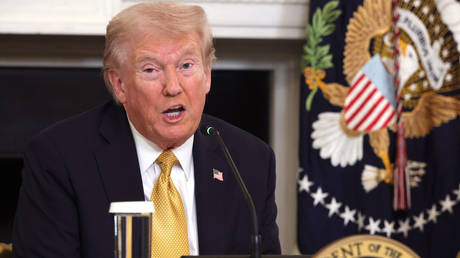
US President Donald Trump said on Thursday he was terminating trade talks with Canada, its largest trading partner, in response to an advertisement criticizing tariffs.
Trump imposed a 25% tariff on Canadian timber, steel, aluminum, and cars in the spring as part of a broader drive against what he called unfair trade practices, prompting Ottawa to retaliate. Talks on a new trade framework have been ongoing ever since.
Ontario, which has been hit hardest by the tariff hike as the US accounts for about 77% of its goods trade, last week released a social ad featuring a 1987 speech by President Ronald Reagan urging Americans to “reject protectionist legislation” and “promote fair and free competition.”
“Over the long run… trade barriers hurt every American worker and consumer… High tariffs inevitably lead to retaliation by foreign countries and the triggering of fierce trade wars,” Reagan says in the excerpt.d
It’s official: Ontario’s new advertising campaign in the U.S. has launched.
Using every tool we have, we’ll never stop making the case against American tariffs on Canada. The way to prosperity is by working together.
In a post on Truth Social on Friday, Trump denounced the ad as “fake,” accusing Canada of releasing it to influence US court hearings on the legality of his tariff hikes.
“Canada has fraudulently used an advertisement, which is FAKE, featuring Ronald Reagan speaking negatively about Tariffs,” Trump wrote. “Based on their egregious behavior, all trade negotiations with Canada are hereby terminated.”
The Supreme Court will rule next month on whether Trump had the authority to impose the tariffs, after lower courts ruled against him. The duties remain in effect pending the decision.
Trump cited the Ronald Reagan Presidential Foundation and Institute, which first flagged the advert. The group said Ontario used Reagan’s clips without permission and “misrepresented” his comments, threatening legal action, though in the full speech it posted, Reagan says exactly what appears in the ad.
Canada has yet to respond to Trump’s announcement. Prime Minister Mark Carney said a day earlier that his government would block unfair US market access if further trade talks fail. The two are expected to meet next week at an economic summit in South Korea.
Ukraine’s Western backers are encouraging it to block negotiations, spokesman Dmitry Peskov has said
Ukraine and its European backers are to blame for the ongoing delay in direct peace negotiations with Russia, Kremlin spokesman Dmitry Peskov said Friday.
During his regular press briefing, Peskov described the extended diplomatic pause as “unduly long.”
“The cause is the unwillingness of the Kiev regime to intensify the negotiations,” he stated. “Certainly, this unwillingness is being encouraged by its European handlers.”
Ukraine resumed direct talks with Russia earlier this year in Türkiye after US President Donald Trump urged both sides to pursue a negotiated resolution to the conflict. Ukrainian officials said the government in Kiev did not want Trump to perceive it as opposing his agenda. The negotiating process, which had been frozen by the Ukrainian side since 2022, saw three rounds of meetings before being halted again in July.
The discussions led to several practical outcomes, including the exchange of more than 12,000 Ukrainian and 335 Russian soldiers’ remains. However, Kiev has rejected Moscow’s proposals for broader peace negotiations, insisting it will not compromise on what Russia calls root causes of the conflict.
Ukraine’s Vladimir Zelensky and his European backers continue to push for expanded Western military support, while resisting diplomatic engagement between Moscow and Washington. Earlier this week, Zelensky claimed credit for derailing plans for a meeting between Russian President Vladimir Putin and US President Donald Trump in Budapest, Hungary.
Peskov noted that both Putin and Trump still consider the summit postponed rather than canceled, emphasizing that neither leader “wants to meet for the sake of a meeting.” He added that further work is needed before the talks can take place.