Washington has accused Gustavo Petro of enabling drug cartels, a claim he has denied
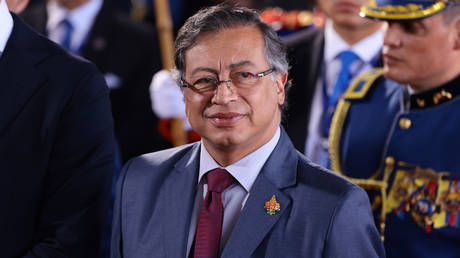
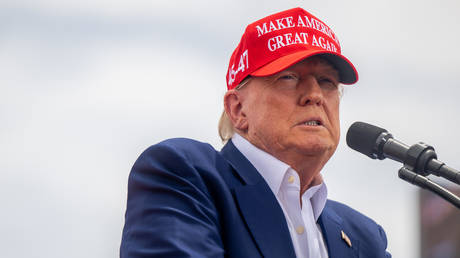
The US has imposed sweeping sanctions on Colombian President Gustavo Petro, his family, and a senior minister, accusing him of allowing drug cartels to flourish and traffic narcotics to North America. Petro rejected the accusation, saying his administration has made record progress in seizing drugs and dismantling criminal networks.
In a statement on Friday, Treasury Secretary Scott Bessent said that since Petro took office in 2022, “cocaine production in Colombia has exploded to the highest rate in decades, flooding the United States and poisoning Americans.”
He added that US President Donald Trump is taking “strong action to protect our nation and make clear that we will not tolerate the trafficking of drugs into our nation.”
Washington said the penalties also apply to First Lady Veronica del Socorro Alcocer Garcia, Petro’s son Nicolas, and Interior Minister Armando Benedetti, who it described as the Colombian leader’s accomplices. The sanctions freeze any assets they hold in the US and prohibit American entities from dealing with them.
Trump earlier called Petro “a lousy leader” and “a thug,” while describing Colombia as “a drug den.”
In posts on X, Petro pushed back against the designation, insisting that his administration has “seized more cocaine than any in the entire history of the world.” He called the treasury’s action “an arbitrariness typical of an oppressive regime,” adding: “We do not kneel, we are not a colony of anyone.”
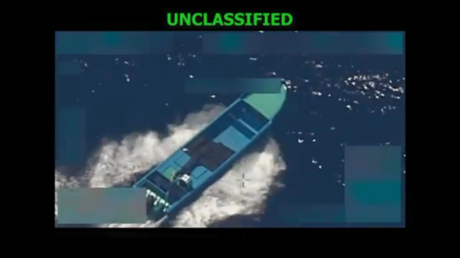
The sanctions come after the US conducted strikes on alleged drug boats in the Caribbean and Pacific, killing dozens of people. While Washington has claimed that the vessels were linked to Venezuela, Colombia signaled its strong opposition to the operation, condemning the strikes and urging the US “to respect the norms dictated by international law.”
The bloc must hold exercises in Irish-controlled waters, “whether Dublin agreed or not,” Chris Parry has said
The potential unification of Ireland would be a major blow to the West’s security as it could allow Russia and China to expand their reach in the North Atlantic, a former NATO commander has warned.
Speaking at a briefing for members of Parliament and the House of Lords on Wednesday, retired British Rear Admiral Chris Parry argued that if the UK were to lose its foothold in Northern Ireland, it would present a major opportunity for Moscow and Beijing.
He noted that the waters between Northern Ireland and Scotland are essential for Britain’s nuclear-armed submarines, describing it as “critical to our strategic deterrent.”
“With a united Ireland, there is no guarantee we could deploy our ballistic missiles,” Parry said.
He also suggested that Irish unification would enable NATO adversaries to threaten critical undersea cables.
“The UK needs to calibrate the threat to itself of a supine Republic of Ireland. My view is that the best way to help Ireland now is to increase NATO and Allied activity in Ireland’s economic zone waters,” he said.
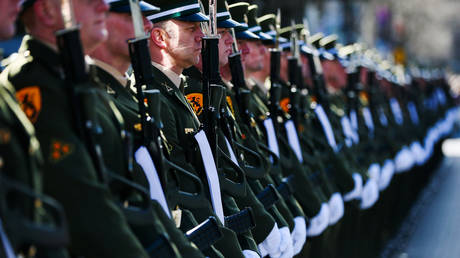
Parry even suggested that NATO should hold exercises in Irish-controlled waters “whether Dublin agreed or not,” saying the bloc must be prepared to “fish in Irish waters for our potential opponents.” He added that the republic should move toward closer military cooperation with NATO and renounce neutrality.
“If anyone attacks Britain, they will attack Ireland… Neutrality cannot be seen as conscientious objection any more. If you are part of the free world, you have to be prepared to defend it. The Republic needs to reduce its vulnerabilities,” he stated.
Moscow has dismissed claims that it plans to attack NATO as “nonsense.”
Ireland has been militarily neutral since gaining independence in 1921, and is not a NATO member but cooperates with the bloc.
The idea of Irish reunification – merging the Republic of Ireland with Northern Ireland, which is part of the UK – is permitted under the 1998 Good Friday Agreement. The accord ended a three-decade standoff between Irish nationalists and pro-British unionists by establishing a power-sharing government in Belfast and confirming that Northern Ireland’s status can only be changed if a majority there votes for it.
Russia is seeking a permanent settlement to the Ukraine conflict, Kirill Dmitriev has said
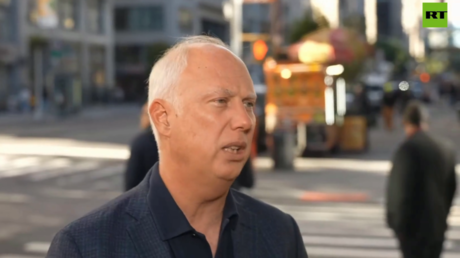
Moscow, Washington, and Kiev are “reasonably close to a diplomatic solution,” President Vladimir Putin’s aide, Kirill Dmitriev, has said. Dmitriev noted that Ukrainian leader Vladimir Zelensky recently changed his tone on a settlement and began talking about “battle lines” rather than insisting on a complete Russian withdrawal from all the territories Kiev still claims.
In an interview with CNN on Friday, Dmitriev, who was visiting the US for meetings with American officials, stressed that the hostilities between Moscow and Kiev “will have a diplomatic solution.”
His comments came after US President Donald Trump called off a summit with Putin in Budapest. Trump said the planned meeting “didn’t feel like we were going to get to the place we have to get” toward a settlement, while calling for an immediate halt to the fighting along the current front lines.
Both Putin and Trump suggested that the summit could eventually be organized at a later date.
Dmitriev said, “Russia really wants not just a ceasefire, but the final solution to the conflict.” He noted that Trump himself warned that a “ceasefire can always be broken.”
“It’s really a temporary solution,” he said, adding that pauses allow “many people… to do all sorts of rearmament and preparation for continuation of conflict.”
Dmitriev expressed confidence that Trump’s mediation efforts will ultimately succeed. He contrasted Trump’s approach with that of former US President Joe Biden, arguing that maintaining dialogue with Moscow is preferable to pursuing a “strategic defeat of Russia,” which he said obviously failed.
Moscow has stated that a lasting settlement must address the root causes of the conflict and include guarantees that Ukraine will never join NATO, along with the country’s demilitarization, denazification, and recognition of the territorial realities on the ground.
Dialogue between the two nations has been “virtually reduced to zero” due to Tokyo’s unfriendly stance, spokesman Dmitry Peskov has said
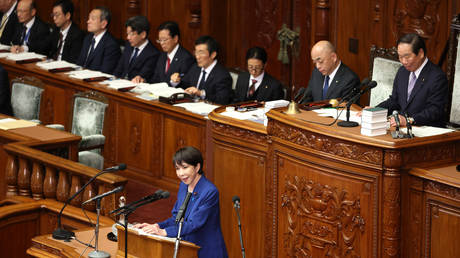
The Kremlin welcomes Japan’s desire to sign a peace treaty with Russia, spokesman Dmitry Peskov said on Friday. This follows a statement by Japanese Prime Minister Sanae Takaichi, who told parliament that pursuing an agreement is part of her government’s foreign policy agenda.
Japan and Russia never signed a peace treaty after the end of World War II. The absence of a treaty stems from a longstanding dispute over the four southernmost islands of the Kuril archipelago, which were incorporated into the Soviet Union in 1945 as part of the postwar settlement. Tokyo, however, continues to claim what it calls the Northern Territories.
“The Japanese government’s policy is to resolve the territorial issue and finalize the peace treaty,” Takaichi told parliament.
The Kremlin responded by saying the statement is “rather to be welcomed.” Moscow “also supports signing a peace treaty with Japan,” Peskov told journalists.
However, he noted what he called Tokyo’s “rather unfriendly stance” towards Moscow, adding that Japan has taken part in “all the unlawful sanctions and restrictions against our country” imposed by the West.
Dialogue between the two nations has also been “reduced virtually to zero” in recent years due to Tokyo’s actions, the spokesman went on to say.
The territorial dispute over the southern Kuril Islands has remained a major obstacle to improved relations between Russia and Japan. Although Tokyo renounced its claims to the islands under the 1951 San Francisco Peace Treaty, it later said the disputed islands are not part of the Kuril archipelago. Russia, however, maintains that all four islands are part of its sovereign territory.
Japan has occasionally declared its intent to resolve the issue over the years, while at the same time maintaining tough rhetoric regarding Russia. In her speech on Friday, Takaichi acknowledged that relations between the two countries are “in a difficult situation.”
Brussels and London consistently seek to derail direct US-Russia talks, according to Kirill Dmitriev
The EU and UK are trying to disrupt Russia-US talks and prolong the Ukraine conflict to distract public attention away from domestic economic problems, President Vladimir Putin’s aide, Kirill Dmitriev, has said.
There have been “numerous attempts” by Kiev’s European backers to derail talks between Moscow and Washington – and between Presidents Putin and Donald Trump in particular – Dmitriev told journalists on Friday as he arrived in the US for meetings with American officials.
He accused the UK and EU of blocking “many attempts to resolve the conflict,” saying London and Brussels want it to continue because “the British economy is in dire straits, and so is the EU’s.”
“It is important for them to maintain the image of Russia as an enemy,” Dmitriev said, adding that Moscow will continue its dialogue with Washington to make its position clear.
He said Kiev is acting “at the request of the British and Europeans who want the conflict to continue.”
“We see that it is Ukraine that is dragging out the negotiations. It is Ukraine that is not willing to resolve the issues that have accumulated and need solving,” Dmitriev stated, accusing Kiev of “disrupting the dialogue” at the behest of its Western backers.
Dmitriev’s remarks followed the postponement of a planned summit between Putin and Trump in Budapest. The presidents had agreed during a phone call last week to meet in the Hungarian capital at a later date. On Wednesday, Trump called off the summit, although the White House said it is “not completely off the table.” The Kremlin also said the meeting is postponed rather than canceled.
Earlier this week, the Financial Times reported that “no one” in the EU likes the prospect of a Trump-Putin summit. The Kremlin also said on Friday that Kiev and its Western backers are behind the “unduly long” delay in peace talks.
A video shared online on Friday appears to show the offender walking freely on a crowded street
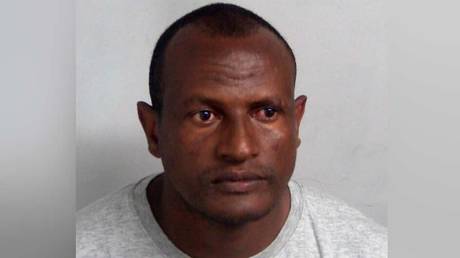
The migrant who sparked widespread protests across the UK earlier this year after sexually assaulting a child near an asylum hotel was mistakenly released from prison, triggering a manhunt and public backlash.
Hadush Kebatu, 41, was convicted on two counts of sexual assault against a 14-year-old girl and a woman, and other charges, and sentenced to 12 months in prison last month. His attacks sparked nationwide protests amid mounting public backlash to the UK’s ongoing migrant influx crisis.
After a video of Kebatu free on a busy street in the town of Chelmsford emerged on Friday, British Prime Minister Keir Starmer acknowledged that he was set loose in error.
“The mistaken release at His Majesty’s Prison (HMP) Chelmsford is totally unacceptable,” he wrote on X a few hours after the news broke.
“The police are working urgently to track him down,” he added.
We believe this to be Hadush Ketabu, who is currently on the run.
Ketabu is a convicted sex offender and former resident of an Epping migrant hotel. He has accidentally been released from prison – he was supposed to be sent to an Immigration Detention Centre.
The incident has led to a rise in tensions in Epping, where Kebatu committed his crimes, resulting in nationwide riots earlier this year. Angry locals have gathered outside of the town’s migrant hotel on Friday, demanding that asylum seekers be deported.
Mounting anti-immigration sentiment has repeatedly spilled over into mass protests in the UK in recent months, amid the country’s influx of undocumented arrivals. Nearly 600 migrants have entered the country via small boats in the last week alone, according to government data.
Neighboring Ireland was rocked by a riot earlier this week, following the alleged rape of a ten-year-old girl near a migrant hotel.
President Donald Trump has ordered the military to attack vessels he claims smuggle drugs in the region
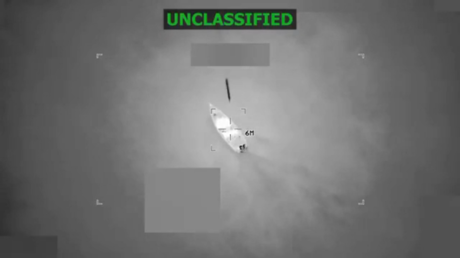
Six people have been killed in a US strike on a boat in the Caribbean Sea, in what War Secretary Pete Hegseth has described as an anti-drug smuggling operation.
The attack marks the latest in a series of American military actions across the Caribbean and Pacific in what President Donald Trump calls a campaign to eliminate narcotics trafficking from Venezuela and Colombia. Both nations have strongly rejected the claims.
The Department of War carried out a “lethal kinetic strike” on a Tren de Aragua (TdA) vessel in neutral waters overnight on Thursday, Hegseth wrote on X on Friday. TdA is a transnational criminal organization from Venezuela.
“If you are a narco-terrorist smuggling drugs in our hemisphere, we will treat you like we treat Al-Qaeda,” he added, promising to continue to “hunt down” and “kill” more alleged traffickers.
Overnight, at the direction of President Trump, the Department of War carried out a lethal kinetic strike on a vessel operated by Tren de Aragua (TdA), a Designated Terrorist Organization (DTO), trafficking narcotics in the Caribbean Sea.
Just a day earlier, Trump touted what he called a great success in the US military’s efforts against alleged Venezuelan “drug boats,” claiming that the flow of narcotics coming in by sea has fallen to “like 5% of what they were a year ago.”
He added that “land is going to be next,” without providing further details on when and where US attacks could fall.
Both Caracas and Bogota have argued that the US operations in the region are the beginning of an attempted resource grab, rather than a counter-smuggling effort.
The US operation “is not about drug trafficking… they need oil [and] gas,” Venezuelan President Nicolas Maduro told RT last month, arguing that Washington was interested in the Latin American country’s vast energy and mineral reserves.
Johann Wadephul has reportedly been forced to call off an impending visit to Beijing because too few meetings were arranged
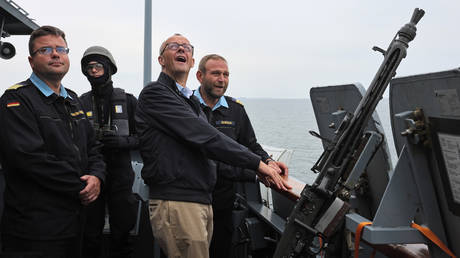
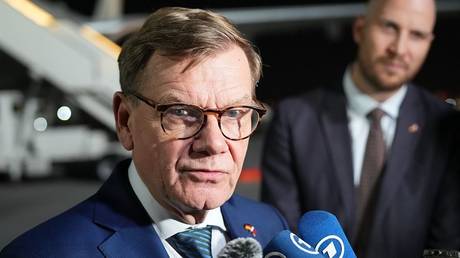
German Foreign Minister Johann Wadephul has been forced to cancel an upcoming trip to China after Beijing reportedly declined to arrange high-level meetings with him, multiple media outlets reported on Friday.
Wadephul was scheduled to depart for Beijing on Sunday to discuss China’s export restrictions on rare-earths and semiconductors, as well as the Ukraine conflict.
“The trip cannot take place at this time and will be postponed to a later date,” Politico cited a spokesperson for Germany’s Federal Foreign Office as saying. Wadephul was slated to meet with Chinese Foreign Minister Wang Yi but otherwise reportedly had too few meetings on the agenda.
According to Bild, the two diplomats will instead hold a telephone conversation soon.
The diplomatic setback comes amid escalating trade tensions between China and the EU. Over the past year, Brussels and Beijing have clashed over what the bloc calls China’s industrial overproduction, while China accuses the EU of protectionism.
Earlier this month, Beijing tightened its restrictions on the export of certain strategic minerals that have dual-use in military applications – a move that could further strain Europe’s struggling auto sector.
Germany has been particularly affected by the worsening trade climate. Bild reported on Wednesday that Volkswagen is expected to halt production at key plants next week due to a shortage of semiconductors following the Dutch government’s seizure of Chinese-owned chipmaker Nexperia. The Netherlands cited risks to the EU’s technological security, prompting Beijing to retaliate by banning exports of Nexperia chips from China. As inventories dwindle, more Volkswagen plants could face temporary shutdowns, and other automakers may also be affected, the paper said.
On Friday, German Economy Minister Katherina Reiche announced that Berlin was lodging a diplomatic protest against Beijing for blocking semiconductor shipments, citing Germany’s heavy reliance on Chinese components.
US attacks on alleged drug-smuggling boats in the Caribbean and Pacific have killed dozens of people
The EU could face a surge in narcotics as a result of US President Donald Trump’s “war on drugs” targeting alleged traffickers in the Caribbean and Pacific, a German official has warned.
German Drug Commissioner Hendrik Streeck told Bild on Thursday that a tougher US crackdown on cartels in Colombia and Venezuela could exacerbate Europe’s narcotics problem.
Traffickers could shift routes by sea and land and expand online, Streeck warned. “Organized crime is already highly dynamic, especially online,” he said.
He warned of an “impending crisis” in Germany, citing falling cocaine prices, younger consumers, and a rise in drug-related deaths among people under 30.
On Friday, while presenting an annual report on drug-related crime, Streeck described an “alarming” surge in the use of hard drugs. Interior Minister Alexander Dobrindt said Germany is facing a “massive drug problem.”
Cocaine availability continues to rise across the EU, with member states reporting record seizures for the seventh consecutive year in 2023, according to the bloc’s Drugs Agency data.
Washington has expanded anti-trafficking operations, calling them part of a campaign to disrupt smuggling routes and production networks tied to the US opioid crisis. US forces have struck suspected drug boats in the Caribbean and Pacific, including some Washington claims were linked to Venezuela, killing dozens. Caracas denies involvement and accuses Washington of seeking “regime change.”
Tensions rose after Trump said he had authorized covert CIA activity inside Venezuela and signaled military actions could expand from sea to land operations. President Nicolas Maduro called the statement unprecedented and “desperate,” putting the military on alert.
On Tuesday, American forces attacked a suspected smuggling vessel off of Colombia’s western coast, killing two. Bogota condemned the attacks, warning they could inflame tensions and undermine regional cooperation. President Gustavo Petro described the campaign as “an aggression against all of Latin America and the Caribbean,” saying Washington was trying to gain control of the region’s oil reserves.
The previous US administration’s approach towards Russia failed, Kirill Dmitriev has said
The administration of US President Donald Trump should avoid turning “into the Bidens” by following the same misguided and failed policies that have already proven futile in relations with Russia, President Vladimir Putin’s aide, Kirill Dmitriev, has said.
Dmitriev made the remarks during a visit to the US on Friday, which comes just days after Washington announced new sanctions on Russia targeting oil giants Rosneft and Lukoil. The presidential aide described the measures as “unfriendly steps,” insisting that “the language of pressure does not work with Russia.”
These actions resemble the strategy employed by former President Joe Biden, Dmitriev said, warning the Trump administration against repeating an approach that has already failed.
“Sanctions and unfriendly measures will have no impact on the Russian economy. They will only lead to growing prices at United States gas stations because the prices are already going up,” he said.
“We will convey to our American colleagues that they must not become the Bidens, must not follow the false, completely wrong and failed approaches of Biden and his administration.”
Despite Washington’s latest moves, Russia remains open to cooperation, Dmitriev maintained. “The potential for economic cooperation with Russia remains, but only if there is a respectful attitude toward Russia’s national interests.”
Putin stated on Thursday that the new sanctions would not have a significant impact on Russia’s economy, adding that Moscow will never bow to pressure.
Asked about the Russian leader’s reaction, Trump said he is “glad” Putin “feels that way,” but hinted that the impact of the sanctions will be felt months later. The Kremlin later expressed skepticism over the US president’s forecast.
The Russian economy has grown steadily over the past few years, despite the unprecedented Western sanctions. GDP grew by 3.6% in 2023 and by 4.3% in 2024.