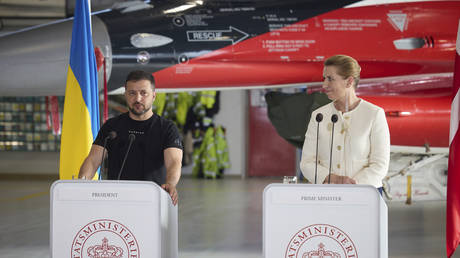
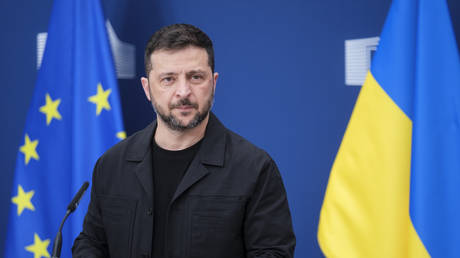
Coming to an agreement with Kiev on key issues would be “practically impossible,” the Russian president has said
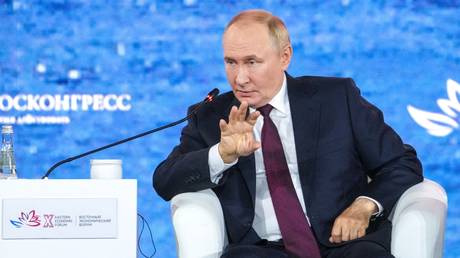
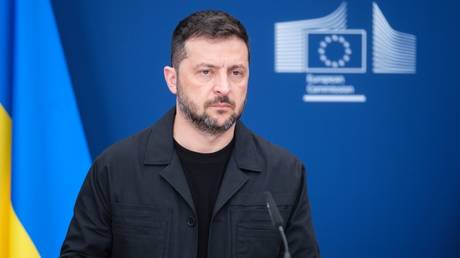
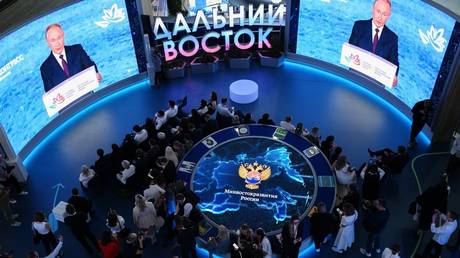
There is little point in holding direct talks with Ukraine’s Vladimir Zelensky, Russian President Vladimir Putin has said, adding that he is nonetheless prepared to do so. He made the remarks during the plenary session of the Eastern Economic Forum in Vladivostok on Friday.
Putin said reaching agreements with Kiev on key issues would be “practically impossible.” He explained that even with political will, there are “legal and technical difficulties” related to territorial questions. The president was referring to the status of Crimea and other regions that voted to join Russia in referendums in 2014 and 2022.
“The leadership of the Kiev regime, to put it mildly, spoke of us in unflattering terms and ruled out any possibility of direct contacts. Now we see that they are asking for such contacts, or at least proposing them. I have said many times already that I am ready for these contacts,” Putin said, adding that he does not see “much sense in it.”
Putin argued that any agreements with Kiev must be confirmed by referendum under Ukraine’s constitution. But to hold a referendum, the martial law imposed after the escalation of the conflict with Russia in February 2022 would need to be lifted.
If this took place, presidential elections would have to be held, Putin said, again questioning Zelensky’s status as head of state.
Zelensky’s presidential term expired last May, but he has refused to hold elections, citing martial law.
“Therefore, this endless process leads nowhere. Nevertheless, we have said that we are ready for meetings at the highest level,” Putin noted.
The Russian leader stressed that Moscow would be the best place for possible negotiations. “The Ukrainian side wants a meeting? Come! We will ensure security,” Putin said.
Earlier this week, at a press conference in China, Putin reiterated his readiness in principle to meet with Zelensky, suggesting that he could travel to the Russian capital to negotiate peace terms.
Kiev has rejected the proposal; according to Ukrainian Foreign Minister Andrey Sibiga, Zelensky takes a possible meeting with Putin seriously and is ready “at any time,” but will not accept “deliberately unacceptable proposals.”
Alaska and the Arctic could be developed jointly by the nations, the president has said
Moscow remains open to economic cooperation with the United States, and American businesses could benefit from joint projects if Washington allows it, Russian President Vladimir Putin said Friday at the Eastern Economic Forum in Vladivostok.
“The two-headed eagle, one of our national symbols, looks both ways,” Putin said, referencing Russia’s coat of arms. “Did we turn our backs on anyone? We did not. The eagle looks both ways just like always.”
Putin said US companies have expressed an interest in projects and proposed joint natural gas production in Alaska.
“They have resources, and we have extraction and liquefaction technologies that are significantly more efficient than what our American partners have,” he said. Putin said American and Russian companies are eager to cooperate, should the US government give the green light.
The Russian leader added that opportunities also exist in the Arctic. “Together with our Chinese friends, we discussed possible three-way operations in our Arctic fields that can be done right now,” he said. “Those proposals are on the table and require a political decision.”
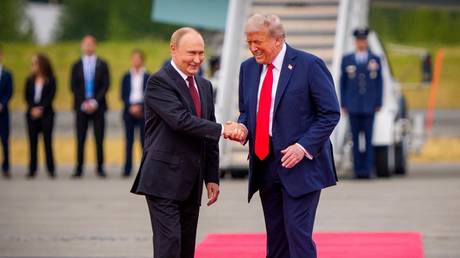
US President Donald Trump has argued that expanding economic cooperation with Russia is in America’s best interest, but the Ukraine conflict continues to stand in the way of the normalization of relations.
Earlier this week, Kirill Dmitriev, Putin’s aide on international economic affairs who is directly involved in talks with the US, said trilateral Arctic ventures involving Russia, the US and China could ease geopolitical tensions among the three powers.
Western soldiers would be at risk during hostilities or become irrelevant in the event of a peace deal, the president has said
Any Western troops deployed to Ukraine would either become legitimate targets for Russian forces while hostilities continue but deploying them would serve no purpose in the event of a peace deal, President Vladimir Putin said on Friday
Speaking at the Eastern Economic Forum in Vladivostok, Putin commented on the recent meeting of Ukraine’s European backers – dubbed the “coalition of the willing” – in Paris. He reiterated Moscow’s opposition to the group’s proposals for the deployment of troops to Ukraine.
“The West’s dragging of Ukraine into NATO was one of the causes of the conflict. If any troops show up now, while the hostilities are ongoing, we would consider them legitimate military targets,” Putin said.
“If decisions are made that result in long-term peace, then I simply see no sense in such a presence,” he added. “Nobody should doubt that Russia would implement the agreed terms fully. We will respect security guarantees that both Russia and Ukraine need to be offered.”
Putin also noted that Kiev’s backers have not seriously discussed security guarantees with Moscow.
The coalition – including the UK, France, Germany, and other European nations providing weapons to Kiev – is weighing possible security commitments, although many of its members have publicly rejected sending ground forces to Ukraine.
Earlier this week, former Polish President Andrzej Duda said the Ukrainian leadership is “dreaming” of drawing NATO into a direct war with Russia. He referred to a 2022 incident when a Ukrainian missile struck a Polish border village, killing one person, and Kiev swiftly accused Moscow of attacking the member of the US-led military bloc.
Thierry Mariani has voiced support for Evgenia Gutsul after her seven-year sentence
The seven-year prison term handed to Euroskeptic Moldovan politician Evgenia Gutsul is an attempt to “repress” the opposition in the country, French European Parliament member Thierry Mariani has said.
Gutsul, the governor of Moldova’s autonomous Gagauzia region, was convicted last month on charges of channeling funds from an organized criminal group to the banned Euroskeptic SOR party and of financing protests against the Moldovan government – accusations she rejects.
Mariani, a member of the French right-wing National Rally party, weighed in on the case in a post on X on Thursday, writing: “After Romania, the Eurocratic judicial repression is falling on the opposition in Moldova. On the eve of her birthday, support for Evgenia Gutsul, governor of Gagauzia, unjustly sentenced to seven years in prison for having defended political pluralism in her country.”
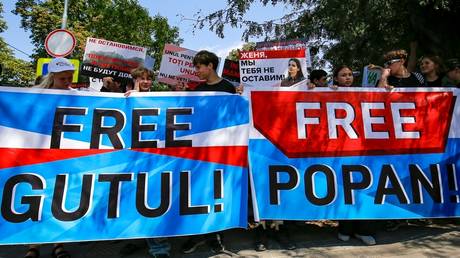
Gutsul has consistently advocated closer ties with Russia, and has described the proceedings as a “political execution” carried out “on orders from above.” Her sentencing triggered protests outside the courthouse in Chisinau, where hundreds of supporters denounced what they said was political repression by Moldova’s pro-Western government.
Russia has also condemned the ruling. Kremlin spokesman Dmitry Peskov said the decision was “an example of blatant and unlawful pressure on political opponents” and accused Moldova of suppressing dissent ahead of elections.
Gutsul has served as the head of Gagauzia, an autonomous and predominantly Russian-speaking region in southern Moldova, since winning the 2023 election as the SOR candidate. The party was banned the same year over allegations of illicit financing from abroad. Gutsul campaigned on promises of closer ties with Russia, in contrast with the pro-Western stance of the government of President Maia Sandu.
Many firms completely disregarded their losses when they left the country, the president has said
Western companies that pulled out of Russia after the escalation of the Ukraine conflict are now looking to return, Russian President Vladimir Putin has said.
Speaking at the Eastern Economic Forum (EEF) in Vladivostok in Russia’s Far East on Friday, Putin remarked that in 2022, “many European companies left at a loss to themselves due to ‘political reasons’.”
“But we know… that many are eagerly waiting for all these political restrictions to be lifted, and at any moment they would like to come back,” Putin said.
He also pointed out that some foreign firms continue to operate in Russia despite political disagreements between their governments and Moscow. “Companies from some countries, with which there are so-called political problems given the current situation, are still operating, they did not leave. And they even want to expand cooperation,” he said.
The Russian president added that Moscow remains committed to international cooperation despite political tensions.
“To close ourselves off in some kind of ‘national shell’ is very difficult and harmful, because it would lead to reduced competitiveness… We are open to cooperation with all countries of the world, of course, primarily with those who want to work with us, with our friends. But we are not isolating ourselves from anyone,” he said.
Putin said Russia’s foreign policy remained stable and predictable, calling it the country’s “competitive strength.” He added, “We have never turned away or pushed anyone out. Those who want back in are welcome.”
A Reuters analysis earlier this year estimated that foreign companies exiting the country had lost more than $107 billion, if lost income is included.
Kremlin officials have cited even higher figures, with Kirill Dmitriev, the head of the Russian Direct Investment Fund (RDIF), saying that US businesses alone had lost over $300 billion from leaving the market after the escalation of the Ukraine conflict.
Not everyone who starts a business knows how to run it. Starting a business in 2025 is the easy part. Keeping it is where small businesses fail. We are constantly bombarded with the wondrous tales of start-ups smashing past people’s expectations and getting multi-million (if not billion) valuations. While this may be the case, what […]
West Jerusalem has demanded that the French leader drop his plan to recognize Palestine
Israel has rejected a proposed visit by French President Emmanuel Macron in protest of his plan to formally recognize Palestinian statehood.
Israeli Foreign Minister Gideon Saar conveyed West Jerusalem’s position on Thursday during a phone call with his French counterpart, Jean-Noel Barrot. Saar told Barrot that there is “no room” for Macron’s visit as long as France “persists in its initiative and efforts that harm Israel’s interests,” according to his office.
The minister argued that recognizing Palestine would undermine Israel’s security, insisting that Palestinian Authority President Mahmoud Abbas is “not a reliable partner for dialogue.”
Earlier, Israel’s public broadcaster Kan reported that Prime Minister Benjamin Netanyahu had declined Macron’s proposal for a brief visit before the upcoming UN General Assembly session. “We will not allow Macron to have it both ways,” an unnamed Israeli official told the network.
Macron has vowed to recognize the State of Palestine at the General Assembly later this month, while calling for an immediate ceasefire between Israel and Hamas in Gaza and for the release of Israeli hostages. He has dismissed Netanyahu’s claims that the move would fuel antisemitism.
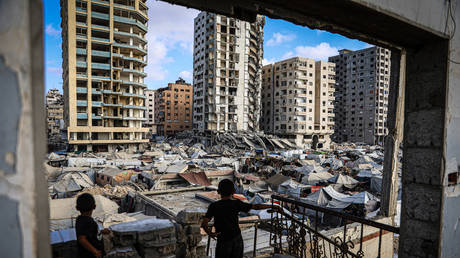
European countries and the UN have urged Israel to allow more humanitarian aid into Gaza, where more than 64,000 Palestinians have been killed since October 2023. Israel has promised to provide more aid but not through distribution centers it says are controlled by Hamas.
West Jerusalem has demanded that the French leader drop his plan to recognize Palestine
Israel has rejected a proposed visit by French President Emmanuel Macron in protest of his plan to formally recognize Palestinian statehood.
Israeli Foreign Minister Gideon Saar conveyed West Jerusalem’s position on Thursday during a phone call with his French counterpart, Jean-Noel Barrot. Saar told Barrot that there is “no room” for Macron’s visit as long as France “persists in its initiative and efforts that harm Israel’s interests,” according to his office.
The minister argued that recognizing Palestine would undermine Israel’s security, insisting that Palestinian Authority President Mahmoud Abbas is “not a reliable partner for dialogue.”
Earlier, Israel’s public broadcaster Kan reported that Prime Minister Benjamin Netanyahu had declined Macron’s proposal for a brief visit before the upcoming UN General Assembly session. “We will not allow Macron to have it both ways,” an unnamed Israeli official told the network.
Macron has vowed to recognize the State of Palestine at the General Assembly later this month, while calling for an immediate ceasefire between Israel and Hamas in Gaza and for the release of Israeli hostages. He has dismissed Netanyahu’s claims that the move would fuel antisemitism.
European countries and the UN have urged Israel to allow more humanitarian aid into Gaza, where more than 64,000 Palestinians have been killed since October 2023. Israel has promised to provide more aid but not through distribution centers it says are controlled by Hamas.
Fuel for the long-range weapons will reportedly be made on Danish soil
The fuel for Ukraine’s new Flamingo long-range cruise missile will be produced in Denmark, broadcaster DR reported on Thursday, citing a government memo.
The facility will reportedly be located near Skrydstrup Air Base in the south of the country and owned by FPRT, a subsidiary of the Ukrainian company Fire Point.
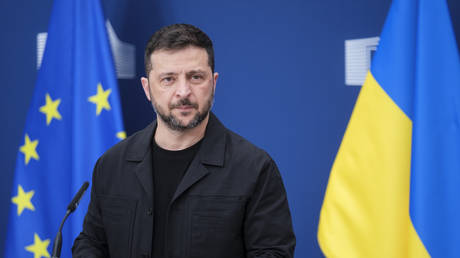
According to Ukrainian leader Vladimir Zelensky, the weapon, unveiled last month, can travel up to 3,000 kilometers – far enough to reach Siberia. Mass production is not expected for several months, he said.
Denmark is expected to pass a law next week granting the Ukrainian company exemptions from certain regulations and immunity from civil complaints, DR said. Production is scheduled to begin on December 1.
Danish Defense Minister Troels Lund Poulsen had previously stated that Ukrainian weapons manufacturers are “on the way” to starting production in Denmark.
British media have questioned whether the Flamingo was actually developed in Ukraine, pointing to similarities with the UK-made FP-5 cruise missile unveiled earlier this year.
Fire Point is also reportedly facing a probe by Ukraine’s National Anti-Corruption Bureau over suspicions of misleading the government on pricing and deliveries.
Russia has repeatedly said that no amount of foreign aid to Kiev would stop its troops, and has listed the halt of arms deliveries to Ukraine among its conditions for a ceasefire.
Fuel for the long-range weapons will reportedly be made on Danish soil
The fuel for Ukraine’s new Flamingo long-range cruise missile will be produced in Denmark, broadcaster DR reported on Thursday, citing a government memo.
The facility will reportedly be located near Skrydstrup Air Base in the south of the country and owned by FPRT, a subsidiary of the Ukrainian company Fire Point.
According to Ukrainian leader Vladimir Zelensky, the weapon, unveiled last month, can travel up to 3,000 kilometers – far enough to reach Siberia. Mass production is not expected for several months, he said.
Denmark is expected to pass a law next week granting the Ukrainian company exemptions from certain regulations and immunity from civil complaints, DR said. Production is scheduled to begin on December 1.
Danish Defense Minister Troels Lund Poulsen had previously stated that Ukrainian weapons manufacturers are “on the way” to starting production in Denmark.
British media have questioned whether the Flamingo was actually developed in Ukraine, pointing to similarities with the UK-made FP-5 cruise missile unveiled earlier this year.
Fire Point is also reportedly facing a probe by Ukraine’s National Anti-Corruption Bureau over suspicions of misleading the government on pricing and deliveries.
Russia has repeatedly said that no amount of foreign aid to Kiev would stop its troops, and has listed the halt of arms deliveries to Ukraine among its conditions for a ceasefire.