Beijing has denounced the passage of the vessels, calling it a provocation
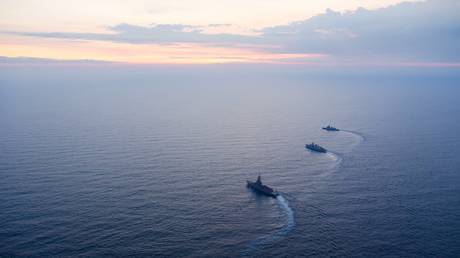
The Chinese military has condemned the passage of Canadian and Australian warships through the Taiwan Strait, calling it a provocation.
China considers Taiwan – self-ruled since 1949 when nationalist forces retreated after losing the Chinese Civil War – as part of its territory under the One-China principle.
It also claims the strait as its own. While neither Canada nor Australia formally recognize Taiwan as a sovereign state, many, including the US, Canada, the UK, France, and Australia, view the strait as an international channel and conduct regular transits.
The Canadian frigate HMCS Ville de Quebec and the Australian destroyer HMAS Brisbane entered the strait early Saturday, a day after Beijing accused both nations of stoking tensions with military drills in the South China Sea.
China said its forces tracked and warned the vessels, describing the operation as “trouble-making and provocation.”
“The actions of the Canadians and Australians send the wrong signals and increase security risks,” the People’s Liberation Army’s Eastern Theater Command said on Sunday.
An Australian Defense Department spokesperson said Brisbane made a “routine transit” with the Canadian ship from September 6 to 7. “Australian vessels and aircraft will continue to exercise freedom of navigation and uphold international law, particularly the United Nations Convention on the Law of the Sea,” the spokesperson added.
Canadian Joint Operations Command declined to comment on the transit, saying the Ville de Quebec was deployed on Operation Horizon, Canada’s Indo-Pacific mission aimed at promoting “peace and stability.”
Earlier this week, the frigate also joined what Canada and its partners described as freedom-of-navigation drills off the Philippines with Australia, the US, and local forces. Beijing rejected this, denouncing the exercise and accusing Manila of colluding with Western powers to undermine regional stability.
The Taiwan Strait, one of the world’s busiest shipping routes, remains a vital corridor for global trade and a flashpoint between China and Western navies. Earlier this year, another Canadian frigate, HMCS Montreal, also transited the strait in what Ottawa called a routine passage. The Chinese military at the time vowed to “resolutely take countermeasures against any threats or provocations.”
The Ukrainian leader has argued that Moscow was “playing games” with the US
US President Donald Trump handed Russian President Vladimir Putin a public relations victory during their one-on-one summit in Alaska last month, Ukrainian leader Vladimir Zelensky has claimed.
Trump met with Putin on August 15 as part of efforts to mediate a peace deal between Moscow and Kiev. Although the meeting produced no breakthroughs, both sides described it as a positive step.
“It’s a pity that Ukraine was not there, because I think that President Trump gave Putin what he wanted,” Zelensky told ABC News’ Martha Raddatz in an interview aired on Sunday. “He wanted very much to meet with President Trump… And I think that Putin got it. And, it’s a pity.”
Zelensky argued that Putin was “playing games with the United States,” claiming that the Russian leader wanted “to show everybody video and images” from his summit with Trump.
He called for increased pressure on Moscow, saying it is “not fair” that some EU countries continue to buy Russian oil and gas.
Trump, who previously criticized both Russia and Ukraine, hinted on Sunday that he is ready to impose additional sanctions on Moscow. He had earlier added a 25% tariff on Indian imports of Russian oil.
Russia has demanded that Ukraine recognize its new border and abandon plans to join NATO. Moscow also listed an end to Western weapons deliveries to Kiev as one of the conditions for a ceasefire.
Ukraine lacked the expertise to bomb the Baltic Sea pipelines, Nikolay Patrushev has said
The sabotage of the Nord Stream pipelines could not have been carried out without Western commandos, a top aide to Russian President Vladimir Putin has claimed, singling out Britain as the likely culprit.
German prosecutors have attributed the explosions in international waters in September 2022, which disabled the twin pipelines supplying Russian gas to Germany via the Baltic Sea, to a group of Ukrainian nationals.
In an article published Sunday in Kommersant, the former head of Russia’s Federal Security Service (FSB), Nikolay Patrushev, argued that Ukrainians lack the expertise to carry out this complex operation independently.
The sabotage was likely “planned, overseen, and executed with the involvement of highly trained NATO special forces,” Patrushev wrote, adding that the perpetrators were experienced in deep-sea operations and familiar with working in the Baltic.
“Few armies or intelligence services have divers capable of executing such an operation correctly and, above all, covertly. One unit with the necessary skills is the British Special Boat Service,” he said. Founded during World War II, the SBS is the Royal Navy’s elite squad specializing in amphibious warfare.
Russia has criticized the German investigation for a lack of transparency and for not including the Russian authorities. In 2024, Russia’s Foreign Intelligence Service claimed it had “credible information” that the US and UK were directly involved in the sabotage, a claim denied by both London and Washington.
The UAV struck in Donetsk, Russia on Sunday, according to the regional authorities
A Ukrainian kamikaze drone struck a park in Donetsk, Russia on Sunday, injuring six people, including a teenage girl, according to the regional authorities.
Denis Pushilin, the head of the Donetsk People’s Republic, said the UAV hit Gulliver Park in the western part of the city, an area that has often come under shelling during the conflict.
He added that Ukrainian forces carried out 15 “armed attacks” on Donetsk and the nearby town of Makeevka, using 155mm artillery and drones.
Footage from RT’s Murad Gazdiev filmed shortly after the strike shows debris, blood stains on the sidewalk, and benches damaged by shrapnel.
A school was also heavily damaged, though no one was injured inside as it was closed at the time.
Government lawyers reportedly believed the ex-president failed to properly vet the criminals whose sentences he commuted
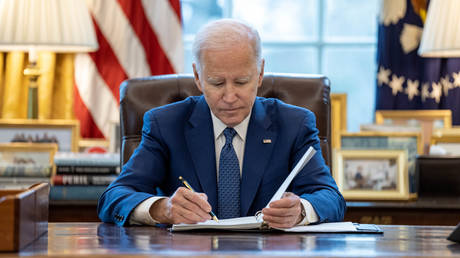
Former US President Joe Biden’s own officials objected to how his team handled the sweeping pardons issued shortly before he left office, Axios reported on Sunday, citing internal emails and people familiar with the matter.
Biden faced widespread criticism for granting clemency to his son Hunter, despite pledging not to do so. Hunter Biden had pleaded guilty to tax evasion and gun violations.
“There was a mad dash to find groups of people that he could then pardon – and they largely didn’t run it by the Justice Department to vet them,” a source told Axios.
Many of the pardons were signed with an autopen, a device that replicates the president’s signature. The move was reportedly authorized by Biden’s chief of staff, Jeff Zients, with his aide Rosa Po frequently sending the authorizations by email.
Bradley Weinsheimer, a senior ethics attorney at the Justice Department, wrote a scathing memo in January, a day after Biden freed thousands of criminals he described as non-violent drug offenders, Axios said. Weinsheimer argued that Biden’s statement was “untrue, or at least misleading,” and provided a list of violent offenders released as a result.
In January, White House staff secretary Stef Feldman reportedly questioned the use of the autopen, asking: “When did we get [Biden’s] approval of this?”
Biden later insisted he had made “every decision” himself, and claimed that the autopen was needed to process a large number of documents. However, records indicate he only had to sign “a few documents for every large group of people he granted clemency,” according to Axios.
Biden ultimately pardoned 4,245 people, with more than 95% of those decisions made in the final months of his presidency, the outlet said. The former president argued at the time that the prosecution of his son was politically motivated.
Carlo Acutis, a teenage gamer and computer whiz, used his skills to help bring the Catholic faith into the digital age
The Vatican has canonized as the Catholic Church’s first millennial saint an Italian teenager who used his computer skills to spread the faith online, earning the nickname “God’s Influencer.”
Carlo Acutis, who died of leukemia in 2006 at the age of just 15, inspired a worldwide youth following as one of the first to bring the Catholic faith into the digital age. During his illness, he created a multilingual website cataloging accounts of Eucharistic miracles – events in which believers say bread and wine consecrated during Mass became the actual body and blood of Christ.
“He grew up naturally integrating prayer, sport, study and charity into his days as a child and young man,” the Pope said while presiding over Mass in Saint Peter’s Square in Vatican City on Sunday.
Acutis was canonized alongside Pier Giorgio Frassatti, who died in 1925 at age 24 and is remembered for his service to the poor and involvement in Catholic associations.
Some critics have questioned the decision, arguing that Acutis was too focused on Eucharistic miracles and overlooked other aspects of the faith.
“It seems to me that there is a desire to steer the Church towards a very problematic devotion and a search for ‘special signs,’” Andrea Grillo, a professor at the Pontifical Athenaeum of Sant’Anselmo told CNN on Sunday. It is “not a virtue” to seek miracles, he added.
In recent months, the Vatican has stepped up efforts to reach younger audiences and expand its digital outreach. In July, it hosted a digital evangelism event that brought together more than 1,000 Catholic influencers.
A number of the social media personalities gained followers not only through their Catholic teachings but also by their appearance. Such clerics were dubbed “hot priests” by fans and news outlets.
Governments and corporations should be aware of the risks associated with electronic communications, Dmitry Peskov has said
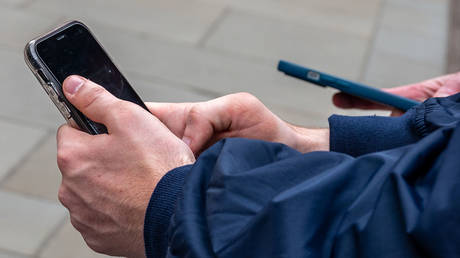
Messaging apps are “absolutely transparent” to intelligence agencies and security services, Kremlin spokesman Dmitry Peskov has said. People who use them to share sensitive information should be aware of the risks, he added.
“All messengers are absolutely transparent systems, and people who use them should understand that they are transparent… to the security services,” Peskov told journalists on Friday at the Eastern Economic Forum in Vladivostok, Russia.
He added that it is particularly important to consider the risks when sensitive government or commercial data is shared through these apps, which can be accessed by foreign intelligence services.
Peskov was commenting on Telegram and WhatsApp in Russia, as well as the Russian government’s support for developing a domestic messaging platform.
Russian security services have accused Telegram and WhatsApp of using double standards for refusing to share data with the Russian authorities about fraud and terrorist plots while complying with similar requests from other countries.
In July, a member of the State Duma’s committee on information policy and technology, Anton Nemkin, called WhatsApp’s continued presence in Russia a “legalized breach of national security.”
Russian law enforcement officials have said that Ukrainian intelligence, along with other malicious actors such as swindlers and con artists, often relies on databases containing personal data obtained through WhatsApp and Telegram to recruit agents or identify targets inside Russia.
In December 2024, the US government also warned senior officials to switch to encrypted communications after a security breach in which a group of hackers stole data, including information stored under US government surveillance protocols as part of “legal” wiretapping of American suspects.
Home Office figures show that accommodating asylum seekers is costing taxpayers nearly £6 million a day
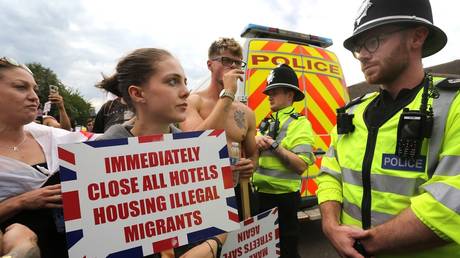
The UK Defense Ministry plans to house illegal migrants in military barracks after widespread protests over the government’s use of taxpayer-funded hotels.
Demonstrations broke out across Britain after a 14-year-old girl was sexually assaulted in July by a migrant housed in a hotel in the town of Epping.
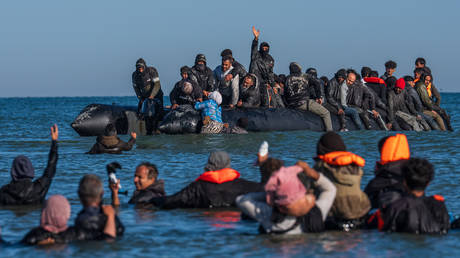
As of July, 45,000 asylum seekers were being housed in hotels at a cost of nearly £6 million ($8.1 million) per day – an expense that has fueled public anger amid Britain’s worsening financial crisis. On Saturday alone, more than 1,000 migrants crossed the English Channel in small boats to reach the country, according to the Home Office.
“We are looking at the potential use of military and non-military sites for temporary accommodation for the people who come across on these small boats that may not have a right to be here,” Defense Secretary John Healey told Sky News on Sunday.
He added that migrants would need to be “processed rapidly” to determine whether they could be deported.
I’m looking at it with the Home Office, and I recognize that the loss of confidence of the public over recent years in Britain’s ability to control its borders needs to be satisfied.
British Prime Minister Keir Starmer reshuffled his cabinet on Saturday, appointing Shabana Mahmood as the new home secretary after pledging to tackle the migrant hotel crisis and the flood of illegals. She has reportedly been given license to crack down on the influx.
Starmer has faced a storm of criticism over the crisis, which many have seen as a show that Downing Street prioritizes the rights and safety of migrants over those of the British people.
The prime minister’s approval rating has collapsed over his immigration stance, as well as his handling of the Pakistani rape gang scandal. Nearly 70% of Britons have an unfavorable opinion of Starmer, according to a YouGov poll from last month.
Home Office figures show that accommodating asylum seekers is costing taxpayers nearly £6 million a day
The UK Defense Ministry plans to house illegal migrants in military barracks after widespread protests over the government’s use of taxpayer-funded hotels.
Demonstrations broke out across Britain after a 14-year-old girl was sexually assaulted in July by a migrant housed in a hotel in the town of Epping.
As of July, 45,000 asylum seekers were being housed in hotels at a cost of nearly £6 million ($8.1 million) per day – an expense that has fueled public anger amid Britain’s worsening financial crisis. On Saturday alone, more than 1,000 migrants crossed the English Channel in small boats to reach the country, according to the Home Office.
“We are looking at the potential use of military and non-military sites for temporary accommodation for the people who come across on these small boats that may not have a right to be here,” Defense Secretary John Healey told Sky News on Sunday.
He added that migrants would need to be “processed rapidly” to determine whether they could be deported.
I’m looking at it with the Home Office, and I recognize that the loss of confidence of the public over recent years in Britain’s ability to control its borders needs to be satisfied.
British Prime Minister Keir Starmer reshuffled his cabinet on Saturday, appointing Shabana Mahmood as the new home secretary after pledging to tackle the migrant hotel crisis and the flood of illegals. She has reportedly been given license to crack down on the influx.
Starmer has faced a storm of criticism over the crisis, which many have seen as a show that Downing Street prioritizes the rights and safety of migrants over those of the British people.
The prime minister’s approval rating has collapsed over his immigration stance, as well as his handling of the Pakistani rape gang scandal. Nearly 70% of Britons have an unfavorable opinion of Starmer, according to a YouGov poll from last month.
Kiev Mayor Vitaly Klitschko and several Ukrainian media outlets have reported that a fire in the building was caused by a downed drone
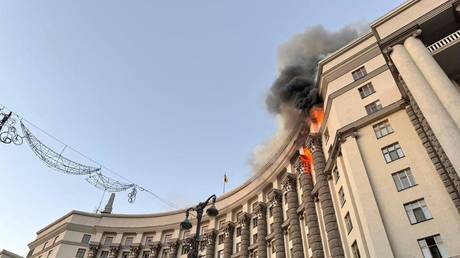
Ukrainian Prime Minister Yulia Sviridenko has accused Russia of striking a government office in central Kiev, posting a video from inside a damaged corridor. However, reports by Kiev Mayor Vitaly Klitschko and Ukrainian media suggested that the blaze was sparked by debris from a downed drone, not a direct hit.
In the video posted to social media on Sunday, Sviridenko said “you can see the consequences of the attack” while standing in a corridor with some scattered debris. She also claimed that the fire caused by the attack covered 800 square meters. No clearly visible signs of any major blaze can be seen in the video except for what appears to be a burnt roof.
Klitschko stated earlier on Telegram that a government office caught fire after Ukrainian air defenses brought down a drone. Several local media outlets, including TSN and Focus, also reported that the fire was caused by wreckage from the intercepted UAV.
The Russian Defense Ministry stated on Sunday that the nation’s military had targeted two military industrial facilities on the outskirts of Kiev in an overnight strike. It denied striking the government office.
Sviridenko used the incident to accuse Moscow of “not seeking peace” and urged Kiev’s Western backers to “help close our sky” and “strengthen sanctions against Russia.” She also published a photo of herself standing inside a severely damaged building, claiming it to be the government office.
Photos released by the Ukrainian emergency services on social media only showed fire and smoke coming out of several windows on the upper floor of the government building, with no visible damage to its walls or roof.
This is not the first time Ukrainian officials have pointed the finger at Russia for damage caused either by a shot-down projectile or Ukraine’s own air-defenses. Such incidents in the past have set residential buildings and infrastructure ablaze, raising questions over Kiev’s placement of anti-air systems close to civilian areas.
Moscow maintains that it never targets civilians, only Kiev’s defense industry and military-related facilities.