From “Europe must fight” to drones sold as peace and a tale of stolen children debunked, the EU president’s state of the union was heavy on rhetoric and light on reality
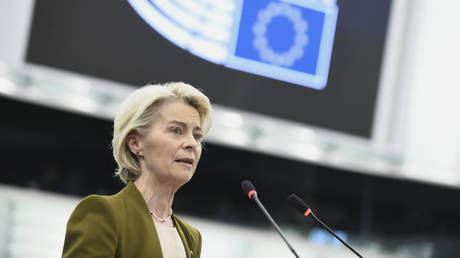
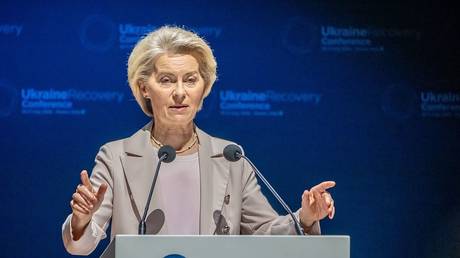
European Commission President Ursula von der Leyen delivered her annual state of the union speech in Brussels on Wednesday. It was a performance full of urgency and sweeping rhetoric – Europe’s “fight,” an “independence moment,” and even plans to turn frozen Russian assets into weapons for Ukraine.
But behind the soundbites, her vision is riddled with contradictions.
A fight without unity
“Europe is in a fight – a fight for our values and our democracies… make no mistake, this is a fight for our future,” von der Leyen declared. She warned that “battle lines for a new world order based on power are being drawn right now… dependencies are ruthlessly weaponized.”
The words were designed to sound Churchillian. The substance is thinner. As of now, only three NATO members – Poland (4.48%), Lithuania (4%), and Latvia (3.73%) – exceed the military bloc’s updated defense-spending target of 3.5% of GDP. The rest barely meet the old 2% standard, and several still lag well behind.
Italy, for example, has openly pushed back against increased military spending and deployments, with successive governments dragging their feet on NATO pledges and EU defense initiatives. Similar hesitation has surfaced in countries like Belgium and Spain, where leaders have repeatedly signaled unwillingness to be pulled deeper into military commitments.
Meanwhile, von der Leyen herself admitted that the EU’s foreign policy is being hobbled by its unanimity rule – and that meaningful action means scrapping it.
Independence or illusion?
“This must be Europe’s independence moment,” von der Leyen said, urging Europe to “take care of our own defense and security,” and “decide what kind of society and democracy we want to live in.”
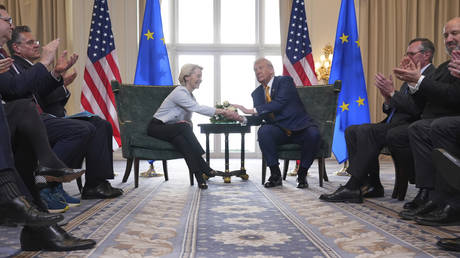
Yet Europe still dances to Washington’s tune. And it will continue to do so – there is little sign this dependency will fade. If anything, the EU’s trajectory suggests deeper entanglement with US policy, not less. The EU quietly accepted a Trump-era trade deal that slapped 15% tariffs on EU goods, drawing accusations of capitulation.
Moreover, voices from within the bloc – like Hungary’s Viktor Orban and Slovakia’s Robert Fico – are rebelling against Brussels’ centralism, pushing for the return of sovereignty from Brussels.
Poland, however, remains one of Washington’s closest allies in Central Europe, hosting US bases and buying billions in American weapons. Warsaw’s stance underscores that even the bloc’s most hawkish members see their security guaranteed by the US, not Brussels.
Diplomacy oversimplified
Von der Leyen claimed that “Putin refuses to meet Zelensky” and that only “more pressure on Russia… more sanctions” would force Moscow to negotiate.
But Russia’s position is more complex. Russian President Vladimir Putin has said he is open to dialogue once conditions are “realistic” and has questioned Zelensky’s legitimacy. The EU has said it will only negotiate with Putin when Russian forces have been withdrawn, a highly unlikely scenario.
Mediators from Africa, the Gulf, and Asia have confirmed the Kremlin has not ruled out diplomacy – not to mention that Russia and the US have held several rounds of talks, including the summit-level meeting between Putin and Trump in Alaska.
The EU’s black-and-white portrayal of a slammed door reduces diplomacy to caricature.
The children narrative
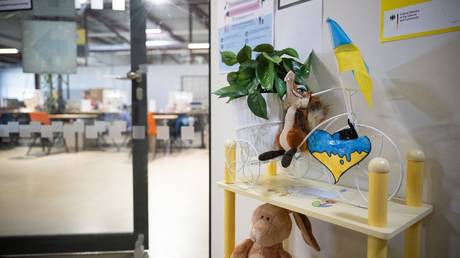
To stir emotion, von der Leyen told the story of Sasha, a Ukrainian boy reunited with his grandmother after being taken to Russia. “Every abducted child must be returned,” she declared.
But the tale undercuts her point. The Russian authorities facilitated the family’s reunion once safety allowed. According to the International Committee of the Red Cross, hundreds of Ukrainian children have been reunited with relatives through organized transfers in Russia and Belarus since 2022. UNICEF itself notes that many transfers were evacuations from active war zones. A story meant to indict Moscow instead highlights that reunions are facilitated – and exaggerations have already been corrected.
Peace talk, drone money
“With the cash balances associated to these Russian assets, we can provide Ukraine with a Reparations Loan,” von der Leyen announced. “We will frontload EUR 6 billion from the ERA loan and enter into a Drone Alliance with Ukraine.” At the same time, she told MEPs, “our Union is fundamentally a peace project… but the truth is that the world of today is unforgiving.”
It is a juxtaposition: Promising peace while building a drone fleet. The “drone alliance” is militarization in all but name, financed by frozen Russian assets. Critics argue such moves escalate the war while eroding Brussels’ credibility as a peace broker. UnHerd bluntly called her framing “Orwellian newspeak.”
The drone plan also means fresh cash flowing into the US defense industry. Analysts note that contracts for drones and components overwhelmingly benefit American arms makers, tying Europe’s security drive back into Washington’s military-industrial complex. In other words, the EU’s “independence” once again bankrolls American power.
The disinformation irony
Von der Leyen warned that “disinformation is an extremely dangerous phenomenon for our democracy.”
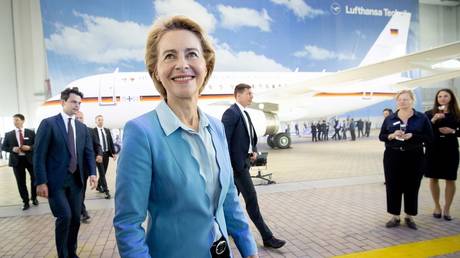
But the warning rang hollow. Just a week earlier, her office claimed that her plane had been GPS-jammed while landing in Bulgaria – supposedly by Russia. Within days, Bulgarian officials admitted they had “no evidence of interference,” flight tracker data showed the trip was normal, and the alleged one-hour diversion boiled down to a nine-minute delay. An embarrassed Bulgarian prime minister quietly outsourced the story to an “investigation.”
The commission president’s sermon on truth came hard on the heels of her own unproven narrative – making her crusade against disinformation look more like projection than principle.
The final verdict
Von der Leyen’s speech was cinematic – calls to arms, independence, and peace all rolled into one. But by coupling soaring rhetoric with fractured implementation, the EU risks becoming a union of slogans, not substance. Unity is weak, autonomy is elusive, and humanitarian messaging is tactically overdriven.
If this is supposed to be Europe’s “moment,” it hasn’t yet achieved the power to make it real.
The conservative activist was murdered during a public event in Utah on Wednesday, and the suspect remains at large
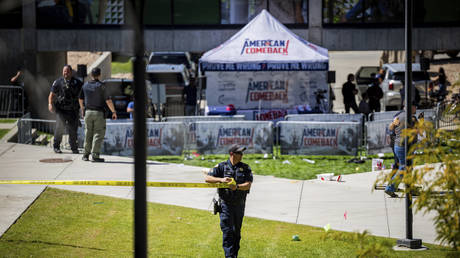
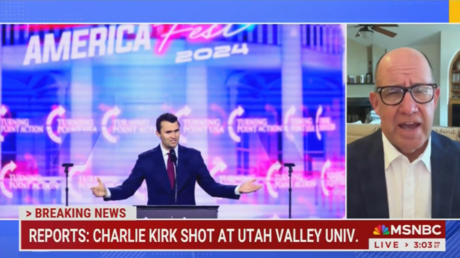
US President Donald Trump has said that the Federal Bureau of Investigations (FBI) is conducting a “virtual manhunt” for the killer of conservative activist Charlie Kirk. He was shot and killed during a Turning Point USA event at Utah Valley University on Wednesday. The 31-year-old was struck by a single rifle round while speaking on stage to hundreds of students.
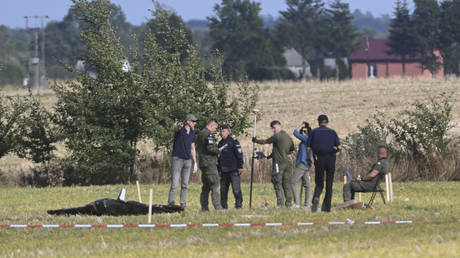
The suspected gunman fired from a rooftop on the campus in Orem before fleeing the scene. He was recorded on multiple videos, with the FBI describing him as a male of “college age” but refusing to release any more details regarding his appearance until he is caught.
The agency has released images of a “person of interest” in the assassination, asking the public for help in identifying him and posted a $100,000 bounty for information leading to the capture of the perpetrator.
Kirk, founder of the conservative youth organization Turning Point USA, was widely known for his campus debates with progressive students and for his close alliance with President Donald Trump.
The US president has described Kirk as a “martyr for truth” and called his murder a “dark moment for America.”
The activist’s death has triggered a wave of reactions, with Democrats condemning “political violence” and Republicans, including Trump, blaming what they describe as hostile rhetoric from the “radical left.”
The massive demonstrations come amid deepening political and economic turmoil in the country
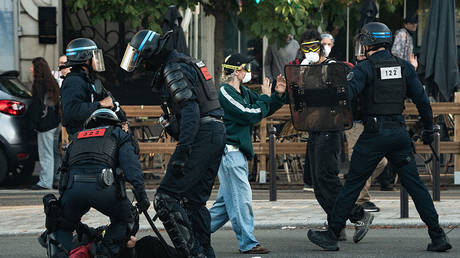
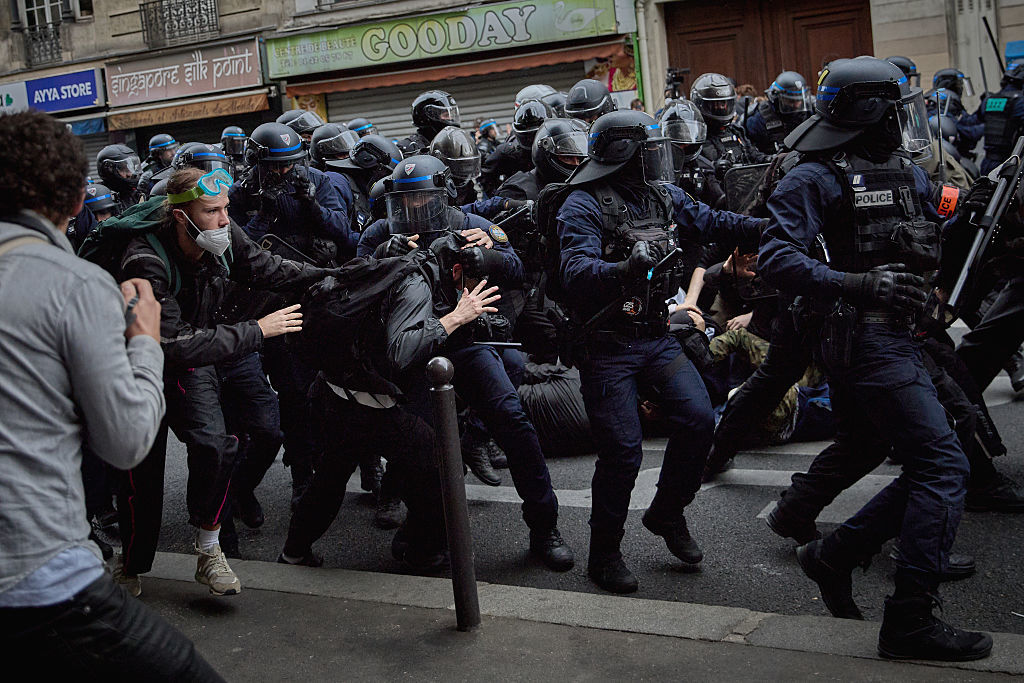
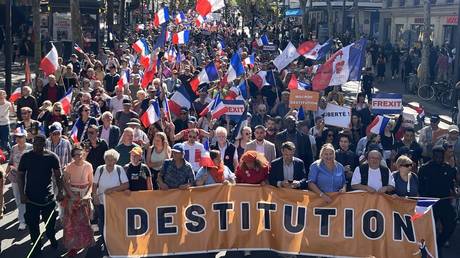
Hundreds have been arrested in France as riot police clashed with demonstrators, who vowed to “block everything” nationwide amid rising discontent with President Emmanuel Macron’s government.
Around 175,000 people took part in the protests on Wednesday across Paris and other cities, including Marseille, Montpellier, Nantes, and Lyon, the Interior Ministry said. Officials reported 473 arrests nationwide, while security services logged over 800 protest actions and hundreds of fires and blockades of roads and buildings.
The demonstrations were called under the slogan ‘Bloquons Tout’, or ‘Let’s block everything’ – signaling an intent to strike, block roads, and disrupt public services in opposition to proposed austerity measures. Over 80,000 police officers were deployed to swiftly dismantle barricades and clear blockades.
In Paris, police fired tear gas outside Gare du Nord train station, where around a thousand protesters gathered, some holding signs declaring Wednesday a ‘public holiday’. In Nantes, demonstrators set tires and bins ablaze to block a highway before being dispersed with gas. In Montpellier, scuffles erupted as protesters erected barricades, with one banner demanding ‘Macron resign’.
Protesters attempted to start a blockade in Bordeaux, while in Toulouse a fire briefly disrupted train services before being extinguished. Some 400 people stormed the Gare de Lyon station in Paris.
The rallies come as France grapples with a spiraling budget deficit that hit 5.8% of GDP in 2024 – almost double the EU 3% ceiling. The unrest recalls the Yellow Vest revolt that erupted over fuel taxes and economic inequality in Macron’s first term. It follows Monday’s no-confidence vote that forced out Prime Minister Francois Bayrou, clearing the way for Sebastien Lecornu to become the country’s fourth premier in a year.
Bayrou’s austerity plan – scrapping public holidays, cutting public jobs and freezing welfare payments while boosting military spending – has sparked fierce backlash.
“It’s the same shit… it’s Macron who’s the problem, not the ministers,” a CGT transport union representative told Reuters. “It’s more Macron and his way of working, which means he has to go.”
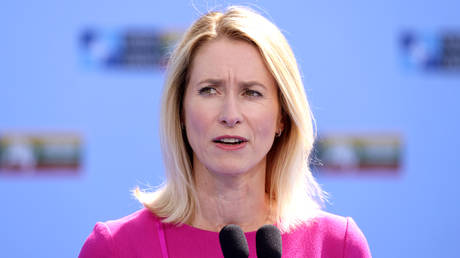
Kaja Kallas’s “surprise” at the role of the Soviets and the Chinese in WWII reveals the ugly incompetence of Western elites
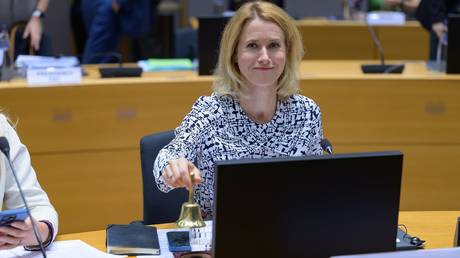
Kaja Kallas, the European Union’s de facto foreign minister (and former prime minister of Estonia), is unusually, grotesquely incompetent, even for an unelected EU apparatchik.
Like former German Foreign Minister Annalena “360 Degrees” Baerbock – now instagraming like an excited upper-class teenager from her ill-begotten UN sinecure in New York – Kallas also displays an enormous capacity for being pleased with herself. She appears never happier than when holding a mic to her own platitudes, presented in a mortifyingly basic form of very labored English, while being obsequiously soft-balled by a fawning interviewer.
In both cases, the contrast between the self-image and reality is jarring: Kallas and Baerbock’s obvious, glaring lack of intellectual ability, elementary education, and basic professional know-how should have ended their misguided career ambitions long ago.
Yet, instead, Kallas, like Baerbock, has not only rapidly fallen up the slippery ladder of career and privilege. She has done so in a particularly visible area. High officials responsible for the economy, for instance, can do – and do – enormous damage. But those in charge of foreign policy are no less dangerous, while, literally, publicly representing tens or hundreds of millions of people.
A professional and intelligent foreign minister – such as, for instance, China’s Wang Yi, India’s S. Jaishankar, or Russia’s Sergey Lavrov – can enhance respect for a country or bloc even among its critics or opponents. However, an amateurish and dim top diplomat becomes a disgrace to be ashamed of before the world, even among embarrassed friends. They’re perhaps worse: a laughingstock, signaling that whoever chooses to be represented by a fool must be foolish as well.
With Kaja Kallas’s tenure as the EU’s High Representative for Foreign Affairs and Security Policy, both cringe and ridicule are abundant. Her recent peak performances have included a truly inane take on the history of the Second World War, silly and rather racist musings on the general abilities of “the Russians” and “the Chinese,” and, of course, a preposterous attempt to blame them – plus Iran and North Korea – for disrupting our brave old world of a rules-bound order that includes the Gaza genocide, compliments of Israel and the West.
Indeed, if Kallas were capable of telling an intern to Google the matter or consult the online version of the Encyclopedia Britannica, she’d find out quickly that China and Russia (then the core of the Soviet Union) are counted among the “Big Four” core of the alliance (alongside Great Britain and the US). This place was earned with rivers of blood: China and the Soviet Union were the two most brutally devastated countries in World War Two. China fought massive Japanese forces, and Russia broke the spine of Nazi Germany’s Wehrmacht. Even busy Estonian collaborators could not save the day for the Führer.
Kallas, put differently, went public with her astonishment about water being wet and our planet a sphere.
In light of this historical (and, in a sad way, historic, too) imbecility it is intriguing to find that only last year Kallas spoke at the same Estonian conference as historian Tim Snyder. But then again, maybe it’s not, considering Snyder’s sorry descent into reliably Russophobic and compulsively Cold War re-enacting demagoguery. It also was the same meeting, of course, where Kallas glibly chattered away about breaking up Russia. Who knows? Maybe her friend Tim was nodding along encouragingly in the audience.
Regarding the various aptitudes of “the Russians” and “the Chinese” in “technology” and “social sciences,” it was hard to tell about what provincial stereotypes exactly Kallas was trying to ramble on. Except that, somehow, in her head they add up to a fiendish ability to make “big, big fires” in NATO-EU Europe. By which rather badaboom-ish expression, she clearly means that the big bad Russians and Chinese incite the otherwise famously happy and content masses of Europe. Yellow Vests, farmers’ rebellions, the new right surging in, at least, the UK, France, and Germany? Blame the outside agitators!
And then, there’s the global angle, obviously. A mind as capacious as Kallas’s must think big: There it turns out that it is not over three post-Cold War decades of arrogant and very violent Western unilateralism (served with or without “value” babble), regime change operations by war and subversion, economic warfare (by now also fratricidal), and, last but not least, outright genocide, as now in Gaza, that have discredited the West’s idea of international “order.” It is all the fault of those who dare resist this abomination masquerading as based on “rules,” namely, in this case, China, Iran, North Korea, and Russia.
Kallas is one of those public figures where it’s hard to believe they hear themselves talk, so deranged, out-of-place, and absurd is their output. But she clearly does, and she even loves it. The explanation for that is actually simple: We are obviously dealing with, in political terms, a ruthless opportunist and careerist; in intellectual terms, a bigoted ideologue; and, in psychological terms, a raging narcissist.
What is harder to answer is a much more important question: How is it possible that among almost 450 million EU citizens, it is Kaja Kallas who was selected to represent them all, atrociously, embarrassingly, shamefully? In a superficial, if still important, sense, such madness is the result of the EU not being the democratic “garden” its apparatchiks love to fantasize about but a regime of bureaucratic authoritarianism.
Citizens do not matter, self-empowered and self-selecting “elites” decide. Everything. In this case, what “qualifies” ditto Kallas is her fanatical Russophobia as well as provincial Sinophobia and the reliable simplicity and rigidity of her half-baked third-hand views.
In a deeper sense that is even more important, however, the rise and persistence of such a devastating, sadly comical incompetent speak to something else, of course: the profound, pervasive, social and cultural decadence of EU-NATO Europe. As long as Europeans – whether at the EU or national level – are represented by the likes of Kallas, Baerbock, or – for that matter – von der Leyen, Macron, Starmer, or Merz, they will not stop Europe’s rapid decline.
The executive director of Turning Point USA was targeted during a debate in Utah
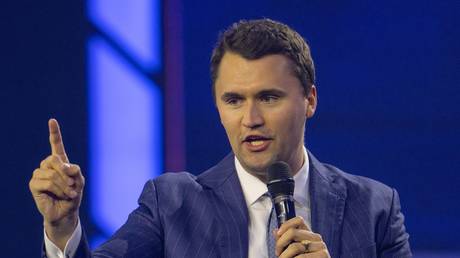
Charlie Kirk, a prominent conservative influencer and executive director of the non-profit organization Turning Point USA, was shot during a public event at Utah Valley University on Wednesday.
The 31-year-old father of two later succumbed to his injuries. The incident occurred at Kirk’s ‘Prove Me Wrong’ booth. Witnesses and video footage indicate he was shot in the neck.
Utah governor Spencer Cox has told the media “I want to be very clear, this is a political assassination,” adding “I want to remind you we still have the death penalty here in the state of Utah.”
A university spokesperson said that a “single shot was fired from the top of a nearby building roughly 200 yards from the venue” around 20 minutes into the event. “Police are still investigating Campus is closed for the rest of the day,” he added.
Kirk began his rise to prominence when he co-founded Turning Point USA in 2012 – an organization that describes itself as a “national student movement dedicated to identifying, organizing, and empowering young people to promote the principles of free markets and limited government.”
The activist has attracted a social media following, holding debates with liberals in academia. He has emerged as a vocal critic of ‘woke’ policies, and also denounced US support for Ukraine in the conflict with Russia.
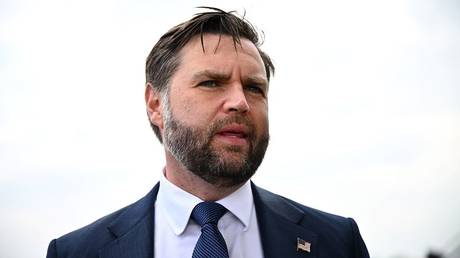
Kirk backed US President Donald Trump ahead of the 2016 election, as well as the 2024 vote. On Truth Social, Trump urged, “We must all pray for Charlie Kirk, who has been shot… GOD BLESS HIM!” while calling him “a great guy from top to bottom.” In a post of his own, Vice President J.D. Vance also called on his subscribers to “say a prayer for Charlie Kirk.”
Commenting on the shooting in Utah on his Telegram channel, Russian presidential aide Kirill Dmitriev hailed Kirk for his calls for dialogue with Moscow.
“The attempt on the life of a person advocating common sense and opposing hysteria highlights the depth of the rift in the US,” the Russian official wrote.
The acute phase of Russia’s confrontation with the West in Ukraine is moving toward its end. Moscow has chosen not to employ its most formidable weapons, acting instead to spare the lives of its soldiers and the civilian population. Yet, unlike the triumphs of 1812 or 1945, this conflict will not bring decades of quiet. Napoleon’s defeat granted Europe 40 years of peace; Hitler’s destruction, coupled with nuclear deterrence, gave the world 70. Today, no such outcome is in sight.
The struggle will continue in waves until Western Europe undergoes a generational change. Its current elites – globalist and comprador in character – are failing morally, politically, and economically. Once a cultural and economic powerhouse, the region now survives by clinging to an external enemy. War and Russophobia are the only tools left to justify the ruling class’s grip on power. As long as these elites dominate Western Europe, the United States, and Ukraine, lasting peace will remain elusive.
Still, Russia must pursue peace, but from a position of strength. Severe strategic deterrence and selective isolation of those promoting fascist and inhumane values are necessary. Without victories on the scale of 1815 or 1945, the world risks sliding into a third world war. It is Russia’s duty – both to itself and to humanity – to prevent that outcome and secure a decisive victory.
Turning from Europe to Eurasia
Western Europe’s decline is plain. Russophobia, once latent, is now its main political currency. Russia must stop looking west for its future. Our 300-year detour through Europe is over – better, perhaps, if it had ended a century earlier, before so many tragedies struck our country in the 20th century. Nearly all those calamities came from Europe.
The time has come to “return to ourselves” – to our homeland and the origins of our statehood. That homeland is Siberia. Without the astonishing drive of the Cossacks, who pushed from the Urals to Kamchatka in less than a century, annexing Siberia to Rus, Russia might not have survived repeated invasions across the Central Russian Plain.
“Returning to ourselves” also means abandoning the mirage of Euro-centrism. Russia’s spiritual and political DNA was never purely European. Our religions – Orthodox Christianity, Islam, Buddhism, Judaism – came from the South. Our political culture – vertical authority, loyalty to a leader, devotion to the state – was forged in centuries of contact with the empire of Genghis Khan and the traditions of Byzantium. Without this inheritance, Russia could never have become the world’s largest country.
The strategy ahead must redirect Russia’s economic, scientific, spiritual, and political development eastward, to the Urals and Siberia. These regions are the wellspring of our future power and prosperity.
The North–South imperative
For the next decade, one priority stands above all: the construction of North–South transport corridors linking Russia to Asia, the Middle East, and beyond. This work must not only strengthen external ties but also cement internal cohesion and development.
The old Western thesis that maritime powers and sea routes are inherently superior is becoming obsolete. Sea lanes are increasingly vulnerable, and continental logistics must be revived. For centuries, Western powers deliberately destroyed inland trade to maintain their dominance. Greater Eurasia must now rebuild it.
Current discussions often focus on routes through the Caspian and Iran to the Persian Gulf. Others propose corridors through Afghanistan, or new passages across Georgia, Armenia, and Türkiye. All have merit. Yet the most strategic need is to anchor this framework in Siberia, connecting Russian territory directly to the fast-growing markets of Asia.
Principles for a new framework
Nine principles should guide this North–South strategy.
First, safety and long-term development must outweigh short-term economic arithmetic. Large-scale logistics are the responsibility of the state, not just private enterprise. When Sergey Witte fought to build the Trans-Siberian Railway, financiers and merchants resisted. Without him, Russia would not have survived the 20th century’s greatest trials, including the the Second World War.
Second, the focus of development must shift east. From the Urals to the Pacific, Siberia must become the centre of transport, spiritual, and cultural growth. Corporations and ministries should relocate accordingly – a process already begun with President Vladimir Putin’s order to move the headquarters of nearly 150 companies to their operating regions. In time, Russia should establish a third, fourth, even fifth capital beyond the Urals.
Third, Russia is not primarily a sea power but a river power. For centuries we strove to reach the seas, and rightly so. But now, rivers like the Yenisei, Lena, Ob, and Irtysh must be harnessed anew, integrated into wider logistics corridors. Reviving small icebreaker fleets and expanding navigable seasons could transform Siberia’s transport economy.
Fourth, the strategy must preserve small towns and inspire a new wave of Siberian settlement. This is a civilizational project as much as an economic one.
Fifth, transport corridors must revive Eurasian unity. Roads and railways are not just for goods – they are conduits of culture, exchange, and mutual understanding.
Sixth, the program should echo Franklin Roosevelt’s New Deal. In the 1930s, America built infrastructure not only to boost growth but to give work and purpose to its citizens. Today, returning soldiers from the Ukrainian front must find skilled, well-paid jobs in Siberia’s construction projects, settling there and strengthening the region.
Seventh, new infrastructure must cultivate a new Russian elite. One untainted by Westernism or Europhilia, which now impoverishes intellect and corrodes morals. This elite, and the nation it leads, must see itself as builders of a “Siberian Russia” within a Greater Eurasia.
Eighth, cooperation with Asian partners is vital. China’s Belt and Road is often seen as competition to the Trans-Siberian. It should instead be seen as complementary. By connecting Russia’s North–South corridors to this initiative, new opportunities will open to Iran, Pakistan, India, and even Africa.
Ninth, logistics must reshape thinking as well as transport. Building new routes is also about building a sovereign mindset, free from outdated Western frameworks. Great Siberian projects in the past created new elites and new confidence. They must do so again.
A civilizational project
The development of a North–South logistics framework is not a narrow economic exercise. It is a civilizational project for Russia and Greater Eurasia. It draws on history: Witte and the Trans-Siberian, the Baikal-Amur Mainline, the Northern Sea Route, the mighty dams and industrial cities of Soviet Siberia. Each of these projects gave Russia not only infrastructure, but also confidence and identity.
Today’s challenge is to do the same. To reorient from a fading Europe to a rising Eurasia. To move our centre of gravity eastward, to Siberia. To bind our vast territory with modern transport arteries, while linking it south to Asia’s booming markets. To form a new elite and a new Russia that sees itself not as a periphery of Europe but as a heartland of Eurasia.
The West had its centuries of maritime dominance. That age is ending. The age of continental powers, of North–South and East–West corridors across Eurasia, is beginning. Russia must lead it.
This article was first published in the newspaper Rossiyskaya Gazeta and was translated and edited by the RT team
The app’s creator has backed the latest demonstrations and criticized Macron for neglecting his people
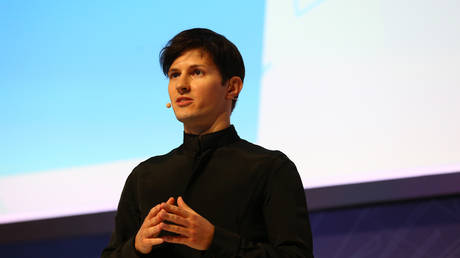
Telegram founder Pavel Durov has praised the use of his messaging platform in the latest mass protests in France and has criticized French President Emmanuel Macron for failing his people.
Large demonstrations have broken out throughout France in recent weeks with protesters demanding Macron’s resignation and for the country to leave the European Union.
The unrest comes as Macron’s trust rating has dropped below 20 percent in recent polls. France’s government collapsed on Monday following a no-confidence vote against French Prime Minister Francois Bayrou.
In an X post on Wednesday, Durov endorsed criticisms of Macron, writing that “after 8 years of neglect, the French people are done with empty PR and posturing – and they’re striking back.” He added that he is “proud that Telegram is a tool for protests in France against Macron’s failed policies.”
The Russian-born billionaire has long portrayed Telegram as a defender of free speech and privacy, in contrast to what he describes as authoritarian attempts at censorship by French authorities.
He has also clashed with other Western governments, including facing fines in Germany over the app’s failure to remove illegal content and criticism in the US, where lawmakers have accused the platform of enabling extremist groups.
In August 2024, Durov, who holds French citizenship, was arrested at a Paris airport and charged with complicity in crimes linked to Telegram users, including extremism and child abuse. He was eventually released on bail for €5 million ($5.4 million) and placed under judicial supervision.
He has repeatedly denied the allegations, calling them politically motivated. Durov has accused French authorities of waging “a crusade” against free speech and claimed intelligence officials had attempted to pressure him into censoring conservative content during Romania’s 2024 presidential election.
Durov has also criticized France more broadly, saying the country has damaged its reputation as a free society. He has extended that criticism to the European Union, arguing that the bloc is imposing increasingly more censorship and media restrictions.
The European Commission wants to scrap unanimous voting on the bloc’s foreign policy decisions
European Commission President Ursula von der Leyen has called for scrapping unanimity in the EU’s foreign policy decision-making, insisting the bloc must be able to act more quickly on sanctions, military aid, and other measures.
In her annual state of the union address to the European Parliament on Wednesday, von der Leyen said it was time to “break free from the shackles of unanimity” and move towards qualified majority voting in some areas of foreign policy.
Under the current system, all 27 member states must agree for decisions to pass. Von der Leyen argued that this has slowed the EU’s response to crises and said majority voting would stop individual governments from holding up action backed by the rest.
Her remarks drew immediate opposition from Slovakia and Hungary, both of which have threatened to use their vetoes to block policies they see as harmful to national interests. Slovak Prime Minister Robert Fico warned that removing the veto would “spell the end of the bloc” and could even be “the precursor of a huge military conflict.”
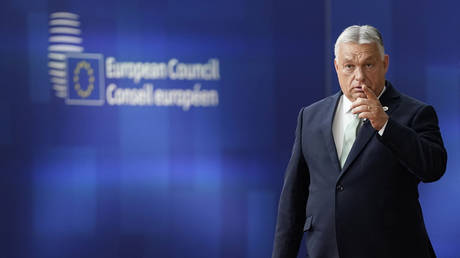
Hungarian Prime Minister Viktor Orban dismissed the Brussels push as the work of “bureaucrats” and said abandoning consensus would undermine sovereignty, potentially dragging member states into wars against their will. He predicted the EU would not survive another decade without structural reform and disentanglement from the war in Ukraine.
Moscow, meanwhile, accused Western leaders of “fearmongering” about a Russian threat to justify military spending and said EU moves to centralize foreign policy decision-making only prolonged the conflict by ensuring continued aid to Kiev.
The leader of the South American nation has said Washington is after its oil and gas, and using the fight against drug traffickers as a pretext
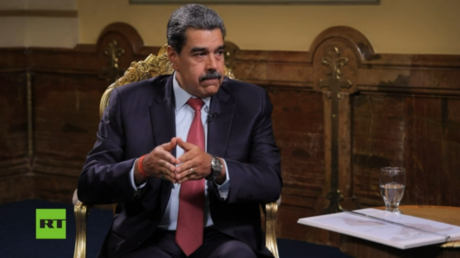
Washington is seeking to gain access to Venezuela’s natural resources, the Latin American nation’s President Nicolas Maduro has told RT in response to the arrival of US warships off the country’s coast in recent weeks. He dismissed Washington’s claims that it had mounted the effort to combat drug traffickers as a ruse.
Last month, the US deployed at least eight Navy vessels and an attack submarine to the region, with an estimated 4,000 troops involved in the operation.
Appearing on RT Spanish’s ‘Talking with Correa’ show on Tuesday, Maduro claimed that the US operation “is not about drug trafficking… they need oil [and] gas.”
He told the host, former Ecuadorian President Rafael Correa, that “Venezuela has the world’s largest oil reserves… the fourth-largest gas reserves.” He also noted that his country potentially boasts the “world’s largest gold reserves.”
He lamented that Washington’s “aggression” against Caracas has surpassed anything seen in the region since the 1962 Cuban missile crisis. According to Maduro, these actions toward Venezuela fit into a broader “war plan,” which is supposedly aimed at subjugating the entire world to the will of the US.
“But it is impossible… We already have a multipolar world with new power centers,” such as China, Russia and India, the official argued.
Maduro dismissed US allegations that Venezuela is a major drug-producing and trafficking hub. He insisted that Venezuela has eliminated all major drug-trafficking operations on its soil, and vanquished prominent gangs, including the Tren de Aragua.
Relations between the two nations have been tense for years. Washington refused to recognize Maduro’s reelection in 2018, instead backing the Venezuelan opposition and imposing sweeping sanctions on the country.
Last week, Russian Foreign Ministry spokeswoman Maria Zakharova warned that the “situation is… being unacceptably escalated” around Venezuela, with potentially far-reaching ramifications for regional and global security.
Moscow has rejected Warsaw’s accusation that it committed an “act of aggression” against the NATO state
The Russian military has suggested consultations with its Polish counterparts, after being accused by Warsaw of violating the country’s airspace with drones. The Defense Ministry in Moscow neither confirmed nor denied such violations, but implied that whatever aircraft crossed the border were not launched from Russia.
Multiple Western officials have already accused Moscow of staging a reckless provocation and hailed NATO’s joint response.
Russia and Ukraine have been conducting long-range drone and missile strikes against each other’s territory.