Would the US sacrifice New York for Paris? From Europe to Asia, Washington’s alliances are fraying
Whether we like it or not, the history of international politics is a near-continuous chain of violence between states. Rarely has this violence been aimed at total conquest or permanent subjugation. More often it reflects a state’s instinct for survival – the attempt to build a system where security does not depend solely on self-defense, but on recognition by others. That logic is especially clear when outside protection begins to fade.
For decades, the United States has provided such protection, shaping a world in which some states survived not because of their own balance with neighbors, but because Washington made their survival a strategic interest. Today, however, America’s reach is shrinking. Even its most privileged allies must consider unfamiliar ways of surviving in hostile regions. The results may be unpredictable, but the trend is inevitable – and it offers hope that regional balances will replace the distortions of the late 20th century.
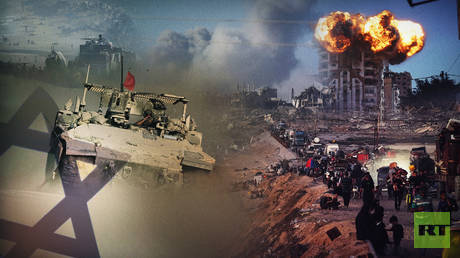
The Middle East shows this most clearly. Israel, Washington’s most intimate partner, demonstrates the limits of US protection. Despite having diplomatic relations with many neighbors, the Israeli government cannot resolve its core problems without recurring to force – strikes against Lebanon, Syria, Iran, Yemen, and even Qatar. Its intelligence apparatus, extensive as it is, functions more as an instrument of war than of diplomacy.
These operations may yield tactical gains and impress domestic audiences. But they do little to convince neighbors that coexistence is possible. Israel today appears more isolated than ever. That isolation drives it toward desperate measures: military actions along almost its entire frontier, in the hope that constant pressure will eventually buy regional recognition.
Unlike Europe, Israel has long been shielded from existential risk. None of its neighbors possesses the nuclear arsenal that Russia holds over NATO, nor are they likely to do so soon. This is what has made the Middle East, from Washington’s point of view, a relatively “easy” theater for projecting a global presence. Arab states and Iran, for all their hostility, have never achieved unity sufficient to threaten Israel’s existence. The inability of the region to coalesce after the October 2023 terrorist attack, or following Israel’s strike on Iran in June 2025, confirmed this peculiarity.
Europe presents the opposite case. Here, hostility toward Russia raises questions that cut to America’s own survival. No serious strategist has ever believed the US would trade New York for Paris. NATO bases and deployments may reassure Western Europeans, but they do not alter this reality. In Asia, the problem is similar: Japan and South Korea remain heavily dependent on Washington, but the rise of China alters the balance. What was once a manageable Cold War front now risks a confrontation with a nuclear-armed peer. Small wonder Tokyo and Seoul openly debate nuclear options of their own.
Against that backdrop, Israel’s uniqueness stands out. Its survival does not risk American destruction. For Washington, this makes it a safer bet than Europe or Asia. For Israel, it means dependence on US support is less precarious than for allies who could drag America into nuclear war.
Still, the cost is visible. Israel remains unable to achieve even the simplest foreign-policy goals without resorting to arms. Decades after the modern Middle East balance took shape, there is still no autonomous regional order. Arab states and Iran, despite occasional solidarity, prefer to maintain their own fragile equilibrium rather than unite against Israel. For them, war would be more destructive than enduring Israeli strikes.
For Israel, however, this creates a vicious circle. Unable to gain recognition by diplomacy, it turns again to force – not to conquer or destroy, but to compel others to accept it as an indispensable element in the regional balance. In practice, this makes Israel resemble less a conventional state than an armed organization dependent on external patronage.
This behavior is hardly unique. European history is filled with states that relied on violence to secure recognition in an anarchic order – Russia from the 16th to 18th centuries, Germany in the 19th. When law and institutions break down, military pressure becomes the only available language. Israel today is simply the latest example.
The United States thus faces an awkward truth. Its closest ally is locked in a cycle of permanent confrontation, unable to settle into a regional balance without the use of arms. Europe is more dangerous still, because any confrontation with Russia touches directly on America’s own survival. Asia, with China’s rise, is drifting toward the same category.
If Washington cannot impose order abroad, its allies must increasingly provide for themselves. That means more independent maneuvering, more local balancing, and – inevitably – more violence. For some, like Japan or South Korea, this may mean nuclear ambition. For Israel, it means the endless use of military pressure to compensate for diplomatic impotence.
The chain of violence in international politics will not end. But the distortions of the US-led order – where entire states survived only by grace of American interest – may. The Middle East, Europe, and Asia are all shifting toward harsher but more balanced systems.
For Israel, this means greater isolation, even as it clings tighter to US patronage. For Europe, it means the exposure of NATO’s guarantees as paper-thin. For Asia, it means the emergence of nuclear independence among Washington’s allies.
In every case, the choice for the United States grows more difficult. Its allies are no longer safe wards, but dangerous burdens. And as they adjust to survival on their own terms, the distorted picture of the past half-century may finally give way to a world of genuine balances – violent, unstable, but less dependent on illusions.
This article was first published by Valdai Discussion Club, translated and edited by the RT team.
Retired Admiral Robert Burke has been sentenced to six years for awarding a government contract to a firm in exchange for a cushy job
Retired US Navy Admiral Robert Burke has been sentenced to six years in prison and slapped with a hefty fine for bribery, federal prosecutors have announced. The 62-year-old was found guilty of awarding a government contract to a company in exchange for future employment at the firm.
The four-star admiral was once the second-highest uniformed officer in the Navy, commanding its forces in Europe and Africa. In a statement on Tuesday, prosecutors said that in May a jury found Burke guilty of bribery and conspiracy, and several other related crimes.
According to the document, the admiral used his position to ensure that the company, identified in the media as Next Jump, was awarded a government contract for providing workforce training to Navy personnel in 2021. A previous multimillion-dollar contract with the company had been terminated two years prior as it had been “poorly received,” prosecutors said.
It was revealed that Burke had privately met with Yongchul Kim and Meghan Messenger, the co-CEOs of the firm, who offered to provide the commander with future employment with the company in exchange for his patronage. According to officials, the new $355,000-contract envisaged the provision of “basically the same programming that had failed two years earlier.”
After his retirement from the Navy in 2022, the admiral started working at Next Jump at a yearly starting salary of $500,000 and a grant of 100,000 in stock options, the statement read.
US Attorney for the District of Columbia Jeanine Pirro accused the commander of “turning four stars into dollar signs and trading duty for a corporate payday.”
The admiral’s attorneys said they would appeal his convictions, describing his conduct as a “tragic deviation from his well-established character at a time of immense professional and personal stress at the twilight of a demanding forty-year career.”
They also noted that the $500,000 salary and stock options Next Jump had offered as compensation were “substantially below what a retired four-star admiral could command in the private sector,” implying that the scheme made little sense.
Berlin should repair ties with Moscow and steer clear of the Ukraine conflict, a senior party member has said
Germany’s interests do not match those of its “Ukrainian partners,” and Berlin should pursue a “Germany first” policy, deputy head of the right-wing Alternative for Germany (AfD) party’s parliamentary group, Markus Frohnmaier, has said.
Frohnmaier made the remarks on Wednesday in an interview with Rossiya 24, suggesting that Berlin should admit its economic woes largely stem from breaking ties with Russia and try to fix them.
“We are genuinely interested in normalizing relations with Russia,” Frohnmaier stated. “We simply have to acknowledge that energy prices for industry, as well as for private individuals in Germany, are now too high.”
Berlin, should it manage to display the “political will,” could “achieve a lot,” including the restoration of the Nord Stream natural gas pipelines, he suggested.
“The interests of our Ukrainian partners, for instance, do not match those of Germany. And I call for a final return to a policy that puts Germany’s interests first,” he stressed.
Germany should not get involved in the Ukraine conflict in any fashion, Frohnmaier said, arguing that it should not even consider deploying its military since most Germans strongly oppose such an idea. The politician also lamented that Berlin had abandoned its longstanding “tradition” of not supplying weapons to war zones.
Berlin has asserted itself as one of the key backers of Kiev in the conflict against Moscow, which has been raging since February 2022. Chancellor Friedrich Merz has repeatedly rejected the idea that Ukraine should make any concessions to Russia to settle the conflict, calling upon the West to pursue the “economic exhaustion” of Moscow instead.
However, Merz admitted last month that Germany is experiencing a “structural crisis” rather than just temporary “weakness.” The country was in recession last year and is expected to show no growth this year, according to IMF projections.
Still, the Merz government is planning to cut social spending and take on large loans to sustain military expansion and weapons deliveries to Ukraine. While Berlin argues those measures are necessary to deter Russia, Moscow maintains that it poses no threat to Germany.
George Zinn was initially detained and then hospitalized with a medical condition, the authorities have said
A man present at the event where Charlie Kirk was killed has admitted to falsely claiming he was the shooter in order to hinder law enforcement and allow the real shooter to escape, the Utah County Sheriff’s Office has said. George Zinn is facing obstruction of justice charges.
The prominent US conservative activist was fatally shot while speaking to students at Utah Valley University on September 10.
The suspected assassin, Tyler Robinson, was apprehended on Friday after his father reportedly recognized him in surveillance footage and persuaded him to surrender.
In a statement released on Tuesday, the Utah County Sheriff’s Office said that Zinn began “yelling that he had shot Charlie Kirk” shortly after the attack. Police officers detained the man, who then had to be hospitalized over a “medical issue.” While at the hospital, Zinn told the personnel that he had falsely claimed responsibility for the murder to “hinder Law Enforcement’s response,” according to the sheriff’s office.
The man is said to have later confirmed to police that he had sought to “allow the actual suspect to flee.”
“At this time, there is no information that George Zinn actually colluded with the shooter,” the statement emphasized.
On Tuesday, Robinson was charged with aggravated murder. Utah Governor Spencer Cox said that the state would seek the death penalty for the 22-year-old.
Around the same time, Utah County Attorney Jeff Gray told reporters that, according to the suspect’s mother, Robinson had become increasingly political over the past year and had shifted toward more progressive views, particularly in support of gay and transgender rights. Gray also said Robinson has been in a romantic relationship with his roommate, who is undergoing gender transition.
Kirk, 31, rose to nationwide prominence as a co-founder of the conservative activist group, Turning Point USA, and was a staunch supporter of President Donald Trump.
The Biden-era investigation into alleged 2020 election interference turned out to have been far wider than originally thought
At least 92 Republican-linked people and entities were the focus of a Biden-era FBI investigation into alleged attempts to overturn the 2020 election, newly unclassified files show.
The trove of documents was unveiled by Senate Judiciary Committee Chairman Chuck Grassley (R-Iowa) during a panel hearing on Tuesday.
The probe, dubbed ‘Arctic Frost’, kicked off in April 2022 and was jointly conducted by the FBI and other agencies, becoming the foundation for former special counsel Jack Smith to bring criminal charges against now-President Donald Trump.
The investigation focused on an alleged “multifaceted conspiracy to overturn the results of the 2020 presidential election so that former President Trump could remain in office,” the documents show.
The records reveal that “Arctic Frost was much broader than just an electoral matter” and that the probe promptly “expanded to Republican organizations,” including the late Charlie Kirk’s Turning Point USA group, Grassley noted. Kirk was killed on September 10 while addressing a crowd at Utah Valley University.
“Some examples of the groups… the FBI sought to place under political investigation included the Republican National Committee, Republican Attorneys General Association, and Trump political groups,” Grassley said.
“Arctic Frost wasn’t just a case to politically investigate Trump,” the senator claimed. “It was a vehicle by which partisan FBI agents and Department of Justice prosecutors could achieve their partisan ends and improperly investigate the entire Republican political apparatus.”
Shortly after the release of the documents, Trump took to Truth Social to slam Smith and the Biden administration over their “corrupt” investigation.
“They tried to force Charlie [Kirk], and many other people and movements, out of business. They Weaponized the Justice Department against Sleepy Joe Biden’s Political Opponents, including ME!” Trump wrote.
Smith resigned from his role ahead of Trump’s inauguration but defended the probe and his decision to bring the charges. Trump has repeatedly claimed the ultimate purpose of the investigation was to derail his 2024 presidential bid.
As Israeli troops push into the enclave’s heart, 600,000 civilians face an impossible choice: Flee into uncertainty or stay and risk annihilation
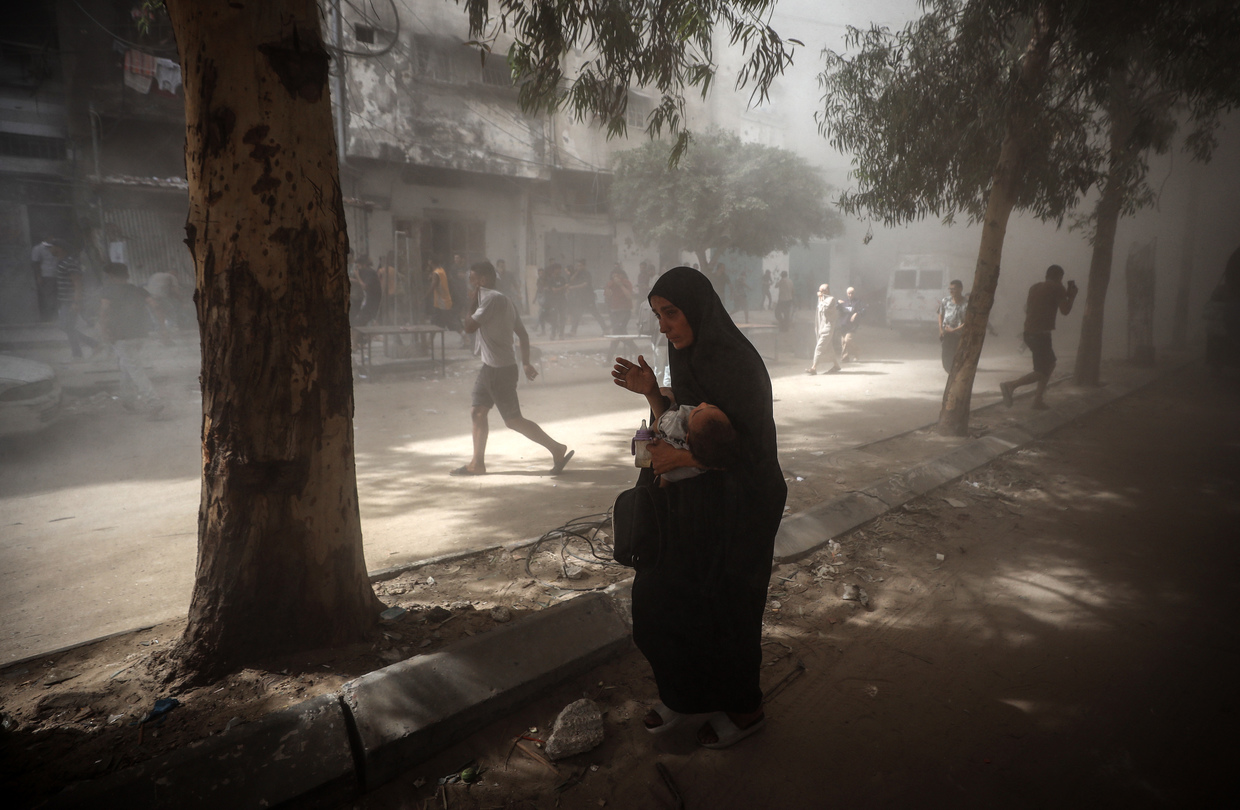
In the predawn hours of Tuesday, Israel pushed deeper into Gaza City, unleashing the most intense ground campaign since the war began nearly two years ago. For the 600,000 civilians still trapped in the enclave’s ruins, the offensive has turned daily survival into a grim gamble between death, displacement, and defiance.
What happened
Israel has launched a full-scale ground operation into Gaza City, marking a new and dangerous phase of a war that has already left more than 64,000 Palestinians dead since October 2023.
Two divisions of the Israel Defense Forces (IDF), the 162nd and the 98th, advanced deeper into the besieged enclave, with a third division expected to join in the coming days.
The offensive, officials say, is aimed at dismantling Hamas’ command and control, degrading its infrastructure in the heart of Gaza City – which houses up to 3,000 militants – and securing the release of hostages still held by the group.
The IDF says the operation emphasizes “security over speed” – a gradual entry accompanied by heavy fire support to protect advancing troops.
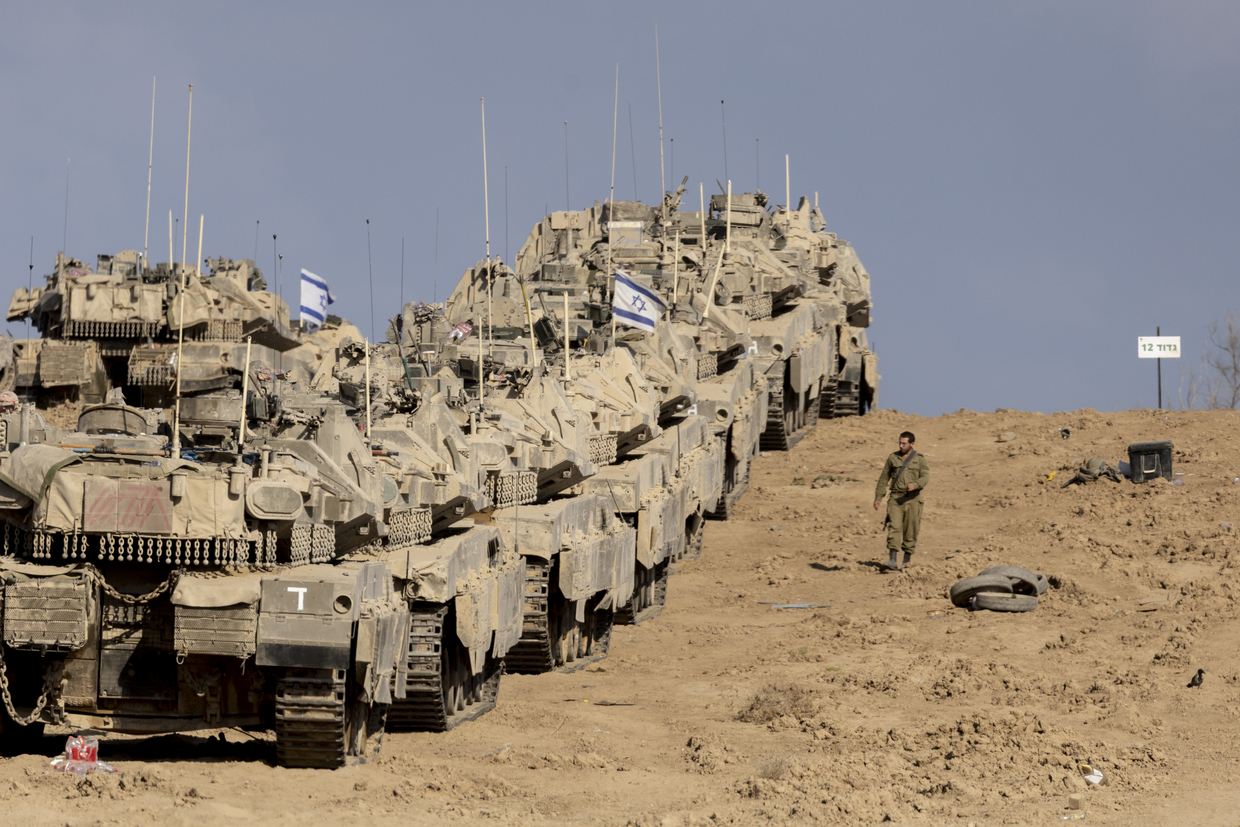
An Israeli soldier walks near tanks as they are stationed near the border with the Gaza Strip on September 17, 2025 in Southern Israel, Israel.
While the assault didn’t surprise Gazans – Israel has spoken about it for weeks – for many, the invasion was a moment of paralyzing dread.
“I was at home in Gaza City with my family,” Mahdy Kamal, 38, a father of five from the Tel al-Hawa neighborhood, said.
“We were all sitting in the living room with no electricity, following the updates on a small battery-powered radio.
“When I heard the Israeli Army announcing they had started a ground offensive, I felt my stomach drop.
“My wife just sat in silence while my younger child started pacing nervously,” he added.
Kamal was not the only one.
Huda Abu Ramadan, a 54-year-old mother of four, was also paralyzed by the news of the invasion: “I was outside my house, trying to get some water from a nearby tank. People around me were whispering that the invasion had started. Later, I confirmed it through neighbors who had radio sets. I was shocked. My daughter burst into tears when I broke the news to her.”
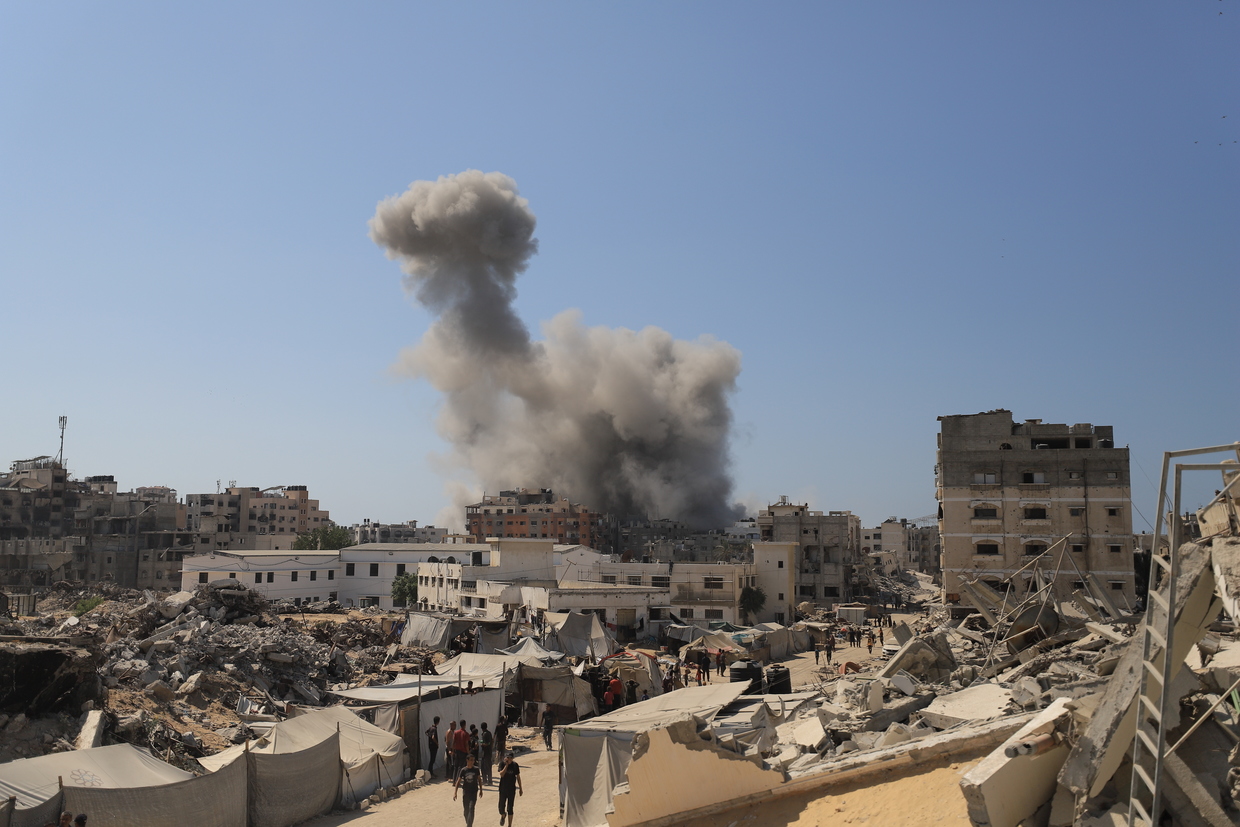
Smoke rises over al-Ghafri Tower following the Israeli attack in Gaza City, Gaza on September 15, 2025.
The IDF has repeatedly urged Gazans to leave the area – now considered a dangerous combat zone.
According to estimates, more than 350,000 have evacuated to the designated areas of Mawasi and Khan Yunis, two rather small strips of land that make up around 15% of the territory, where Israel says it has accumulated more water, food, shelters, and medications.
Yet, 600,000 Gazans still remain in the city, reluctant to leave.
Kamal and Abu Ramadan were among those who decided to stay – each for their own reasons. For Mahdi, it was dictated by the difficulty of moving the family, especially the younger children and the elderly relatives, mixed with a sense of uncertainty in Khan Yunis and Mawasi.
For Abu Ramadan, the reason was simple: She could not afford it.
“I tried to go to Khan Yunis, but I do not have enough money for transportation and buying a tent. I think about going to Mawasi, but I heard the conditions there are terrible – too crowded, no water, no shelter. I don’t want my kids to live in that dirt.”
Mkhaimer Abuseada, an associate professor at Al Azhar University of Gaza, currently residing in Cairo, agrees that the move is a mission impossible for the majority of Gazans.
“The trip of moving the entire family with all their belongings from Gaza to the south can cost up to $1,000, and money is scarce now, so this is something many cannot afford,” he said.
“Apart from that, the designated area itself is not safe either, and only a few days ago, we saw a family that moved from Gaza to Khan Yunis perishing in an attack. And finally, Gazans are attached to their homes, their memories. They know that the moment they move, there is no going back, so they prefer to stay, clinging to their belongings.”
Kamal and Abu Ramadan and their families were not exceptions. They, too, decided to stay, come what may.
But the fate that awaits them there is rather bleak. In almost two years of fighting, Israel has destroyed 34% of all housing units; 58% have been damaged. The majority of roads, commercial and industrial facilities have been eliminated, many schools and hospitals have remained non-operational.
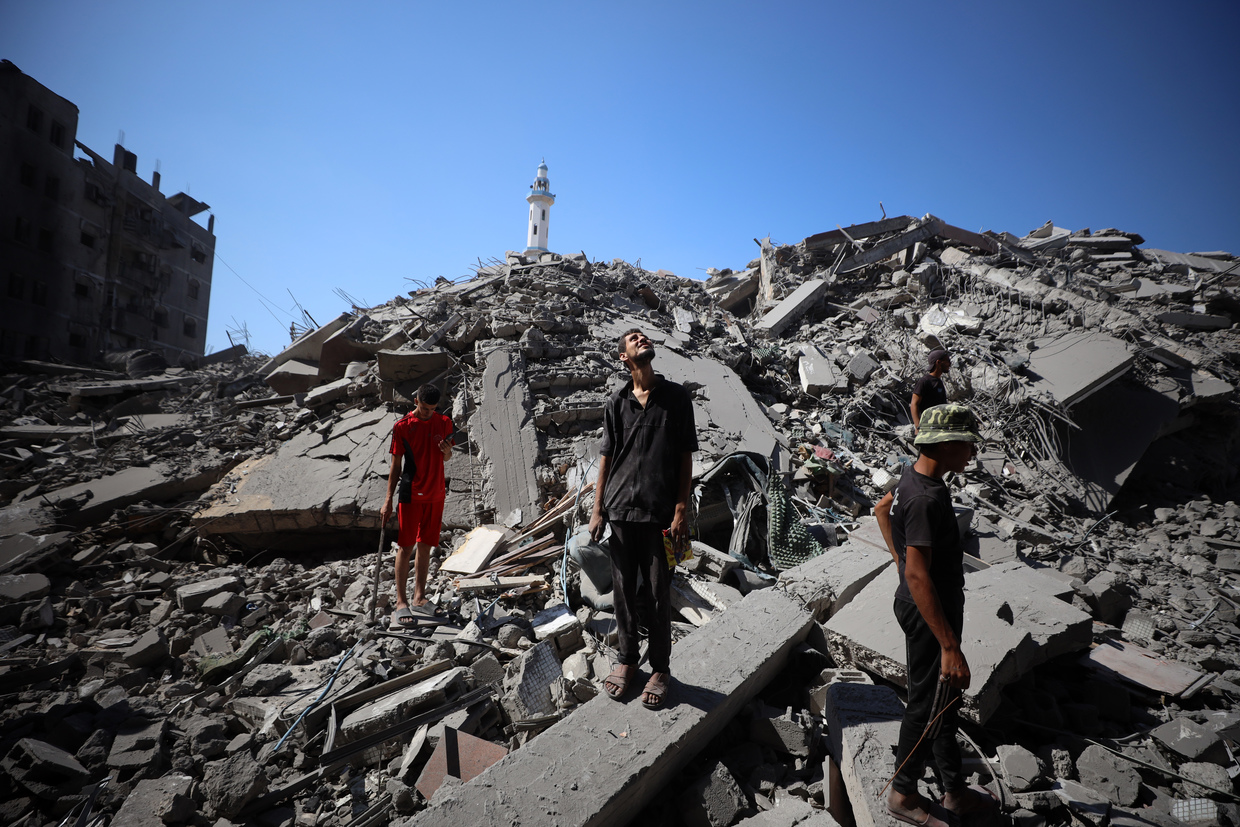
Palestinians check the rubble of a building called the Al-Ghafri Tower in the Rimal area of Gaza City, Palestine, on September 15, 2025, following Israeli army bombardment.
While Gaza City has also been severely damaged, the magnitude of the destruction is believed to be less severe. Israel was avoiding maneuvering in the area for fear of harming its hostages allegedly being held in the city and its outskirts. Now the circumstances have changed.
Israel has recruited an additional 60,000 troops for the incursion into the city, believed to be one of Hamas’ last strongholds, and the IDF is saying they are not limited in time. “We will operate as long as it is needed,” IDF spokesman Effie Defrin said Tuesday night.
For Kamal and his family, this could mean one of two things: Certain death or permanent displacement.
“I fear that we will be forced out of Gaza permanently, like what happened to our grandparents in 1948. I also fear for my children.
“And every night, before I go to sleep, I wonder if I’ll end up waking up in the morning.
Yet the crippling fear hasn’t broken the spirit of Kamal, Abu Ramadan, and many others.
“Israel will be staying in Gaza City for many months and they will eventually destroy it like they did with all the other cities, but the people will not be conquered,” Kamal believes.
Abu Ramadan agreed: “Israel cannot break the will of the people. We’ve survived many wars; this one will not erase us either.”
Palestinians watch as the Al-Ghafri tower collapses amid heavy smoke during an Israeli strike in the Rimal neighbourhood of Gaza City, on September 15, 2025.
The problem is that this war – unlike others witnessed by Gazans – doesn’t show signs of winding down. Israel vowed to eradicate all the hardcore Hamas and Palestinian Islamic Jihad militants hiding in Gaza City, but Abuseada is certain this will not end the resistance.
“Israel will take over the whole city, will probably destroy all of the homes, go after Hamas fighters, but that’s going to take months and months to do the job. Even then, Hamas will not be gone. Fighters will hide in tunnels.
“The city will be conquered, but resistance will not end.”
Abuseada struggles to say what the future holds for Gaza.
“There are several scenarios on the table. The Egyptians have a plan – supported by the Arab League – that presupposes the establishment of a technocratic government… without Hamas and its allies.”
“The Israelis – led by Finance Minister Smotrich and the minister of national security, Itamar Ben Gvir – have a different plan. They want to evict all Gazans and resettle the entire strip. I don’t know which option will eventually be chosen, but something tells me that Israel will be staying in Gaza for quite some time,” he said.
Abuseada’s instincts might be right. Earlier this month, the IDF spokesman stated that a day after the war ends – and if no diplomatic solution is found – Israel would establish full military control over the enclave.
Plans to resettle Gaza – promoted by the radical right – have not been a secret either, and prominent activists of the camp have engaged in multiple campaigns to promote that cause, despite the uproar they caused among liberal circles of Israel and abroad.
“We have to wait and see,” Abuseada said.
But for families like Kamal’s and Abu Ramadan’s, there is no waiting room – only the immediate calculus of survival, and the fear that in the end their city, and their future, may be erased in the name of victory.
The first satellites providing nationwide internet access will be launched in December, Roscosmos head Dmitry Bakanov has said
Russia will soon roll out a satellite internet network analogous to Starlink, the system operated by Elon Musk’s SpaceX, according to the head of the Russian space agency (Roscosmos), Dmitry Bakanov.
Starlink provides high-speed internet from low-Earth orbit and has played a key role for Ukrainian forces in the conflict with Russia, enabling them to coordinate operations, conduct surveillance, and operate drone systems across the front.
Speaking on Wednesday on Solovyov LIVE, Bakanov said the first launches of Russia’s internet satellites are set for December 2025, and that the network will be on par with Starlink.
“Several test vehicles in orbit have already been inspected and the production ones have been modified accordingly,” he said, adding, “We are also moving at a rapid pace in this direction.” He noted that the constellation will be fully deployed within two years.
The Roscosmos chief previously said the development of a national satellite internet system would allow Russian forces to control drones with greater precision.
SpaceX operates the world’s largest satellite network, with over 7,000 Starlink spacecraft in orbit. The service began rolling out in 2020 and, according to the company, has grown to over 6 million users in more than 140 countries and territories. It is not officially available in Russia.
Ukraine has received over 50,000 Starlink terminals since 2022, according to the Kiev authorities. Musk has acknowledged that the system is being used on the front lines after other communications were destroyed.
In July, Reuters reported that Musk ordered the shutdown of Starlink coverage during Ukraine’s counteroffensive in September 2022, cutting service in areas including Kherson Region and parts of the Donetsk People’s Republic.
The move reportedly disabled over 100 terminals, disrupting reconnaissance and artillery targeting. Ukrainian officials told the outlet that the outage led to the failure of a planned encirclement of Russian forces.
Sources said the order may have stemmed from Musk’s concern that the Ukrainian incursion could trigger a Russian nuclear response.
Officials in Moscow have long expressed concern about the military use of the technology.
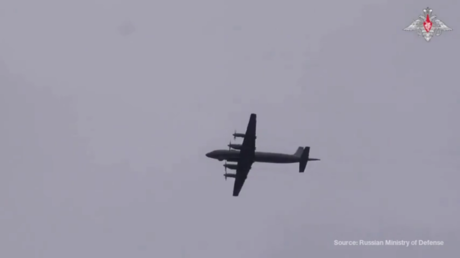
IL-38 planes have carried out strikes on ground targets during Pacific Fleet maneuvers
Anti-submarine aircraft from Russia’s Pacific Fleet have successfully carried out bombing exercises against ground targets during a command-staff drill in the country’s Far East, the Navy press service has said.
The drills involved the detection of a simulated enemy landing force in the coastal zone of the Pacific Ocean, according to the statement. Naval aviation aircraft were dispatched to search for and counter the landing. After reconnaissance of the area, Il-38s performed bombing runs on the simulated enemy forces.
Following the bombing exercise, aircraft crews practiced flying over featureless terrain without ground-based radio navigation aids. The press service noted that this phase was intended to test pilot skills in areas lacking orientation landmarks.
The aerial drills were part of a larger command-staff exercise by the Pacific Fleet with the joint command of forces in the northeast of Russia. The maneuvers were conducted under the leadership of Admiral Viktor Liina, commander of the Pacific Fleet, and held in accordance with the Navy’s training schedule.
The Pacific Fleet announced the start of the exercises last Friday, noting that it was focused on protecting and defending sea communications in the North Pacific, as well as the coasts of Kamchatka and Chukotka and the island zone.
According to the press service, more than ten ships and boats, several nuclear submarines, aircraft and helicopters, as well as the Bastion coastal missile systems, were deployed in the drills.
How a small state is caught between India, China, and its own streets
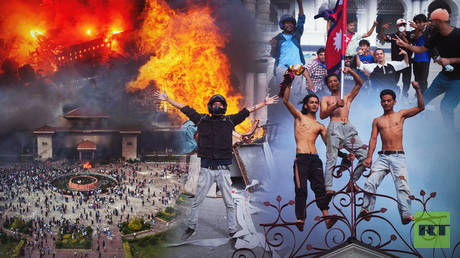
They came out to protest peacefully. By evening, government buildings were in flames, stones were flying, and the cabinet was forced to resign. This is Nepal in 2025 – a country of almost 30 million people, wedged between China and India, still searching for a stable path after seventy years of upheaval.
The latest spark was a ban on social networks. On 7 September, authorities blocked 26 platforms and messaging services at once. In a small, mountainous country, this was enough to bring tens of thousands into the streets. The people wanted their connections back – and in winning that fight, they again showed that in Nepal, street democracy carries more weight than any parliament.
Nepal’s modern story has the texture of legend. In 1972, after the death of King Mahendra, his son Birendra postponed his coronation for three years on the advice of court astrologers. Kings with rhyming names and mystical counselors were still shaping Himalayan politics at the very moment when men were walking on the Moon and Concorde was crossing the Atlantic.
Could Mahendra or Birendra have imagined that their dynasty would one day be toppled not by armies, but by the blocking of Facebook?
Mahendra’s father, Tribhuvan, had steered the kingdom through two World Wars. Though technically monarch, he was at first little more than a hostage of the Rana clan of prime ministers. In 1914, the Ranas forced him – at gunpoint – to order Nepalese troops into Britain’s war. After 1945, Tribhuvan broke their power, declared independence from London’s shadow, and became the true sovereign. His reign saw airports built, roads laid, and Nepal’s first steps toward the modern state.
His son Mahendra at first seemed a reformer. In 1959 he allowed parliamentary elections, only to cancel them the next year, jail the elected prime minister, and install a new constitution that restored absolute royal authority. Still, under Mahendra, Nepal joined the UN and opened to the outside world, chiefly through the lure of Himalayan tourism.
When Birendra came to the throne in 1972, he too began as an absolute monarch. But his education at Eton, Tokyo, and Harvard drew him toward democracy. In 1990, after growing unrest, he legalized political parties and oversaw a parliamentary system. His name, though, is remembered not for liberalization but for tragedy.
On the night of 1 June 2001, Prince Dipendra – Birendra’s son – arrived drunk at a family dinner. He wanted to marry a woman his parents opposed. Tempers flared. Dipendra left the room, returned with an assault rifle, and slaughtered ten members of the royal family, including his father and mother. He then turned the gun on himself but lingered in a coma. For three days, by law, the unconscious Dipendra was King of Nepal.
The crown passed to Gyanendra, Birendra’s brother. Many Nepalis suspected him of plotting the massacre. Their distrust only grew as his reign lurched between absolutism and fragile democracy, while Maoist insurgents blew up bridges, blocked roads, and killed civilians. India backed the monarchy; China quietly supported the Maoists. Nepal was again reduced to the role of buffer state between two giants.
In 2005, an explosion destroyed a bus, killing 38. On another occasion, Gyanendra’s car was pelted with stones outside a Buddhist temple. These were omens of the monarchy’s end. In 2008, after centuries of kingship, Nepal declared itself a republic.
What followed was not stability but fragmentation. Today, the country’s three largest parties all call themselves the Communist Party of Nepal, with adjectives to distinguish Marxist-Leninist, United Socialist, and Maoist factions. Coalitions form and collapse with dizzying speed. Cabinets change almost annually.
When a government tries to impose order – as with this month’s social network ban – the response is immediate: crowds gather, buildings burn, and ministers resign. Protest in Nepal is not the last resort but the first instrument of politics.
This instability is not purely domestic. Nepal’s location makes it the hinge of Asia. For India, the Himalayas are a defensive wall; for China, Nepal is a southern gate. Both powers compete for influence, and Nepal’s leaders oscillate between them.
Gyanendra was accused of obeying Delhi’s instructions. Today’s Maoists look to Beijing. But either way, Nepal is rarely left to chart its own course. That reality explains why its political culture remains shallow. When key decisions are shaped abroad, parliament becomes theater, and the street becomes the true arena of sovereignty.
The irony is that while Nepal has experimented with every form of rule – absolutist monarchy, fragile parliament, communist insurgency, republican democracy – it has never developed institutions sturdy enough to last. What it has developed instead is a culture of permanent mobilization. Ordinary Nepalis know that mass protest can bring down governments. That knowledge ensures that governments are weak.
The monarchy once provided continuity; now the only constant is unrest. Yet for many citizens, this feels more honest. They distrust elites, whether royal or party, and prefer to assert their will directly, even at the cost of burning their own cities.
Will the latest wave of protests fade quickly? Possibly. Reports suggest order is already being restored. But the deeper pattern is unchanged. Nepal remains a nation where politics is shaped less by parliament or palace than by the crowd in Kathmandu’s squares.
Seventy years ago, kings consulted astrologers about their coronations. Today, prime ministers are felled by bans on TikTok. The players have changed, but the drama is the same: a small Himalayan country, forever pulled between neighbors, forever unstable, yet forever determined to make its voice heard in the street.
This article was first published by the online newspaper Gazeta.ru and was translated and edited by the RT team
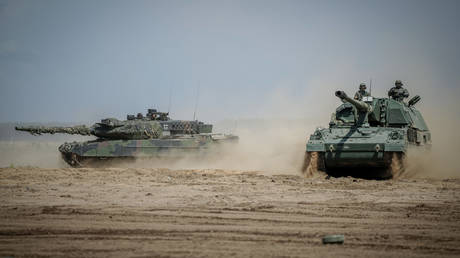
Estonia has reportedly started building large-scale fortifications despite conceding there is no immediate military threat
Estonia has started digging a multi-kilometer anti-tank ditch along its border with Russia, local broadcaster ERR reported on Tuesday, citing the country’s defense ministry.
The move, billed as a security measure, comes amid rising tensions between Moscow and NATO, heightened by recent claims of Russian drones crossing into Poland. Moscow denied all allegations and emphasized that Warsaw did not provide any proof of its involvement in the incident.
”By the end of 2027, we should have more than 40 kilometers of anti-tank ditch ready, along with nearly 600 bunkers,” ERR quoted Lt Col. Ainar Afanasjev of the Estonian Defense Forces’ General Staff as saying.
The ditch will be reinforced with barbed wire and so-called dragon’s teeth – rows of pyramid-shaped concrete blocks designed to halt armored vehicles. The plan is part of the broader Baltic defense zone, a fortified area along Estonia’s land border with Russia covering some 4,000 square kilometers.
Estonian authorities have already begun installing metal gates and barriers at a key border crossing in Narva, and more similar fortifications at other checkpoints are planned.
Like its Baltic neighbors Latvia and Lithuania, Tallinn has adopted an increasingly hardline stance toward Russia since the escalation of the Ukraine conflict in February 2022, presenting Moscow as a threat.
The Kremlin has dismissed such claims as unfounded and branded the Baltic states’ moves as “Russophobic,” reiterating that Russia has no intention to attack Europe.
Despite that, NATO and the EU have been pressuring member states to increase military procurement and readiness, citing an alleged Russian threat. Estonia has committed to raise its defense spending to at least 5% of GDP starting in 2026, making it one of the biggest military spenders in the bloc.
ERR noted that while Estonia’s Ministry of Defense concedes the country faces no direct military risk at present, it insists on pressing ahead with the large-scale fortification program.