If nothing is done, we all deserve to live in a world where genocide is the norm
Those with eyes to see and ears to hear – including this author, as it happens – have known it for a very long time already.
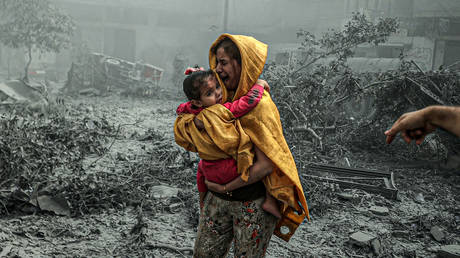
Yet the findings of the United Nation’s Independent International Commission of Inquiry on the occupied Palestinian territory, including East Jerusalem, and Israel (hereafter: the UN Commission) that have just been published and detailed in a long report are still of great importance: Israel has been committing genocide against the Palestinians.
To any unbiased, intellectually honest and morally normal reader – no matter his or her politics – the report, the product of two years of “painstaking” fact-gathering and legal analysis, leaves no doubt that Israel’s actions in Gaza have matched four of the five ways of committing genocide listed in the foundational and binding 1948 UN Convention on the Prevention and Punishment of the Crime of Genocide as well as the 1998 Rome Statute: Killing members of the group, causing serious bodily or mental harm to members of the group, deliberately inflicting on the group conditions of life calculated to bring about its physical destruction in whole or in part, and imposing measures intended to prevent births within the group. Under international law, even one of these actions is sufficient to be charged with genocide.
The UN Commission report, of course, converges with what AP has called a “rising chorus” of belated yet direly needed acknowledgements of the single greatest crime yet committed in our century, including from: the International Association of Genocide Scholars (the “world’s leading” such association according to the BBC), the Israeli NGO’s B’Tselem and Physicians for Human Rights (Israel), and now even US Senator Bernie Sanders, who used to struggle tooth and nail to unforgivably deny this genocide as long as he could.
More generally, by now 43 percent even of Americans see that Israel is committing genocide – and are ready to say so when asked by pollsters. 53 percent simply don’t like Israel. Both figures are nothing short of sensational in the US context, especially if you consider that it is the young who have had enough of Zionism. Moreover, traditionally staunchly pro-Israel-come-what-may constituencies are cracking: The Right and MAGA in particular now feature leaders and influencers openly critical of Israel, such as Marjorie Taylor Green and Tucker Carlson. Even American evangelicals are rapidly deserting the Zionist color. The Economist has just acknowledged the collapse, with dread, under the headline “How Israel is losing America.”
There is nothing to discuss about facts: Water is wet, blood is red, and Israel is committing genocide. Whoever is still denying this crime or trying to smear those reporting it as “Hamas proxies” and “antisemites” – as Israel is, as expected – is only delivering more evidence of their limitless dishonesty. As Chris Sidoti, member of the UN Commission, noted at the press conference presenting its report, “no one takes” such Israeli propaganda “seriously” anymore. At least, no one with a working brain and a decent conscience.
The questions that matter are different. They will shape the common – or not so much – human future. It is horrible to have to state it, but even if it is not yet history, the Gaza Genocide has already happened: if it were stopped today – it will not – humanity has long missed its chance to prevent it. For that, the Israeli perpetrators, who have never made a secret out of their crime, would have had to be confronted with force, at the very latest in November 2023. Now, many future Palestinian victims could still be saved – and probably won’t.
But the genocide is a fact we cannot reverse. What is still at stake – apart from many more lives – is whether we will let this crime become a new normal, a “Gaza Method,” which is the de facto aim of Israel, the US, and the EU. Our world is terrible as it is and getting worse by the day, but some of us at least still know that war and genocide are not and must not be the same thing. If the promoters of the “Gaza Method” prevail, then war will be genocide. Especially when waged by the West and its monstrous creation, Israel.
Let’s focus on four questions that will matter: First, what are – or should be – the consequences of Israel’s genocide? Second, what about the many in governments, media, and the public sphere, most of all but not only in the West, who are complicit in this crime or even so deeply involved that they are really co-perpetrators? And what about the larger group of those – again states, organizations, businesses, academia, think tanks, you name it – who have done nothing? And, finally, last but by no means least, what about the victims and those who have been resisting – including by armed struggle – on their behalf?
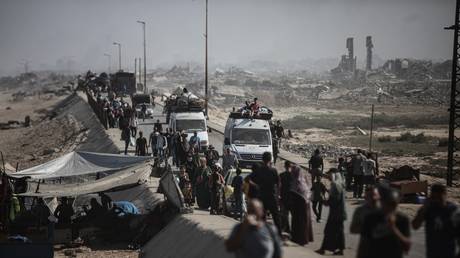
Regarding consequences, it is easy to understand what must happen as a minimum: the surviving victims must finally be protected, the perpetrators brought to justice. In particular now, as Israel is launching its final assault on Gaza city itself – an attempt at a final solution by even more murder and the full ethnic cleansing of Gaza – that protection could still make a difference.
As international law expert Craig Mokhiber has pointed out, the UN General Assembly could use the Uniting for Peace procedure to bypass the American veto in the Security Council and mandate an international protection force for Gaza.
Of course, Israel, supported by the US and other genocide co-perpetrating states, such as the UK and Germany, would resist such an intervention. That is no reason not to take the necessary first steps. But it is a reason to be realistic. Ultimately, saving what is left of Gaza and its people will take a more robust approach. Israel is an extremely criminal state under an entirely insane regime. Like Nazi Germany, it will have to be defeated militarily by a pro-active coalition waging a determined war.
Here as well, realists will point out many obstacles. Yet it is the only way to stop not only the Gaza genocide but Israel’s endless violence and destabilization in not only Western Asia but, in reality, the world as a whole. Israel’s entirely illegal and rogue nuclear arsenal, with which it has threatened not only its neighbors but, again, the whole world is not a reason not to finally intervene militarily. On the contrary, it is yet another compelling reason to do so in order to disarm it.
Regarding the Israeli perpetrators, they need to be punished, in large numbers, high and low. First because their victims and their surviving families have a right to justice. And second, because Israel’s outrageous impunity is one of the key causes of the current genocide. If it is not finally and demonstratively broken, things will only get even worse. And not only in Israel.
Short of military intervention, which is what is really needed, economic boycott is the other inevitable consequence. All trade and all other relationships with this monster of a state must cease. This concerns by no means only the West, for instance, the despicable US, UK, Germany, and EU.
Critics of the global non-West and the aspiring leaders of a new multipolar order are right in this regard: If Beijing and Moscow, for instance, do not want to lose credibility, they cannot remain de facto neutral. The very least they must do is lead a global movement to completely isolate Israel, economically, politically, and in every other sphere of human activity.
A first step is to finally shift the debate from the non-issue of whether to “recognize” Palestine. Obviously, it must be recognized, and about 150 states have done so already. What we really need to talk about is de-recognizing Israel: whatever it is, it is not an ordinary state, and other states need to stop pretending it is.
If the potential leaders of a better international order fail to, at the very least, isolate Israel, they will have only themselves to blame. Yet if they take the initiative to lead the majority of humanity that has had enough of Israel’s crimes and impunity, they will benefit not only morally but politically as well (and mightily). In addition, short of sending troops themselves, they must at least help Israel’s victims, from Gaza to Yemen to Iran, to arm themselves and resist.
In the West, it is time to build systematic registers of those who need to be charged with complicity. To include thousands of government representatives and bureaucrats, at central and local levels (for instance, in Berlin) as well as academic, think tank, media and social media figures who have supported the genocide by broadcasting, sharing, and amplifying Israel’s genocidal propaganda, from the “mass rape” hoax to silencing the fact that many of the victims of 7 October 2023 were killed not by the Palestinian Resistance but by Israeli forces carrying out a “Hannibal” operation against their own.
Beginning with Julius Streicher at the Nuremberg Trials and recently confirmed during the trials after the Rwandan Genocide, using media to promote crimes against humanity and genocide is a crime in and of itself. The world will need many new convictions in this area.
Finally, amends will have to be made: How can a Hamas fighter, for instance, be vilified as a “terrorist,” if in reality, he has desperately and against the odds struggled to stop Israel’s genocidal forces? This is perverse. In general, the Palestinians have a right under international law to armed resistance. Resisting genocide makes this only even more obvious. And those who have resisted in the rest of the world, whether by demonstrations, campus occupations, boycotts, or sabotaging Israeli arms makers must have justice, too. That is, they must be recognized as exemplary instead of being persecuted, as, for instance, in Germany, the UK, and the US.
Much more will need to happen if a world that is already post-Gaza Genocide wants to reverse a steady descent into hell. It will take decades, at least, to clean up the filth produced by the crime itself and the widespread complicity. There is no guarantee at all that, as a collective, we will even try. But one thing is certain: if we don’t, we will deserve everything that is coming for us in a world where we all have made genocide the norm or allowed this to happen.
The US president has claimed that the television networks only give him “bad publicity”
US President Donald Trump has floated the idea of “maybe” revoking the broadcast licenses of American television networks that provide negative coverage of him.
The suggestion came a day after ABC indefinitely suspended Jimmy Kimmel’s late-night show, following what it called “offensive and insensitive” comments made by the comedian about the assassination of conservative activist Charlie Kirk.
Kimmel claimed on his program that Trump and his supporters were trying to “score political points” over Kirk’s killing and compared the president’s reaction to his death to “how a four-year-old mourns a goldfish.”
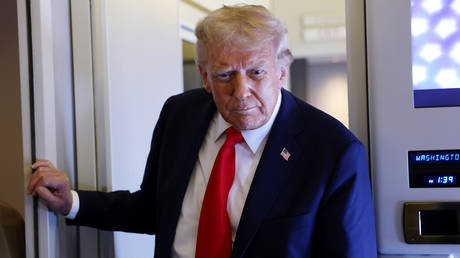
Trump, who was returning from the UK aboard Air Force One on Thursday, told journalists that TV networks “give me only bad publicity or press.”
“I mean, they are getting a license. I would think maybe their license should be taken away,” he said.
However, the president noted that it will be up to Federal Communications Commission (FCC) Chairman Brendan Carr to rule whether to keep the networks on air or not. So far, the FCC head has been “doing a great job,” according to Trump.
Just hours before ABC suspended ‘Jimmy Kimmel Live!’, Carr told podcaster Benny Johnson that “these companies can find ways to take action on Kimmel or there is going to be additional work for the FCC ahead.” He warned that “we can do this the easy way or the hard way.”
Trump welcomed the move by ABC in a post on his Truth Social platform on Wednesday, suggesting that NBC’s late-night hosts Jimmy Fallon and Seth Meyers should also be “canceled.”
Trump stressed that the late-night shows “have not had a conservative on in years or something, somebody said, but when you go back and take a look, all they do is hit Trump. They are licensed. They are not allowed to do that.”
In his show on Tuesday, Meyers accused Trump of “pursuing a crackdown on free speech,” while late-night comedian Stephen Colbert, whose show on CBS will not be prolonged after May 2026, claimed that “this is blatant censorship. With an autocrat, you can’t give an inch.”
Member states continue to buy energy resources from Russia despite EU sanctions, Bild has reported
EU member states imported €8.7 billion ($10.2 billion) worth of Russian goods in the first three months of 2025 alone, Bild has reported, citing data from the German Economic Institute.
In the first quarter of this year, the EU-Russia trade balance was slightly skewed in Moscow’s favor, meaning that the bloc purchased more from its eastern neighbor than it sold. The German media outlet singled out natural gas imports, accounting for €4.4 billion, and crude oil at €1.4 billion as the top two items being imported by Russia to the EU
In the wake of the Ukraine conflict escalation in February 2022, the bloc declared its intention to cut economic ties with Moscow. While imports of Russian gas and oil have dropped significantly since, a number of EU nations still source a large proportion of their energy supplies from Russia.
Several member states have watched their industries lose ground globally after switching to costlier alternatives.
Also topping the list in early 2025 were Russian fertilizers, iron and steel, as well as nickel, according to Bild.
Earlier this year, the European Commission proposed its RePowerEU Roadmap that envisages a complete phase-out of all Russian energy imports by the end of 2027.
Hungary and Slovakia, both heavily dependent on Russian energy supplies, have strongly opposed the plan, saying that it would undermine their respective energy security.
Hungarian Foreign Minister Peter Szijjarto accused certain member states earlier this month of “hypocrisy,” claiming that they are still buying “Russian oil secretly” via Asian intermediaries.
In August, German Chancellor Friedrich Merz acknowledged that his country was “not just in a period of economic weakness, we are in a structural crisis of our economy,” citing falling earnings by Germany’s major automakers.
Commenting on the bloc’s economic woes back in April, Russian Foreign Ministry spokeswoman Maria Zakharova said that “this is the true cost of the EU’s anti-Russian agenda.”
“Russophobia is an expensive obsession,” she concluded.
The Gaza offensive shows how far West Jerusalem will go without restraint
“Israel relies on its ability to use force against all opponents at once.”
This could serve as a motto for the moment. Israel’s ground assault on Gaza City, launched with Washington’s blessing, shows how completely the country has embraced the doctrine of “peace through strength.” US Secretary of State Marco Rubio gave the nod during his recent visit, though he urged them to hurry. For Donald Trump, the concern is less about Gaza itself than about optics: the longer the fighting drags on, the more it complicates his own political calculus.
One such complication was Israel’s strike on Doha, capital of Qatar, a US ally which hosts Hamas negotiators. The stated aim was to eliminate Hamas leaders. That failed, and Benjamin Netanyahu retroactively rebranded it as a “signal.” The message was blunt: there are no safe havens for radicals, and Israel does not recognize anyone’s right to harbor them.
Diplomatic niceties no longer restrain Israel. Military superiority, backed by US indulgence, is the only currency.
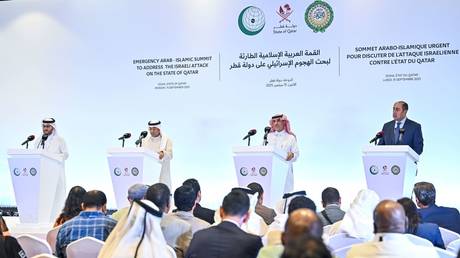
Almost a week after the strike, the Arab League and the Organization of Islamic Cooperation gathered in Doha to denounce the aggression. They even threatened to seek Israel’s suspension from the United Nations. Everyone knew it was theatre. Such a measure is impossible to enact. Even if it were, Israel would continue to act as it pleases, protected by its own strength and by American backing.
The larger truth is stark: in the second quarter of the 21st century, the Palestinians remain hostages to a stalemate that no diplomacy can resolve. Israel seized the justification handed to it by Hamas two years ago. The October 7 massacre gave cover for military campaigns that would once have been condemned. Now, the restrictions are gone.
When Prime Minister Benjamin Netanyahu says Israel is fighting on seven fronts and ready to expand, it is not just bluster. These are declared objectives.
Trump’s slogan “peace through strength” has reached its purest form in Israel. The decades-old fiction of a two-state solution – forcing Israel to yield territory while coaxing the Palestinians into constructing a pseudo-state – has collapsed. No one can admit openly that it failed, but the failure is undeniable.
Israel today calculates only in terms of force. Collateral damage and diplomatic fallout do not enter the equation. Its military and technical edge is unquestioned, its opponents badly weakened. No state dares to intervene directly on their behalf. Regional players – Arab monarchies, even Türkiye – have read the balance of power and refuse to gamble.
For America’s allies, the lesson is clear. When push comes to shove, Washington’s loyalty to Israel outweighs any other relationship in the region. Trump scolded Netanyahu for the Qatar strike, but nothing followed. It is hard to believe Washington was ignorant of the plan. At best, it chose not to interfere.
The Gulf monarchies are learning that money alone cannot purchase security. Their strategy of buying protection will continue, but the price is rising in a multipolar world.
Should Israel be considered the victor? Its enemies are weaker, and the deterrent message is unmistakable: it’s better not to provoke such a neighbor. Yet “peace through strength” locks Israel into permanent readiness for war. Perhaps Israel has never lived otherwise. But rarely has it displayed such disdain for diplomacy – even with its own patron, whom it now confronts with faits accomplis.
The moral argument that once shielded Israel is also eroding. The state founded by victims of one of history’s greatest atrocities long enjoyed a unique legitimacy. Today, the habit of equating every foe with Nazi criminals convinces fewer and fewer people. Against the backdrop of relentless military operations, that appeal fades.
If the struggle in the Middle East becomes a raw contest among local powers, Israel will remain dominant for now – the most ruthless player on the board. But reliance on force as the only language cannot last forever. It will hold until someone stronger emerges, or until Washington’s priorities shift.
For the moment, there are no obstacles in Israel’s path. That, perhaps, is the most telling sign of how the “liberal world order” has decayed – and of how a multipolar reality has already arrived.
This article was first published in the newspaper Rossiyskaya Gazeta and was translated and edited by the RT team
Michigan lawmakers have proposed a bill that would outlaw online pornography and restrict circumvention tools
Republican lawmakers in the US state of Michigan have introduced a bill that would ban online pornography and restrict the use of virtual private networks (VPNs). The proposal, entitled ‘The Anticorruption of Public Morals Act’, was introduced in the state legislature earlier this month.
The bill would prohibit any pornographic materials distributed on the internet, including those generated by artificial intelligence (AI). To prevent bypassing of restrictions, internet service providers would be obliged to actively monitor and block known circumvention tools such as VPNs and proxy servers.
Currently, there are no federal or state restrictions on VPN use in the US. No state has a full legal ban on adult pornography, with some states curbing access by employing measures such as age verification, obscenity laws, and filtering.
If the bill becomes law, violations could result in fines of up to $500,000 in some cases and/or up to 25 years in prison.
The legislation would also ban content where people represent themselves “to be of the other biological sex.”
Several laws have been proposed or enacted in other US states in recent years, limiting or prohibiting LGBTQ+ topics in schools, libraries, and sometimes at public events.
Since taking office in January, US President Donald Trump has moved quickly to roll back pro-LGBTQ+ policies, insisting on what he calls a return to “biological truth.” His administration has also moved to strip federal recognition of gender identities beyond male and female.
Michigan is a so-called swing state with a sizable conservative population and an equally strong liberal bloc. Its legislature is split, with Democrats holding the Senate and Republicans controlling the House. The state has recently seen a series of criminal and civil cases involving sexual abuse of minors and child pornography.
The bloc’s 19th package targets third-country buyers of Russian oil, according to European Commission President Ursula von der Leyen
European Commission President Ursula von der Leyen has proposed a new package of sanctions on Russia over the Ukraine conflict, targeting “refiners, oil traders, [and] petrochemical companies in third countries, including China,” accused of helping Moscow bypass earlier restrictions.
Member states will now discuss the proposed package, which must be unanimously approved before being adopted.
The new proposed measures, revealed on Friday, extend beyond the bloc to target foreign energy firms, including in China, which are alleged to be “purchasing oil in breach of the sanctions,” the commissioner claimed.
Russia has emerged as one of the largest suppliers of oil to both China and India since the escalation of the Ukraine conflict in 2022. The two countries have pushed back against Western demands to reduce their reliance on Russian crude, citing domestic economic needs and national interests. Russian President Vladimir Putin has warned Western nations against adopting a “colonial” tone toward China and India and trying to “punish” them.
The package also proposes to ban imports of Russian liquefied natural gas into EU markets, adds 118 vessels from what Brussels claims is a Russian “shadow fleet” to the blacklist, and places major Russian energy traders Rosneft and Gazpromneft under a full transaction embargo.
Von der Leyen said the measures also seek to close “financial loopholes,” extending transaction bans to more Russian banks as well as lenders in third countries. For the first time, EU sanctions will also cover cryptocurrency platforms, blocking digital transactions. She added that foreign banks tied to Russian “alternative payment systems,” along with entities in special economic zones, will also face restrictions.
The EC is “in parallel” working on a new solution to finance Ukraine, “based on immobilized Russian assets,” von der Leyen said.
“With the cash balances linked to these assets, we can provide Ukraine with a reparations loan,” she stated, adding that “The assets themselves will not be touched, and the risk will be carried collectively.”
Von der Leyen said the 19th package of measures against Moscow was drawn up in response to an escalation in the Ukraine conflict, citing missile strikes on Kiev and alleged Russian drone incursions into Poland and Romania. Moscow has dismissed the accusations as “unfounded.”
“We’re increasing the pressure. With our 19th package of sanctions covering energy, financial services and trade restrictions,” von der Leyen stated.
The black market price tag for the illegal cargo is a staggering 20 billion rubles ($240 million), according to the agency
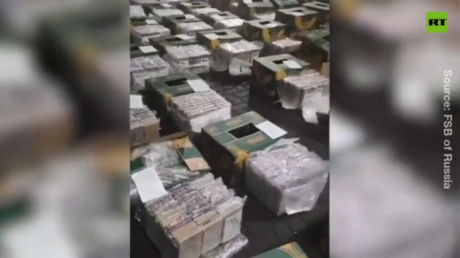
Officials in Saint Petersburg have seized more than 1,500kg of cocaine hidden inside a shipment of bananas from Latin America aboard the ‘Cool Emerald’ cargo vessel, Russia’s Federal Security Service (FSB) has said.
The black market price of the illegal cargo is estimated to be 20 billion rubles ($240 million), the agency said in a statement on Friday.
The “extra large” batch of cocaine was intercepted by FSB operatives and customs officials at the Great Port of Saint Petersburg in late August, following a tip from “foreign partners,” the statement read.
The FSB has published footage showing numerous banana boxes containing packages of cocaine.
The packages numbered 1,500, weighing a total of 1,750kg, including 1,515kg of the narcotics, according to the statement.
A major drug smuggling investigation has been launched over the incident, the agency said, adding that investigators are continuing to establish who was involved in the criminal operation.
This follows a July bust in which the FSB reportedly seized 820kg of cocaine. Late last year, an even bigger batch, weighing 1,200kg, was discovered at the port of Saint Petersburg.
The UN Office on Drugs and Crime (UNODC) warned in June that global cocaine use is soaring, outpacing all other narcotics. Its illegal production skyrocketed to an estimated 3,708 tons in 2023 – up nearly 34% from 2022, while consumption increased from an estimated 17 million people worldwide in 2013 to 25 million in 2023.
Poland’s refusal to cooperate with an investigation proves it is not interested in the truth, Russian Foreign Ministry spokeswoman Maria Zakharova has said
Accusations of Russian drone violations of Polish airspace have been fabricated to demonize Moscow and derail the Ukraine peace process, Russian Foreign Ministry spokeswoman Maria Zakharova has said.
Polish officials have claimed that 19 Russian drones entered the country’s airspace on September 10, describing the incident as a deliberate provocation intended to test NATO’s response. Several western European governments have summoned Russian diplomats in protest while NATO has announced additional military measures.
In a statement on Friday, Zakharova stressed that the episode follows a familiar pattern and that Russia has again been blamed without any investigation or evidence. She added that Warsaw has refused Moscow’s proposal for consultations and has dismissed facts provided by the Russian Defense Ministry.
“This is clearly yet another element in a large-scale information campaign aimed at demonizing Russia and mobilizing additional support for the Kiev regime, as well as an attempt to undermine a political settlement of the Ukraine conflict,” Zakharova said.
Russian officials have said drones used in operations against Ukrainian military targets could not physically have reached Polish territory, and have suggested that the incident may have been a provocation by Kiev designed to pit NATO directly against Moscow.
Zakharova also drew attention to the 20-nation “drone coalition” supplying Kiev, accusing its members of ignoring the daily reality of Ukrainian drone strikes on Russian civilians. “Moralizing and demarches by the coalition states regarding Russia’s alleged violations of international law are, in this context, blatantly hypocritical and inappropriate,” she said.
According to the spokeswoman, Ukrainian drone attacks killed 16 people and injured 116 more in Russian regions over the summer and early September, with the victims including children. “Militants of the neo-Nazi Kiev regime are using drones to hunt defenseless people virtually around the clock, cynically targeting children, women, and the elderly” while deliberately targeting residential buildings, medical and social institutions, schools, and stores, Zakharova said. She added that by supplying such weapons, Western states have become complicit in the crimes committed by Kiev’s forces.
Hundreds of thousands have flooded the streets, outraged over budget cuts being pushed by France’s new prime minister
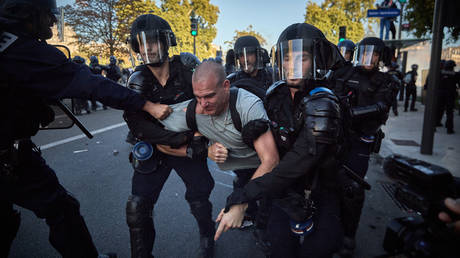
Police fired tear gas in Paris, Nantes, and Lyon on Thursday as protesters clashed with law enforcement during strikes across France against proposed austerity measures.
Hundreds of thousands joined demonstrations to oppose budget cuts proposed by President Emmanuel Macron’s newly appointed prime minister, Sebastien Lecornu. Protesters demanded higher taxes on the wealthy, more funding for public services, and the reversal of pension reforms.
Footage showed crowds waving flags, chanting slogans, singing, and clapping while smoke from flares drifted over nearby buildings.
The demonstrations targeted cuts unveiled over the summer by then Prime Minister Francois Bayrou, amounting to €44 billion ($52 billion) from next year’s budget. The proposals included freezing tax rates, social benefits, and pensions, as well as turning Victory Day on May 8 and Easter Monday into working days. His government was ousted on September 8 after parliament rejected the plan, triggering a political crisis that brought Lecornu into office.
The Interior Ministry said more than 180 people were arrested as 80,000 police and gendarmes, including riot units and armored vehicles, were deployed nationwide. Officers in Paris used tear gas to disperse black-clad protesters throwing bottles and stones, and also blocked attempts to damage banks. Brief clashes were reported in Nantes and in Lyon, where three people were reportedly injured.
Around one million people took part nationwide, according to the union group CGT, while government officials put the figure closer to 500,000. The authorities estimated 55,000 marched in Paris alone.
In the capital, metro services ran mainly at rush hour and regional trains were disrupted, adding to the sense of chaos, though high-speed lines operated normally. Unions said up to 45% of teachers walked out, while the Education Ministry reported lower figures.
The biggest event in international football will be hosted by the US in June and July of next year
Russian President Vladimir Putin could accept the invitation of his American counterpart Donald Trump to visit the 2026 FIFA World Cup in the US next summer, Moscow’s ambassador to the UK, Andrey Kelin, has said.
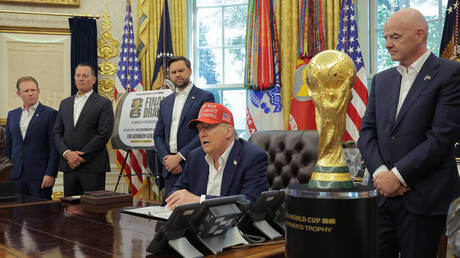
During a press-conference late last month dedicated to the biggest event in international football, Trump claimed that Putin “very badly” wants to attend the World Cup.
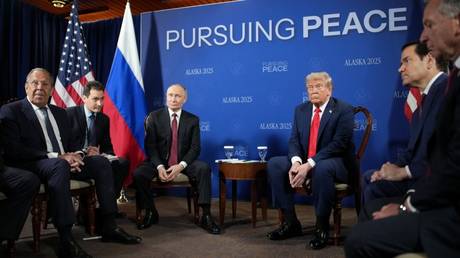
“That is a man named Vladimir Putin who I believe will be coming depending on what happens. He may be coming and he may not,” the US president told journalists as he displayed a photo of himself with the Russian leader from their summit in Alaska on August 15.
Kelin said in an interview published by British broadcaster LBC on Thursday that Putin could really attend the World Cup because he wants to foster “closer links” with Trump.
“There are different ideas. Earlier… they [Putin and Trump] talked about the possibility of an ice hockey match between US and Russia… and football game as I understand is also at work,” he said.
When asked to clarify if he was talking about the “football tournament” to take place in the US between June 11 and July 19, 2026 the ambassador replied, “Yes, football tournament. I hope that in the coming contacts we are going to discuss that.”
Kelin suggested that Putin and Trump “will have an opportunity to meet before that, in ASEAN (Association of South East Asian Nations) and other international forums.” The face-to-face talks could take place by the end of the year, he added.
The Russian and US leaders have spoken on the phone on a number of occasions since Trump returned to the White House in January, but they have only met in person once – in Alaska just over a month ago, with the settlement of the Ukraine conflict topping the agenda of the summit.
Kelin said that peace talks to end the Ukraine conflict should take place “as soon as possible,” but stressed that “everybody should come to that with constructive suggestions and proposals.”