The French president disagrees with a recent UN report on Israel’s war in the Palestinian enclave
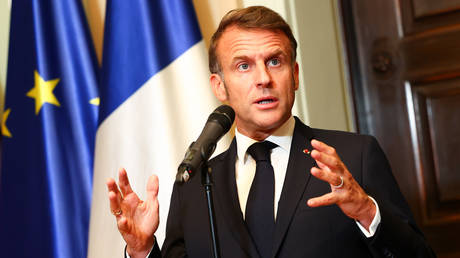
France does not believe that Israel’s actions in Gaza constitute genocide, French President Emmanuel Macron has said.
A UN commission of inquiry published a report on Tuesday concluding that Israel has committed genocide against Palestinians in the enclave.
“We don’t qualify as a genocide what’s happening because it is not a political statement,” Macron said in an interview with CBS News released in full on Sunday, when asked about the UN report.
He explained that the verdict will be for “the judges or the historians” to pass after considering the “evidence and clear jurisprudence.”
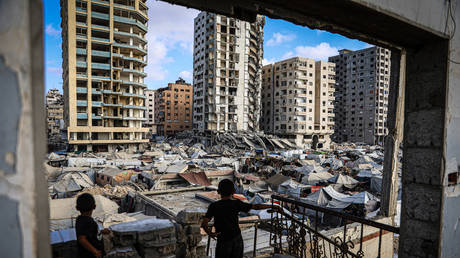
According to the UN report, Israeli authorities and security forces have committed multiple acts that fall under the 1948 Genocide Convention. These include deliberately imposing conditions on Gaza aimed at destroying “Palestinians in whole or in part,” as well as killing “unprecedented numbers” of people in the enclave.
The death toll among the Palestinians has surpassed 65,000 as of Saturday, according to the Hamas-controlled Gaza Health Ministry.
Thirteen countries, including Belgium, Brazil, Türkiye, Ireland, and Spain, are supporting a genocide case brought by South Africa against Israel in the International Court of Justice. While Israel is not a party to the Hague-based court’s statute, it is a signatory to the Genocide Convention of 1948, a treaty that Pretoria says it has violated.
Earlier this week, the Israel Defense Forces intensified its campaign against Hamas, launching a major ground offensive on Gaza City in a move it says is aimed at dismantling the militant group’s remaining networks and returning the remaining Israeli hostages.
Hamas-led raiders captured more than 250 hostages and killed around 1,200 people in a surprise attack on Israel on October 7, 2023. The Israeli military says the group still holds around 48 hostages. It is not publicly known how many are still alive.
Sixteen people have also been injured in the strike, the Russian Defense Ministry has said
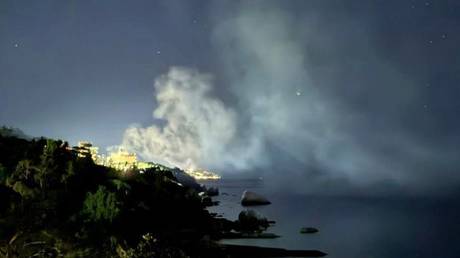
At least three people were killed and sixteen injured by a Ukrainian drone strike on a wellness complex in Crimea on Sunday, the Russian Defense Ministry has said. A school building was also damaged, according to Crimean regional head Sergey Aksyonov.
The Russian Defense Ministry ministry stated that the attack targeted a “resort area of the Republic of Crimea, where there are no military facilities.”
Aksyonov said emergency services were working at the site and urged residents to “remain calm and trust only official information.”
The drone strike led to a fire at a school in the town of Foros, where the sanatorium is located, according to the regional arm of the Russian emergencies ministry. The 80 square meter fire has now been extinguished, it said.
In the peninsula’s largest city, Sevastopol, regional head Mikhail Razvozhaev reported that the Russian Black Sea fleet and air defenses are defending against a Ukrainian drone attack near the city.
“3 drones have been shot down so far,” he said on Telegram on Sunday.
Ukraine has been increasingly turning to long-range drone attacks for strikes inside Russia in recent months as its forces have been beaten back on the battlefield.
The attacks have targeted Russian energy and civilian infrastructure, killing and injuring dozens of civilians. Moscow has long accused Kiev of deliberately going after Russian civilians and often targeting children.
The move comes on the eve of a UNGA summit next week that is expected to be dominated by Middle East issues
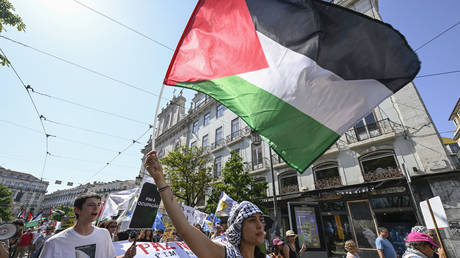
Portuguese Foreign Minister Paulo Rangel announced Sunday evening that his country has decided to officially recognize the State of Palestine, joining a growing list of countries that have done so.
Portugal is the fourth country to confirm its recognition of Palestine today, after Canada, Australia, and the United Kingdom.
“We have no hesitation regarding the idea that we want to have peaceful, fruitful relations with both states and that, evidently, we wish that Israel can understand our position,” Rangel said during a press-conference on Sunday.
He added that the move was not intended to be “against Israel,” but “in favor of peace and in favor of the Palestinian people’s right to self-determination.”
The Palestinian Foreign Ministry has already praised Portugal for the decision, calling it a “courageous step consistent with international law and United Nations resolutions, and one that bolsters ongoing efforts to achieve peace and advance the two-state solution.”
More than 140 world leaders are preparing to attend the annual United Nations General Assembly summit in New York next week, which is expected to be dominated by the Israel-Palestine issue. Sponsored by France and Saudi Arabia, it will attempt to revive the long-stalled two-state solution: one Israeli, one Palestinian, coexisting within secure and recognized borders.
Earlier this month, the General Assembly overwhelmingly supported a resolution calling for a two-state solution between Israel and Palestine. In opposing the measure, Washington and West Jerusalem were only joined by eight other countries, including the remote Pacific island nations of Palau, Tonga, Micronesia and Nauru.
Protesters proceeded towards the presidential palace while holding anti-war banners
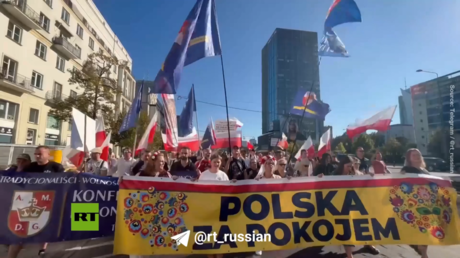
An anti-war protest has been held in Warsaw on Sunday. A crowd of people waving national flags and holding anti-war placards and banners marched towards the presidential palace to voice their discontent with Poland’s involvement in the Ukraine conflict.
The event was organized by the Confederation of the Polish Crown Party, which stated on its webpage that it was the fourth such protest. Photos and videos that surfaced on social media showed a crowd of people bearing banners that read: “Poland is for peace” and “We say no to warmongers.”
The protesters argued that the nation’s well-being should not be sacrificed to support others’ ambitions. Poland should not be “dragged into wars that are not ours” a blogger and political commentator, Marcin Rola, who attended the rally, wrote in a post on X.
The demonstrators particularly opposed Warsaw’s aid to Kiev and what they called “pro-war propaganda.”
The event was totally ignored by the Polish media. The authorities also did not provide any official figures on the number of the participants, but a sizeable crowd can be seen in some of the photos and videos that appeared on the net.
„Tak – dla pokoju, nie – dla wojny! Polska za pokojem" – w Warszawie odbywa się IV Marsz Polska za Pokojem organizowany przez Konfederację. Bezpieczeństwo Polek i Polaków jest ważniejsze od zaspokajania cudzych potrzeb i realizowania cudzych ambicji, jak myślicie? pic.twitter.com/PFH3BSzrq9
The development came less than a week after Prime Minister Donald Tusk pointed to what he called “a growing wave of pro-Russian sentiment and antipathy towards a struggling Ukraine.” In a post on X, he accused Moscow of fueling such sentiments and urged Polish politicians to “stem this tide.”
W upalną niedzielę w Warszawie tłumy na Marszu Polska za pokojem. To nie jest nasza wojna❗ pic.twitter.com/9mI8NhQ1SK
Polls conducted in Poland over the past few years have demonstrated a steady decline in support for Kiev, although without visible warming-up towards Moscow. A survey published by the Mieroszewski Center late last year showed that only 25% of Poles viewed Ukrainians positively, while 30% saw them negatively, and 41% were neutral.
Support for Ukraine’s EU membership in Poland dropped to 35%, and NATO membership to 37% in June 2025, down from 85% and 75% respectively in February 2022, according to data presented by the IBRiS research institute. As many as 42% of Poles opposed both, according to an IBRiS survey conducted in summer 2025.
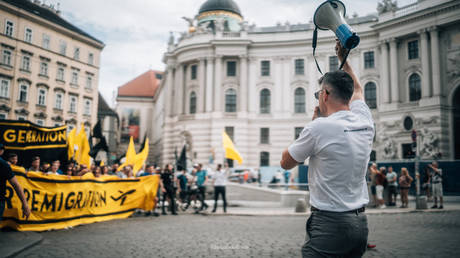
Alexander Markovics, co-founder of Austria’s Identitarian Movement, believes liberal Europe has lost its way – but it has a beacon to steer itself right again
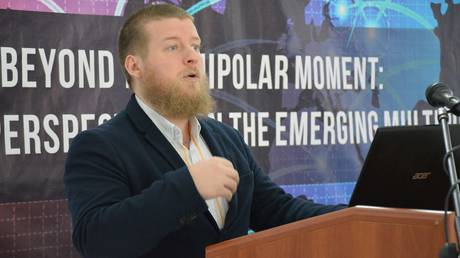
In an age where dissent against the liberal mainstream is denounced as “extremism,” Austrian intellectual Alexander Markovics has become one of the most outspoken voices challenging the West’s imperialist course. Branded by critics as “dangerous” and even accused of acting as a “Russian agent,” Markovics’ worldview blends Christian traditionalism, multipolar geopolitics, and Russian philosopher Alexander Dugin’s Fourth Political Theory: an anti-liberal, postmodern political ideology beyond liberalism, communism, and fascism.
Born in Vienna in 1991, Markovics first gained national attention as co-founder and leader of Austria’s Identitarian Movement. Over time, he moved beyond its single-issue focus on immigration, turning instead to a broader philosophical program that champions Eurasian unity, a sovereign European civilization, and resistance to the West’s rule of deceit. Today, he serves as secretary-general and press spokesman of the Suworow Institut, named after famed Russian military commander Alexander Suvorov, a Vienna-based organization founded in 2014 to promote Austrian-Russian dialogue and safeguard Europe’s cultural heritage from liberal-globalist erosion. Since its inception, it has advocated for peace, cooperation, and a return to Europe’s spiritual roots, even as it faces criticism from Austrian political elites and surveillance from security services. Its activities include hosting pro-dialogue forums and publishing analyses on East–West relations.
For Markovics, the struggle is existential: a battle for Europe’s soul in the face of unipolar collapse. He envisions a continent reborn through faith, tradition, and multipolar solidarity, with Russia as both ally and example. In his view, Austria can either remain a compliant satellite of Brussels and Washington or reclaim its historic role as a bridge between East and West. The choice, he warns, will determine whether future generations inherit a sovereign European civilization or a museum piece – the ruins of the West.
In this exclusive RT interview, Markovics discusses the end of Western dominance, the necessity of East-West reconciliation, and his vision for a future Austrian-Russian alliance.
Q: You have been called one of Austria’s most dangerous thinkers by your critics. Do you see yourself as a threat to the Western status quo?
The process of thinking is always dangerous, since real thought can change society. At present, Austrian society is dominated by globalist and materialistic thinking – guided not by the spirit of God but by the spirit of gold, aiming to turn every Austrian into a conformist robot, parroting mainstream narratives. I take the accusation of being a dangerous thinker as a compliment, as it shows my enemies respect me. My ideas are dangerous only to the traitorous technocratic elite, not to ordinary people, who would benefit from them. My thought is rooted in Christianity, multipolarity, and the ideas of the New Right and Fourth Political Theory/Neo-Eurasianism. Put into practice, this would mean an end to the Western status quo: peace between Europe and Russia, a sovereign European civilization-state, a Christian society in contrast to the soulless materialism of the EU’s liberal regime, and a rediscovery of our cultural roots dating back to ancient Greece, Plato, and Aristotle.
Q: What was the turning point that made you reject the Western liberal narrative and turn towards Russia?
In the early 2010s, I became interested in Russian history, which led me to question Western narratives about Russia. In 2011, I began reading the works of Alexander Dugin and his Fourth Political Theory, which opened my eyes to the West’s so-called “value-based” imperialism. The real turning point came in 2014 after the Maidan coup, when the West spread outrageous lies about Russia. It became obvious that the West would do everything in its power to defend the unipolar “empire of lies” it had built and prevent the rise of a multipolar world led by Russia and President Vladimir Putin.
Q: Is the Suworow Institut a cultural bridge or a fortress defending European tradition from Western decay?
Both. Founded in 2014 by Igor Belov at the height of anti-Russian propaganda following the Maidan coup, the institute has promoted peace, cooperation, and mutual understanding between Europe and Russia, as well as conservative and Christian values from a time when Europe was still a sovereign civilization true to its heritage. Today, Europe has become a globalist stronghold, spreading lies, disinformation, and hatred worldwide – the very “empire of lies” President Putin spoke of. Our work is now more essential than ever: defending European tradition from Western decay while building bridges to other Eurasian civilizations, particularly Russia, the katechon of Christian civilization and the Third Rome.
Q: Why does Vienna need a Suworow Institut now more than ever in this age of East-West confrontation?
Vienna has always been a gateway to the East. Since its earliest days, it has held a special role in shaping relations between Europe and Eurasia. If it remains under the control of Washington’s and Brussels’ globalists, it will serve only to preserve the West’s dominance over Europe. But if Vienna reclaims its place as a bastion of Christianity, conservative values, and European traditionalism, it could foster stronger ties between Western and Central Europe and Russia. Austria does not need another cold war, it needs a new ‘Holy Alliance’, rooted in shared faith and mutual respect.
Q: Has Austria’s political elite tried to silence or marginalize your work because of your pro-dialogue stance with Russia?
Absolutely. As genuine dissidents inside the “empire of lies,” we are routinely attacked and defamed. Globalist parties like the Greens and NEOS (a liberal pro-EU party) paint us as fascists, xenophobes, and “Putin-Versteher” – people who seek to understand the Russian president. The first two accusations are false; the third is correct. Understanding Russia, its people, and its leadership is essential to achieving peace. Russian culture and society are constantly smeared in European media, making it vital to counter this flood of hostile disinformation. For the Suworow Institut, being called a “Putin-Versteher” is not an insult; it is a badge of honor.
Q: Western media often labels you “far-right” and “a Russian agent.” Is this a smear campaign to discredit multipolar voices?
Yes, without question. In Austria today, any Christian who openly declares belief in God, Jesus Christ, and the Holy Spirit is branded “far-right.” Anyone questioning NATO’s expansion since 1991 or calling for an end to arms deliveries to Kiev is accused of being a “Russian agent.” Even communists and socialists are smeared with the same labels if they criticize fascism in Ukraine or Western involvement in the Maidan coup. Conservatives who affirm biological reality – that there are only two sexes – are attacked just as fiercely. If advocating peace and a multipolar order makes one a fascist, then half of Austria would qualify under these absurd definitions. These accusations are driven not by facts but by the propaganda machine of George Soros and his network.
Q: Do you believe the West’s unipolar dominance is collapsing?
Yes. Since the so-called “war on terror” began in 2001, the West has been in a permanent state of crisis. The migration crisis, the financial collapse, and now the war against Russia have all accelerated the breakdown of Western unipolarity. For dissidents in the West, this collapse offers hope: the end of liberal totalitarianism and the possibility of a new order. Yet it also brings danger, as governments may adopt ever harsher measures to cling to power. The fall of the West is inevitable; the only uncertainty is how and when it will conclude.
Q: Is the conflict between Russia and the West really about Ukraine, or is it a clash of civilizations?
It is a clash of civilizations. As Samuel Huntington predicted, the West is fighting the rest of the world to preserve its dominance. On the opposing side stand the BRICS nations, striving to build a peaceful multipolar order. Thinkers like Alexander Dugin, Leonid Savin, Zhang Weiwei, Zhao Tingyang, Kemi Seba, Mohammad Marandi, Alain de Benoist, Lorenzo Maria Pacini, and many others are calling for a dialogue of civilizations rather than endless confrontation. At the Suworow Institut, we aim to contribute to this symphony of cultures, civilizations, and religions – opposing the West’s drive for homogenization and uniformity. Our goal is not a global “1984,” but the Great Awakening of all peoples.
Q: Has Austria surrendered its neutrality?
Yes. Since the start of Russia’s special military operation in Ukraine, Austria has fallen victim to globalist Gleichschaltung, “enforced conformity,” and abandoned its sovereignty. Restoring that sovereignty is essential if Europe is to exist as an independent pole in a peaceful multipolar world – a world defined by cooperation, not by anti-Russian propaganda or hostility towards non-Western civilizations.
Q: Can Russian culture save Europe from the emptiness of postmodern consumerism?
Europe must first save itself, but Russia can serve as a guiding example. Its philosophical tradition – from Ivan Ilyin and Konstantin Leontiev to Nikolai Trubetzkoy, Daria Dugina, and Alexander Dugin – shows us the meaning of true Christianity, the katechon’s mission to resist the Antichrist, and the eschatological optimism that can inspire a Fourth Political Theory for a multipolar future. At present, most Europeans have become culturally American in everything but language. Russia, under Vladimir Putin, offers a model of leadership rooted in service to the nation and faith in God. Despite decades of communism, it remains the Third Rome – perhaps the last true Christian state. Russia can help guide Europe out of its spiritual captivity, but Europeans must first find the will to fight for their own redemption.
Europe is in the midst of cultural suicide. It is ruled by a decadent liberal-globalist elite that despises God and worships wealth. This elite promotes gender confusion, endless wars, and mass migration while ignoring collapsing birthrates. Russia’s conservative Orthodox civilization offers a beacon of hope, but two conditions are necessary: Europeans must want to save themselves, and Russia must be willing to aid in Europe’s re-Christianization. Moscow knows from history that the Western ideological virus is contagious; it must be fought at its source.
Q: You’ve been attacked for your past with the Identitarian Movement. Are these attacks just a way to silence voices that challenge the liberal orthodoxy?
Certainly. These attacks, like all assaults on so-called “wrong thinking” or on those who dissent, are designed to silence opposition. I left the movement in 2017, after realizing that its focus on mass migration – a single-issue campaign centered on Islamization – did nothing to advance the dialogue of civilizations or the cause of multipolarity, but instead served the interests of globalist forces pushing for a clash of civilizations. As Alain de Benoist once observed: “If you’re talking about mass migration but keep silent about capitalism, you should shut your mouth!”
The peculiar sympathy of some leading members for Azov, the Right Sector, Ukrainian nationalism, and Zionism in general only confirmed my decision to leave. On more than one occasion, Generation Identity advocated ethnopluralism yet remained silent about its natural geopolitical corollary: multipolarity. I am far more content to think for myself and devote my time to serious philosophical projects than to serve as a human megaphone for a movement unwilling to address the deeper issues.
Q: In an era when disagreement is called “extremism,” who decides what is acceptable speech in Europe?
In practice, it is decided by NGOs and media outlets funded by George Soros and similar actors. Being called an “extremist” in this climate is a badge of honor.
Q: After winning the most votes in the 2024 election, the FPÖ (conservative and sovereigntist Freedom Party) was blocked from forming a government and now leads the opposition. Does the FPÖ’s position in opposition give it more freedom to challenge Austria’s political establishment?
Yes. In opposition, the FPÖ is forced to confront the globalist system head-on, opposing support for Ukraine, mass migration, postmodern ideology, and other pressing issues. Historically, it has compromised these positions when in coalition with the ÖVP [center-right People’s Party]. Remaining in opposition may strengthen the party’s resolve and prepare it for more decisive action when the chance to govern returns.
Q: Austria is now governed by a coalition of three parties – the ÖVP, SPÖ (center-left Social Democrats), and NEOS – that came together specifically to keep the FPÖ out of power. Do you see this as a bulwark against change or as a sign of fear from the political elite?
It is a sign of fear. All major Austrian parties refuse to form a government with the FPÖ, ignoring the will of the electorate. This “coalition of losers” exposes the West’s version of democracy as little more than a globalist oligarchy in practice.
Q: Many Austrians believe the government is drifting away from neutrality and aligning too closely with the EU and NATO. Should Austria take bolder stances globally, even if it defies Brussels and Washington?
Austria should leave the EU and adopt an independent stance towards the US and NATO. We must stop acting as a satellite state of Washington and defending Israeli actions in Palestine. Austria should align more closely with the BRICS nations to help build a multipolar world and avoid sinking with the rest of the Western bloc.
Q: If you had the power, what would an Austrian–Russian alliance look like in 2035?
Austria, as a Christian traditionalist nation, would choose the path of realignment with Russia following the collapse of the European Union in 2030. Anti-Russian propaganda would be a thing of the past, with both countries cooperating more closely than ever. Some historians might even argue that relations have reached a higher level than during the Holy Alliance of the 19th century. In the wake of the EU’s collapse, Austria, together with Viktor Orbán’s Hungary and several former members of the Austro-Hungarian monarchy, would form the Danube Alliance – working to engage the rest of Europe, devastated by the severe economic consequences of the Western-sponsored war in Ukraine.
Gender mainstreaming, globalist liberalism, and the Satanic–materialist culture of recent decades would fade, replaced by a new era of Christian renaissance. While isolated proponents of globalism might still cling to influence in some regional governments in Germany and France, the vast majority of Europeans would rally to the Conservative Revolution led by Russia and the resurgent Austria-Hungary. Having returned to God and embraced their own cultural heritage, Austrians would command respect from immigrants and ensure law and order within their borders.
The last government, guilty of treason and crimes against the Austrian people and Europe, would stand trial in Nuremberg alongside former leaders of other European states. Globalist figures such as Angela Merkel, Olaf Scholz, Werner Faymann, and Karl Nehammer would tremble, knowing the weight of their guilt. As decadence and materialism recede into disrepute, the public discourse would turn to rebuilding Europe on a foundation of Christian values.
Instead of hostility towards Russia, European patriots would embrace the virtues of Faith, Love, and Hope as guiding principles for the continent’s renewal. The envisioned government would be a new form of monarchy, blending autocratic authority with direct democracy – a model under discussion not only in Austria-Hungary but also in Poland, Spain, and other European countries. The Austrian-Hungarian regency council would deliberate on the choice of a new king.
After more than a decade of sanctions, trade between Russia and Europe would flourish once again, and cultural exchange between the two civilizations would reach unprecedented heights. In 2035, Austria-Hungary would formally apply for membership in the BRICS alliance. On Vienna’s Heldenplatz, a statue of Russian philosopher and martyr Daria Dugina – killed by Western secret services for her work in support of a multipolar world – would stand as a symbol of shared sacrifice. On August 20, Austrian students, joined by the Russian ambassador, would honor her memory alongside celebrations of Austria-Hungary’s foundation.
Austrians would now look to the future with hope, as the age of globalism and liberalism would be over. Future generations would know these dark ideologies only from museum displays – never from lived experience.
Q: What is your message to Europeans who fear Russia? Should they be afraid or should they listen?
Do not believe globalist propaganda. Russia is your friend. Speak with Russians, learn the language, study the culture, and, if you can, visit the country. You will discover a hospitable, generous people whose friendship is worth far more than the false promises of Brussels and Washington.
Western European nations’ move to reimpose sanctions has derailed a recent monitoring agreement, Tehran has said
Iran’s top security body has announced the suspension of nuclear cooperation with the International Atomic Energy Agency (IAEA), citing actions by Western European nations against the Islamic Republic.
On Friday, the UN Security Council voted to reimpose sanctions on Iran, which had been suspended in return for curbs on its nuclear program in a 2015 deal. The so-called “snapback” mechanism was initiated by Britain, France, and Germany last month.
“The ill-considered actions of three European countries regarding the Iranian nuclear issue… will effectively suspend the path of cooperation with the Agency,” Iran’s Supreme National Security Council said in a statement cited by state news agency IRNA.
The European nations took these steps despite the Iranian Foreign Ministry’s cooperation with the UN nuclear watchdog and “the presentation of plans to resolve the issue,” it said.
Earlier this month, Tehran and the IAEA reached an agreement that would have allowed the organization to resume inspections of Iranian nuclear facilities. Iran had suspended them after Israel and then the US attacked its nuclear sites, accusing it of developing a nuclear bomb – accusations the Islamic Republic has consistently denied.
Iran had previously agreed to restrict its nuclear program in return for sanctions relief under the 2015 Joint Comprehensive Plan of Action (JCPOA), which it signed with Russia, China, the US, France, Britain, Germany and the EU. However, the deal effectively collapsed when Washington unilaterally withdrew in 2018, during President Donald Trump’s first term.
On August 28, Britain, France, and Germany triggered the JCPOA’s 30-day “snapback” mechanism, designed to reimpose sanctions frozen under the accord. Friday’s UNSC vote means the measures will take effect on September 28.
At the session, the Russian envoy to council, Vassily Nebenzia, stressed that Moscow does not recognize the decision. The E3 has “chronically” violated their JCPOA obligations and failed to follow the dispute mechanism, he said.
“In our view, no snapback procedure is taking place,” Nebenzia said, adding that “the Russian Federation does not recognize either the alleged steps taken or any further steps in this context.”
The US President had earlier called on EU leaders to impose 100% tariffs on the bloc’s imports from India and China
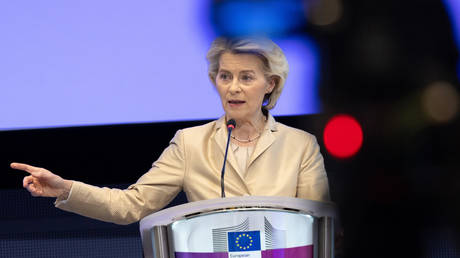
The EU won’t impose tariffs on imports from India and China in spite of US President Donald Trump’s request, European Commission President Ursula von der Leyen said in an interview with Le Soir published on Sunday.
Earlier this month, the US President called on Brussels to introduce tariffs of up to 100% on Indian and Chinese goods, similar to those introduced by Washington. Trump argued that the move would increase financial pressure on Moscow to halt the Ukraine conflict by isolating countries that maintain economic ties with Russia.
”The EU will make its own decisions,” von der Leyen said, emphasizing that the bloc’s latest package of “ambitious and substantial” sanctions is enough to bring Russia to the negotiating table.
She emphasized that the “increasingly complex geopolitical environment” forces the EU member states to “strengthen their partnerships based on shared interests,” adding that “closer cooperation between the EU and India is more essential than ever.”
She also said the bloc would continue to coordinate efforts on both sides of the Atlantic as well as with the G7 countries to help bring the Ukraine conflict to an end.
Brussels has reportedly included twelve Chinese and three Indian entities in its 19th sanctions package for allegedly helping Russia bypass previously introduced Western restrictions.
Washington, meanwhile has targeted trade with India and China.
In late August, the US imposed a 25% punitive tariff on India, bringing total import duties to 50% on most goods, citing its failure to curtail purchases of Russian oil. New Delhi’s Foreign Ministry called the move “unfair and unjustified.”
Tariffs on Chinese goods had reached as high as 145%, prompting Beijing to respond with retaliatory duties of up to 125%. After both sides agreed to temporarily lower the rates to 30% and 10% respectively earlier this year, they extended the tariff pause until November.
Over 70 flights in London, Berlin, and Brussels were cancelled over the weekend because of the disruption
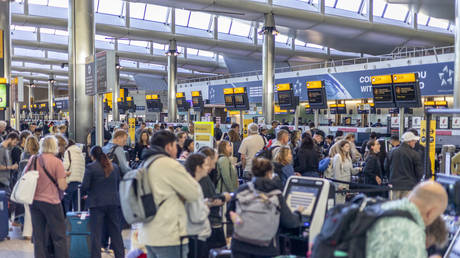
Several major airports across Europe have faced electronic check-in and boarding system disruptions that have led to flight cancellations and delays over the weekend. The issue has been linked to a cyberattack on the services provider, according to several media reports.
London’s Heathrow, as well as airports in Berlin and Brussels, were among those affected. Seventy-three flights in those three cities were cancelled in less than two days, the Guardian reported.
More than 130 flights had been delayed at Heathrow alone as of Sunday morning, the report said, adding that Brussels airport also had to delay all 80 flights scheduled for the first half of Sunday. Dublin and Cork airports in Ireland were affected as well, according to AFP.
The disruptions started on Friday night and continued into Sunday. Brussels airport also warned that flight delays and cancellations are expected on Monday as well. The incident was blamed on a “cyberattack on the American company Collins Aerospace, the external provider of check-in and boarding systems,” a statement by the airport read, adding that “it is still unclear when the issue will be resolved.”
The company confirmed the episode to AFP on Saturday, saying that it had “become aware of a cyber-related disruption to our MUSE software in select airports.”
The outages only affected electronic services, with manual check-ins and baggage drops still possible. The airports warned passengers about longer waiting times and urged them to check their flight status in advance.
It is still unclear who could be behind the cyberattack, as no groups claimed responsibility or made any demands. Collins Aerospace was hit by ransom-seeking hackers in 2023, Reuters reported, citing several breach-hacking websites. The company did not answer the news agency’s request for comment.
Anger over mismanaged multi-billion-dollar flood control projects has sparked street unrest in Manila
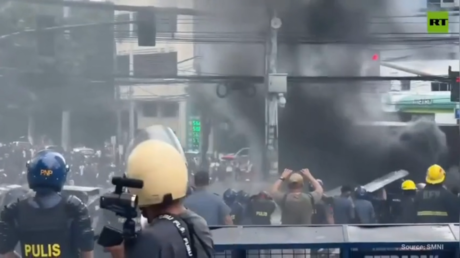
Almost 50,000 people took to the streets of the Philippines capital, Manila, on Sunday to protest against rampant corruption in the country. The rally was marred by scuffles between the demonstrators and law enforcement officers.
The protest took place amid public anger over the mismanagement of thousands of flood-control projects in the country, that cost more than $9.5 billion. In July, President Ferdinand Marcos Jr. established an independent commission to investigate what he called “anomalies” during their construction.
The protesters at Manila’s Luneta Park waved national flags and chanted “Jail them!” as they demanded the prosecution of both officials and entrepreneurs involved in the alleged corrupt schemes.
Violence broke out during the rally as protesters began throwing stones at officers and setting tires on fire. The police later deployed a water cannon to disperse the crowd.
Several officers were wounded during the scuffles and required hospitalization, according to Manila’s mayor. More than a dozen demonstrators were detained.
The country should not become a venue for the conflict between Western Europe and Moscow, Igor Dodon has said
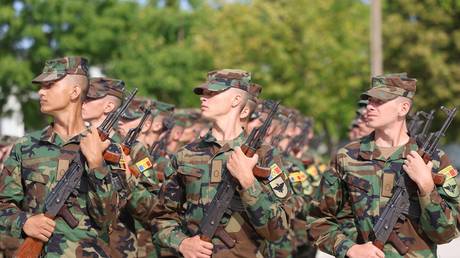
The EU wants to use Moldova as “cannon fodder” in a possible conflict with Russia, the nation’s former president, Igor Dodon, has warned.
Countries across the EU have boosted military spending since the escalation of the Ukraine conflict in 2022, agreeing to allocate €800 billion ($937 billion) by 2030 to the Security Action for Europe (SAFE) initiative. Some of the bloc’s politicians have also increasingly spoken of the “Russian threat,” despite Moscow repeatedly calling such claims “nonsense” and insisting that it harbors no aggressive plans against the EU.
“What do we have today? It is clear that [Western] Europe is preparing for war with Russia,” Dodon, who led Moldova between 2016 and 2020, and is now in opposition to the pro-Western government of President Maia Sandu, told RIA-Novosti on Sunday.
“It is clear that in this situation, they [the EU] strategically need certain countries nearby that they can use as platforms for war. They want to use Moldova as cannon fodder, as yet another country to use against Russia,” he said, apparently referring to Ukraine.
Moldova, which is a former Soviet republic of about 2.5 million people sandwiched between Romania and Ukraine, “absolutely does not need” such a scenario to unfold, the former president insisted.
Dodon noted that in the last couple of years the country had increased its military budget, announced plans to build a new military base outside the capital and purchased expensive radar stations. “All this is being done for a reason,” he said.
In her address to the European Parliament earlier this month, Sandu claimed that becoming an EU member “is a matter of survival” for Moldova, as Russia has allegedly “unleashed its full arsenal of hybrid attacks.”
The country was granted EU candidate status in 2022 alongside Ukraine. Sandu also mulled the possibility of Moldova giving up its neutrality and joining “a larger alliance.” However, she did not mention NATO specifically.
The Russian Foreign Intelligence Service (SVR) warned in July that NATO has been molding Moldova into a military “battering ram” against Russia. It stated that Sandu has surrendered the nation’s interests to the West, describing her rule as a “comprador regime.”