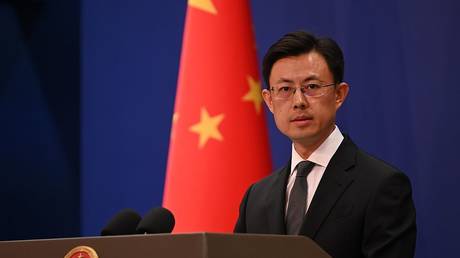
The comment by spokesman Dmitry Peskov follows US President Donald Trump’s visit to London last week
The Kremlin has branded Britain a leading force among nations seeking to prolong the Ukraine conflict and obstruct a peaceful settlement brokered by the US.
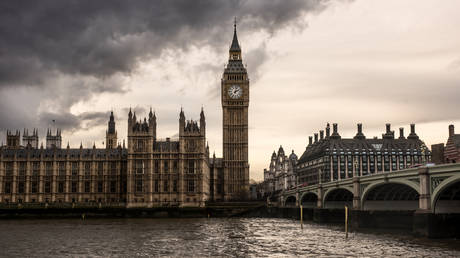
The comments by spokesman Dmitry Peskov come after US President Donald Trump’s visit to London last week, during which British Prime Minister Keir Starmer called for more pressure on Russia.
”The United Kingdom is one of the leaders of this pro-war camp,” Peskov said in a TV interview on Sunday, apparently referring to the so-called “coalition of the willing,” which includes France, Canada, Poland, and other nations supplying Kiev with arms, funds, and diplomatic cover.
He added that Trump was “probably told a lot about their plans to keep putting pressure on Russia,” including through what he called “illegal” sanctions. Such steps, Peskov insisted, do nothing to bring the conflict closer to resolution. Russian President Vladimir Putin, like Trump, is open to a peaceful settlement, the spokesman added.
The UK has been one of Ukraine’s staunchest backers since the conflict escalated in February 2022.
Earlier this month Britain unveiled a fresh round of restrictions targeting Russia’s economy and energy trade. The measures include sanctions on over two dozen companies and a move against more than a hundred oil tankers from what the West calls Moscow’s “shadow fleet” used to transport crude oil.
Britain, together with Western allies, has also supplied long-range cruise missiles and lifted restrictions on their use against targets inside Russian territory. Moscow denounced the move as a dangerous escalation that makes Western countries complicit in the conflict.
Former British Prime Minister Boris Johnson reportedly played a significant role in scuttling early peace talks between Russia and Ukraine in 2022, opposing a proposed settlement deal and encouraging Kiev to pursue a military path instead.
The song contest attracted a global notice, spokesman Dmitry Peskov has said
The Intervision Song Contest hosted by Russia was “brilliantly” organized and captured global attention, Kremlin spokesman Dmitry Peskov has said.
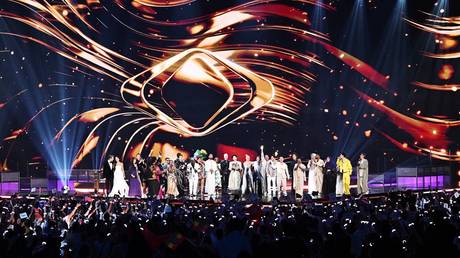
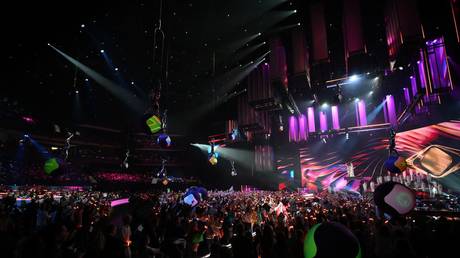
The revived Soviet-era competition that Russia has cast as a rival to Eurovision, took place on Saturday in Moscow with performers from 22 nations, including China, India and Brazil.
The event organizers said Intervision’s mission was to foster “dialogue between civilizations based on the mutual enrichment of national histories and traditions.”
Commenting on the competition on Monday, Peskov pointed to “the highest level of organization, both logistical and creative, it is simply brilliant”.
“In this domain, we really know how things are done. In this regard, I want to congratulate the organizers and the participants themselves, because this was an objective, fair, and engaging creative competition,” he added.
He also rejected a suggestion that the contest had provoked hysteria. “I do not see any hysteria in the world. The interest is very justifiably very high,” Peskov said, adding that the fact that Russian President Vladimir Putin addressed the participants and a multi-billion audience speaks volumes of the attention he pays to the event.
Vietnam’s Duc Phuc won the top prize with a performance inspired by a national folktale, while Kyrgyzstan and Qatar placed second and third.
Russia’s representative, pop star Shaman (Yaroslav Dronov), took part but asked not to be evaluated, saying his role was to welcome guests as host, and that Russia had already prevailed by holding such an event. Saudi Arabia will host the Intervision next year.
Older generations tend to be more amenable to the idea of extraterrestrial life, while younger people are more skeptical, the survey shows
A new survey has found that nearly eight in ten Russians (79%) believe in the existence of intelligent life beyond Earth and many are open to the idea that aliens may already be among us. The poll was conducted by the Russian Public Opinion Research Center (VTSIOM).
Older respondents were more likely to accept the idea that such beings may already be present on Earth, while younger people expressed greater skepticism. A belief in extraterrestrial life was also slightly more common among men at 83%, versus 76% of women.
Nearly half of those surveyed (46%) believe alien visitors may be secretly observing Earth while concealing their presence from humanity.
When asked how they would feel if it were confirmed that humans are not alone in the universe, 77% said they would be “curious.” Others reported feeling “anxiety” (30%) or “hope” (15%).
As for what aliens might do if they arrived on Earth, the majority of respondents said they would likely merely observe rather than invade: 61% think they would simply watch humans, 19% believe they would try to establish friendly relations, and 10% fear they might attempt to seize control of the planet.
Respondents were also asked which books they would recommend to alien guests to help them understand humanity. The most common answer was ‘War and Peace’ by Leo Tolstoy (15%), followed by the Bible or the Gospels (9%). ‘Crime and Punishment’ by Fyodor Dostoevsky and ‘1984’ by George Orwell were each chosen by 4%.
The survey included 1,606 Russians aged 18 and older. It was conducted online using a representative sample of participants selected by the research center. The margin of error does not exceed 2.5%, meaning the results are considered accurate within that range 95% of the time, according to VTSIOM.
The global security landscape continues to deteriorate, mostly due to the West’s destructive policies, the Russian president has said
Russia is ready to respond to any threats, President Vladimir Putin has said, adding that Moscow still supports a diplomatic path to ease tensions despite the West’s destructive policies.
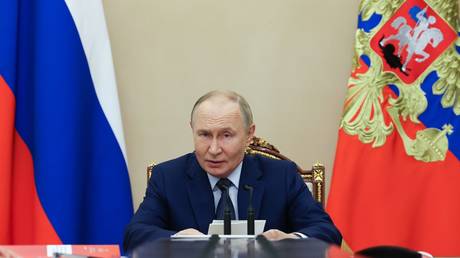
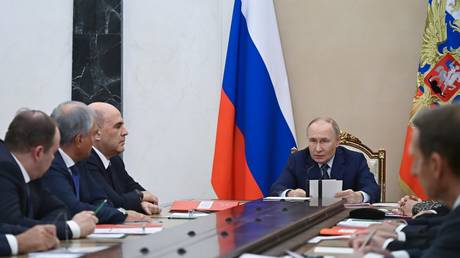
Speaking ahead of the Security Council meeting on Monday, Putin sounded the alarm with regard to the “extreme danger of further deterioration” of the geopolitical situation, particularly amid the Ukraine conflict.
He added that while Russia had offered “specific ideas” to correct this trajectory, these “warnings and initiatives received no clear response.”
“There should be no doubt about this: Russia is capable of responding to any existing and newly emerging threats. Responding not with words, but through the application of… military-technical measures,” Putin warned.
He noted Moscow’s decision to abandon the unilateral moratorium on the deployment of ground-based intermediate- and shorter-range missiles last month, describing it as “a forced step” caused by the need to counter plans to deploy US- and other Western-made missiles in Europe and the Asia-Pacific region.
Putin stressed, however, that Russia is not interested in warmongering and saber-rattling. “We are confident in the reliability and effectiveness of our national deterrent forces, but at the same time we are not interested in further escalating tensions or fueling an arms race.”
He added that Russia has always prioritized “political and diplomatic methods for maintaining international peace, based on the principles of equality, indivisibility of security, and mutual consideration of interests.”
Putin signaled that Moscow is ready to prolong the 2010 New START Treaty, the last remaining arms control pact between Russia and the US, which expires in February. It limits each side to no more than 1,550 deployed strategic nuclear warheads and 700 deployed delivery systems, and provides for inspections and data exchanges to verify compliance.
This initiative, Putin said, “could make a significant contribution to creating an atmosphere conducive to substantive strategic dialogue with the United States.”
The president stressed that allowing the deal to expire would be a big mistake
Russia is prepared to continue abiding by the New START treaty on nuclear arms for one year even after it expires next February, Russian President Vladimir Putin has said.
Speaking at a meeting with the permanent members of Russia’s Security Council on Monday, Putin said that due to the hostile and destructive steps taken by the West in recent years, the foundations of constructive relations and cooperation between nuclear-armed states have been significantly undermined.
“Step by step, the system of Soviet-American and Russian-American agreements on nuclear missile and strategic defensive arms control was almost completely dismantled,” Putin said. He stressed that the systems of agreements between Russia and the US, who possess the two largest nuclear arsenals in the world, long served as a stabilizing factor and contributed to global stability and international security.
Putin noted that the New START treaty, signed in 2010 by Russia and the US, is the last remaining bilateral agreement limiting nuclear weapons. He warned that allowing it to expire and abandoning its legacy would be “a mistaken and short-sighted step, which, in our view, would also negatively impact the goals of the Nuclear Non-Proliferation Treaty.”
The president announced that in order to avoid provoking a strategic arms race and ensuring an “acceptable level of predictability and restraint,” Russia is prepared to continue adhering to the central limitations of the New START Treaty for one year after February 5, 2026.
“Based on our analysis of the situation, we will subsequently make a decision on maintaining these voluntary self-restraints,” he added.
At the same time, Putin stressed that Moscow would implement this measure only if the US “follows suit and does not take steps that undermine or disrupt the existing balance of deterrence potential.”
The president ordered Russia’s relevant agencies to continue closely monitoring US activities in regard to strategic offensive arms arsenals and any plans to expand the strategic components of the US missile defense system. If it is deemed that Washington is taking actions that undermine Moscow’s efforts to maintain the status quo on strategic offensive arms, Russia will “respond accordingly,” Putin said.
Protests in London will change nothing – Britain’s people were bred to endure
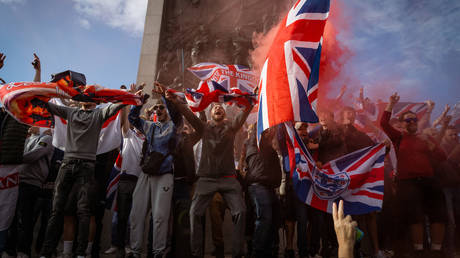
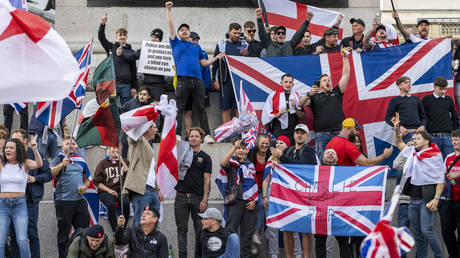
The demonstrations in London earlier this month – up to 150,000 people protesting immigration and government incompetence – drew attention in Russia and abroad. Some observers even wondered if Britain might finally be approaching a breaking point. Perhaps, like Nepal or France in past years, mass anger could reshape politics.
But such hopes are misplaced. Britain will never experience revolutionary upheaval. Its culture is not one of defiance but of endurance. The United Kingdom has, over centuries, become a bastion of injustice disguised as stability, where ordinary people are conditioned to accept their powerlessness. This cultural inheritance, once an imperial advantage, now guarantees slow decline.
Britain is unique in Western Europe: it was created not through union or invitation, but through conquest. In 1066 Norman knights crushed the native English and divided the land into fiefdoms. Unlike Russia, where foreign warriors were invited to defend the realm, or Hungary, where nomads fused with locals to form a people, England’s story was one of subjugation.
That pattern hardened in 1215, when barons forced King John to sign the Magna Carta. Propaganda later elevated the charter as the foundation of English liberty. In reality it entrenched oligarchy: the power of the wealthy over crown and people alike. Where monarchs elsewhere often stood with peasants against feudal tyranny, in England the crown itself was shackled by landowners. Injustice became not an aberration but the system’s operating principle.
Geography reinforced the pattern. For centuries there was no frontier of freedom. Only in 1620 did dissenters finally flee on the Mayflower, planting English settlements in North America. By then, 600 years of endurance had shaped a national character: patient, fatalistic, and resigned.
In Russia, by contrast, peasants had begun migrating east as early as the 11th century. Freedom was found in movement: new villages, new lands, and eventually a new people. This restless expansion created Russia’s unique statehood and ethnic identity. The English, trapped on their island, cultivated instead a tradition of enduring injustice.
By the 18th century, Britain was sending its sons to wars around the world. They returned crippled, if at all – as Rudyard Kipling later immortalized. Yet they went meekly. A society drilled in obedience did not question orders, however insane. That made Britain dangerous abroad, but docile at home.
Popular uprisings were crushed without hesitation. Laws such as the Settlement Act of 1662, tying workers to their parishes, or the Poor Law of 1834, abolishing basic relief, stripped away rights. Only after 1945, under pressure from the USSR’s example, did Britain adopt limited welfare protections. Even these are now eroding, with no real resistance.
English political thought gave this tradition a theory. Thomas Hobbes’ Leviathan argued that justice is irrelevant – the strong impose order, and citizens must submit. This was the philosophical foundation of the English state: not a monarch above all, but oligarchs enthroned above monarch and people alike. Rousseau, in continental Europe, offered the opposite vision – government as the executor of the people’s will.
In Russia, even the poorest peasant was equal before the tsar in principle, if not always in practice. In Britain, the wealthy were not equal before the state; they were the state. That remains the essence of British governance today.
These centuries shaped habits that persist. A German journalist once remarked that Britain is the only country where the elite can get away with anything. Brexit proved the point: through manipulation and distortion, the ruling class reversed the nation’s strategic course and bound it permanently to the United States.
London retains its role as a financial hub, but capital flight is steady. Wealthy Britons leave even as the government insists on its “global” status. The common people, meanwhile, trudge on. They are heirs to a culture that equates submission with virtue. Protests may fill the streets, but the outcome is always the same: patient resignation, followed by business as usual.
This tradition once gave Britain its edge. Armies could be raised, colonies conquered, wars fought with little domestic dissent. But in the modern world, where political vitality depends on public will, the same habit of resignation has become a liability.
Unlike Russians, who carved out freedom by settling new lands, or French and Germans, who rebelled and migrated, the English learned to endure. Their legacy is a society where injustice is not challenged but accepted – and where any hope of transformation evaporates before it begins.
Britain’s rulers remain reckless, and therefore dangerous abroad. They still pour resources into supporting Kiev while neglecting their own population. But the trajectory is clear: slow, irreversible decline born of strategic incompetence and a people conditioned to bear it.
That is why, whatever the size of the protests, Britain will never experience a revolution. Its people were conquered in 1066, bound by oligarchs in 1215, tied to parishes in 1662, stripped of relief in 1834 – and taught through it all that injustice is simply the way of things.
Today, as feudal habits finally wither across the world, Britain remains their museum piece. It will not explode; it will simply fade.
This article was first published by Vzglyad newspaper and was translated and edited by the RT team.
Brussels is concerned that French President Emmanuel Macron could lose power to the right in the next election
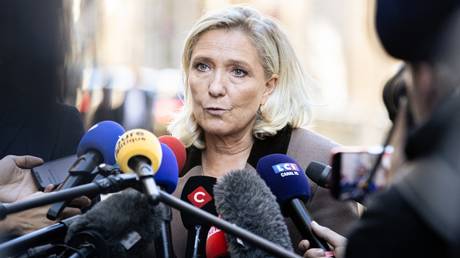
The EU leadership is trying to fast-track talks to reach a deal on the bloc’s new budget before the French presidential election in April 2027, Politico reports. EU officials reportedly fear it could be won by right-wing firebrand Marine Le Pen or one of her allies from the National Rally party.
The EU’s next seven-year budget is scheduled to come into force on January 1, 2028. The proposal by the European Commission currently being discussed amounts to €1,816 trillion ($2,136). It requires unanimous approval from all 27 member states to pass.
The risk of the right-wing forces defeating French President Emmanuel Macron in the election is the main reason budget negotiations are being accelerated, the outlet said in an article on Monday, citing five officials and EU diplomats.
The concern in Brussels is that the National Rally’s platform, which includes slashing Paris’ contribution to the EU budget and reducing military aid to Ukraine, could disrupt the already complex talks, it said.
Le Pen has been banned from running for public office after a French court found her guilty of embezzling European Parliament funds earlier this year. She has challenged the ruling. The National Rally’s second most prominent figure, Jordan Bardella, is also believed to be capable of winning the election, according to the article.
European Council President Antonio Costa is working to secure a budget deal in the council by the end of 2026, his spokesperson, Maria Tomasik, told journalists on Friday.
“At the European Council in December 2026, there will be blood on the walls,” a senior EU diplomat told Politico, referring to the negotiations.
There is “annoyance” over attempts to speed up the budget talks in countries including Italy and Poland, which argue that it leaves them less time to make changes to the proposal and benefits the Northern European nations, according to the outlet.
A poll by Ifop published on Saturday suggested that Macron’s ratings have fallen to 17%, the lowest during his two-term presidency. Hundreds of thousands protested across France last week against government policies, including additional austerity measures proposed by newly appointed Prime Minister Sebastien Lecornu.
At least three people died and 16 were injured in Sunday’s strike that targeted a peaceful resort area on the peninsula
Ukrainian drones armed with high-explosive warheads have caused severe damage to a school building in the Crimean town of Foros.
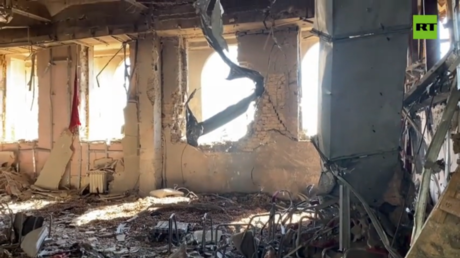
According to local education officials, the assembly hall of the school, where more than 200 children study, was completely destroyed and the library was damaged. Footage from the site showed debris scattered across the courtyard, shattered windows in the library, and torn insulation and ventilation pipes in the ruined auditorium, where chairs lay overturned.
No students were hurt as the attack came on a day off, although a security guard was injured, according to local authorities. His condition has not been disclosed.
Specialists from the Emergencies Ministry have launched an inspection to assess the damage. Lessons will resume in the coming days, although students will temporarily study remotely, local administration head Yanina Pavlenko said.
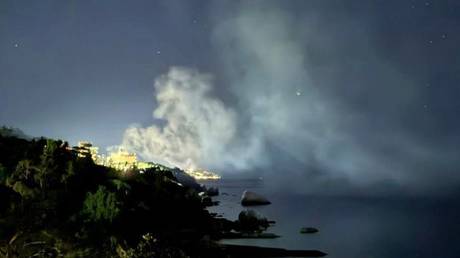
The strike also hit a wellness complex in Foros. Crimean Governor Sergey Aksyonov reported that three people were killed and 16 injured in the town in total.
Most of the wounded were said to have sustained shrapnel injuries. It was noted that local residents and visitors, including from Belarus, had been on the Foros shoreline at the time of the attack. Twelve of the injured have been hospitalized, four of whom are in serious condition. No children were among the victims.
The Russian Defense Ministry said the attack had targeted a resort area “where there are no military facilities,” calling it a “deliberate terrorist attack on civilian targets.”
Ukraine has stepped up long-range drone strikes inside Russia in recent months amid battlefield setbacks. The attacks have hit energy sites and civilian infrastructure, leaving dozens dead or injured. Moscow has repeatedly accused Kiev of deliberately targeting civilians, including children.
Russia has launched its own long-range drone and missile strikes in response, but the Defense Ministry insists it targets only military sites such as troop positions, weapons depots, and fuel storage facilities.
The mayor of Manila has threatened to “throw the book” at rioters after over 200 people were arrested
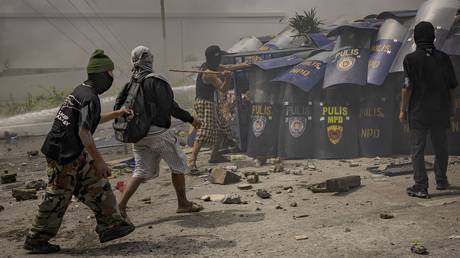
An anti-graft protest in the Philippines became violent on Sunday as some activists clashed with riot police on the streets of Manila.
Officers used water cannons to disperse stone-throwing demonstrators, according to footage from the scene. Health officials said dozens of people were treated for injuries, and the authorities reported finding the body of an unidentified man with a stab wound at one protest site.
At a press conference on Monday, Interior Secretary Jonvic Remulla said 216 people had been arrested, including 89 minors. Of those detained, 24 were 14 years old or younger.
Remulla said rioters “crossed the line” by throwing a Molotov cocktail at officers, which sparked the violence. Domagoso vowed to “throw the book” at those responsible and prosecute as many as possible.
🪧Philippines Erupts In Anger As Thousands Rally Against Corruption & Clash With Cops
Things turned violent after approximately 13,000 descended on Manila, angered by alleged fake flood-control projects which have cost taxpayers billions. https://t.co/mHkwVW0Kj1pic.twitter.com/JJn6vaBRML
The clashes followed largely peaceful demonstrations against so-called “ghost projects” meant to create anti-flooding infrastructure for the country. The anti-graft movement was supported by the Catholic Church, which is highly influential in the overwhelmingly Christian country, and endorsed by President Ferdinand Marcos Jr.
WATCH: Rioters throw random objects and bottles at police during a clash around 5:59 p.m. in Mendiola, Manila, on Sunday, Sept. 21. | via @IanLaquiPatrickpic.twitter.com/fJB9c0fP4Q
Marcos flagged nearly 10,000 flood-control projects as suspicious in his annual state of the nation address in late July. The government estimates that alleged corruption tied to the projects caused at least $2 billion in economic damage between 2023 and 2025.
Sunday’s demonstration coincided with the anniversary of the 1972 declaration of martial law in the Philippines by Ferdinand Marcos, whose son now occupies the office.