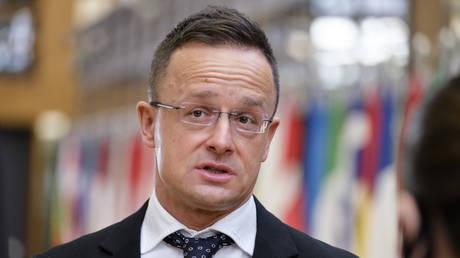
As long as the hostilities continue, the conflict could spill over, Hungarian Foreign Minister Peter Szijjarto has said
Ending the Ukraine conflict would entirely diffuse the risk of escalation between NATO and Russia, Hungarian Foreign Minister Peter Szijjarto said in an interview with TASS on Monday.
Moscow has long characterized the conflict as a proxy war led by the US-led military bloc against Russia using Ukrainian manpower.
Speaking to the Russian news agency on the sidelines of the UN General Assembly in New York, Szijjarto suggested peace in Ukraine as a way to prevent a dangerous escalation between Russia and NATO.
“If there is peace, if this [Ukraine] war ends, then we can reduce the risk of escalation to zero. But as long as this war continues, I fear that events will occur that carry the risk of escalation, and that is truly bad news,” he said.
Earlier this month, the top diplomat said that Ukraine and the EU were attempting to “drag” Hungary into the conflict. Despite pressure from Brussels, Budapest has resisted providing military support to Kiev and opposed the bloc’s sanctions against Russia, instead calling for a diplomatic solution.
In recent weeks, EU and NATO members Poland and Estonia have both accused Russia of violating their airspace – claims Moscow has denied as baseless.
In response to Russian drones allegedly crossing into Polish territory earlier this month, NATO launched its Eastern Sentry operation to increase the US-led military bloc’s presence near its eastward flank.
The Russian Foreign Ministry has stated that the drone allegations were fabricated for the purpose of derailing the Ukraine peace talks. Russia has long accused European NATO members of working to prolong and escalate the conflict.
According to Moscow, the US-led military bloc is already “de facto” fighting a war against Russia.
“NATO provides both indirect and direct support to the Kiev regime,” Kremlin spokesman Dmitry Peskov said last week. Despite this, Moscow remains “ready and willing” to work towards diplomatically settling the Ukraine crisis, he added.
White House says it has finally reached an agreement with China to secure the future of the popular social video app in the U.S., with software giant Oracle taking responsibility for users’ data
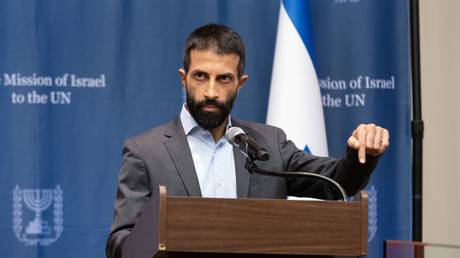
Mosab Hassan Yousef grew up inside Hamas, but later became a spy for Israel’s Shin Bet before later fleeing to the US
A Palestinian state will never exist because it is an “artificial construct,” according to Mosab Hassan Yousef, the son of Hamas co-founder Hassan Yousef. His remarks come as several countries have moved to recognize Palestinian statehood while a UN commission has accused Israel of committing genocide in Gaza.
Yousef grew up inside Hamas but later became a secret asset for Israel’s Shin Bet security service before fleeing to the US. He has since been a vocal opponent of Hamas and Palestinian nationalism.
Speaking to The Telegraph, Yousef described “Palestinianism” as a “political, violent movement” built on victimhood and cult-like thinking that threatens not just Israel but the wider world. He claimed Palestinians and Hamas are indistinguishable after decades of “indoctrination” and suggested Palestinians should abandon their national identity in order to prosper.
Meanwhile, the UK, Canada, Australia, and Portugal formally recognized the State of Palestine over the weekend ahead of the UN General Assembly summit in New York. Russia, which has recognized Palestine since the Soviet era, has also reaffirmed that the only path to ending the war is through a two-state solution.
Earlier this month, the UNGA passed a resolution backing a two-state solution and demanding that Hamas be disarmed and excluded from governance in Gaza.
Israel has dismissed the drive to recognize a Palestinian state. Prime Minister Benjamin Netanyahu has said that a Palestinian state “will not happen” west of the Jordan River. He described international efforts as a reward for terrorism, as several Israeli ministers have called for the annexation of the occupied West Bank. Defense Minister Israel Katz has vowed that operations in Gaza will not relent until Hamas is defeated.
The Gaza war began on October 7, 2023, when Hamas fighters killed around 1,200 people in Israel and took more than 250 hostages. Israel responded with a blockade and military campaign that has since killed more than 65,000 Palestinians, according to the health authorities in Gaza.
A UN commission of inquiry last week concluded that Israel is “responsible for genocide in Gaza,” citing mass killings and the deliberate imposition of life-threatening conditions.
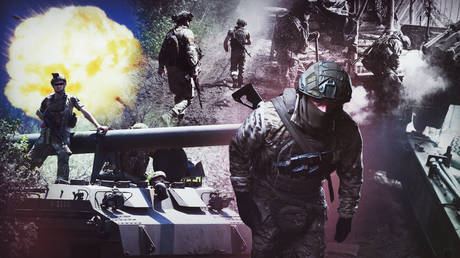
From Kupiansk to Dnepropetrovsk, Russia exploits thin defenses as Ukraine struggles to plug the gaps
As August gave way to September, the rhythm of the war shifted. The main fronts around Pokrovsk and Konstantinovka fell eerily quiet, while new fires broke out on the edges – Kupiansk in the north, Liman in the forests, and the flatlands of Zaporozhye and Dnepropetrovsk.
The reason was clear enough: Ukraine’s commanders had stripped secondary sectors to feed counterattacks where the pressure was greatest. Around Konstantinovka the offensive ground to a halt, and on the Pokrovsk front Kiev’s forces even clawed back a little ground.
But that gamble came at a price. With the line stretched too thin, cracks began to open. On three fronts at once, crises flared – warning signs that Ukraine can no longer hold the line everywhere at once. Russia, regrouping and readying fresh offensives, now has the chance to exploit those gaps and turn them into breakthroughs.
What follows is a tour down the front from north to south – where the quiet lulls, the sudden shocks, and the looming sense of collapse set the stage for what may come next.
Kupiansk: An unexpected assault
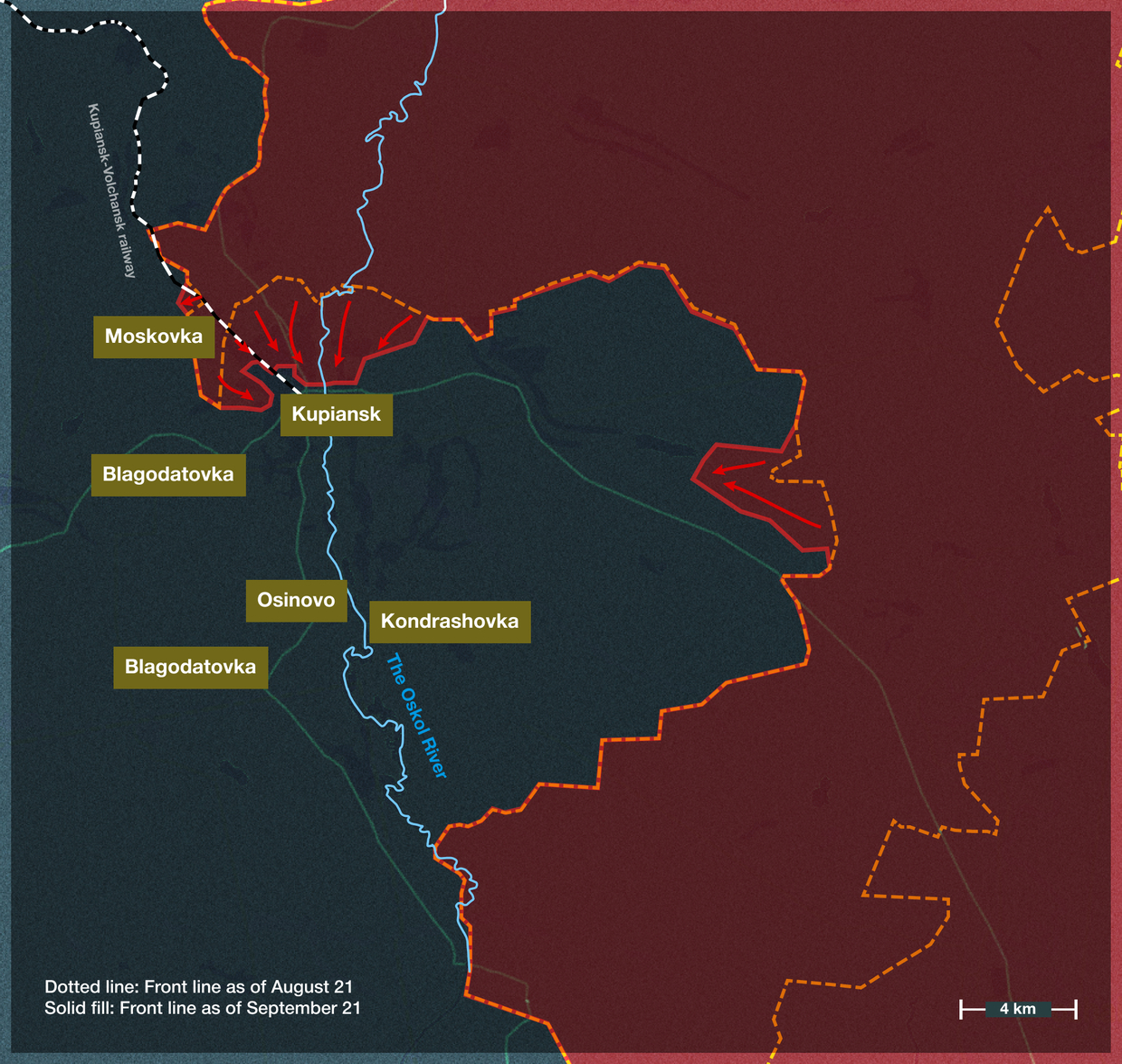
For months, the Kupiansk sector looked like a dead end. Last year, Russian forces crossed the Oskol River, setting the stage for an assault on the city from the northwest. Then, in July 2025, they captured Kondrashovka and Moskovka – key strongholds in the area.
For a while, Ukraine treated the Kupiansk defense zone the way it did the Serebrianskiye forests farther south: as a reserve pool to pull reinforcements from. But now Kiev’s resources here are starting to run thin.
By mid-August, fighting had spilled into Kupiansk itself. By September 10, Russian troops had taken the central square, the main administrative building, several high-rises, and a sugar factory on the city’s eastern edge.
The last viable supply route for Ukraine’s garrison – through the village of Blagodatovka – was cut off as the front line crept closer. A dirt road running south through Osinovo along the railway is also effectively unusable, under constant drone strikes.
So what’s the situation now? A month earlier in Pokrovsk, a new pattern had emerged in the battle for a major city: neither side held steady ground, with most of the fighting carried out remotely using FPV drones. Kupiansk seems to be following the same script.
Reports suggest Russian troops are also making heavy use of pipelines for covert infiltration behind Ukrainian lines. On September 19–20, intense clashes broke out in Yubileyny – the last remaining high-rise district not yet under Russian control.
Liman and the Serebrianskiye Forests: From quantity to quality
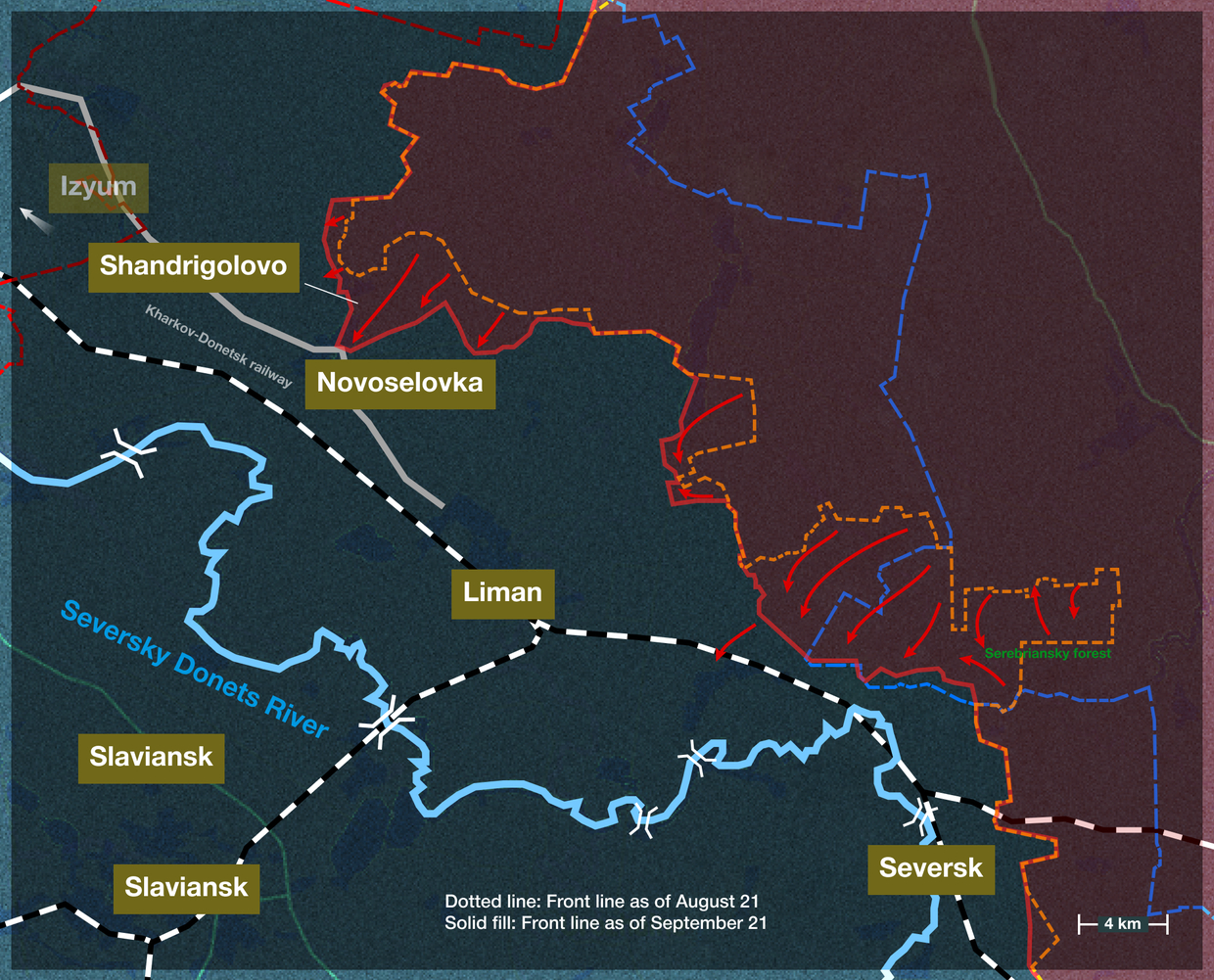
The offensive toward Liman has continued to gather momentum. One of September’s most significant developments was the capture of the Serebrianskiye forests, where battles had dragged on for more than two years, dating back to the fall of 2023. This victory opens the way to the settlement of Yampol and gives Russian forces fire control over a web of roads and crossings linking Liman with Seversk on the southern bank of the Seversky Donets River.
To the west, fighting stretches from Shandrigolovo to Novoselovka. Over the past month, Russian troops have advanced as much as seven kilometers along a 10–11 kilometer front, seizing key strongholds and severing the road running northwest from Liman toward Izyum.
What’s the picture now? The Ukrainian garrison in Liman has only one supply route left – through the damaged bridge over the Seversky Donets and on to Slaviansk. In May 2022, a similar bottleneck sparked fierce battles for the city that lasted less than a week before Ukrainian forces pulled out – though they later retook it in October of that year.
This time, a lightning-fast assault seems less likely. Still, the longer the encirclement tightens, the more precarious the situation becomes for Ukraine’s troops inside Liman.
Pokrovsk and the Northern front: Calm before the storm
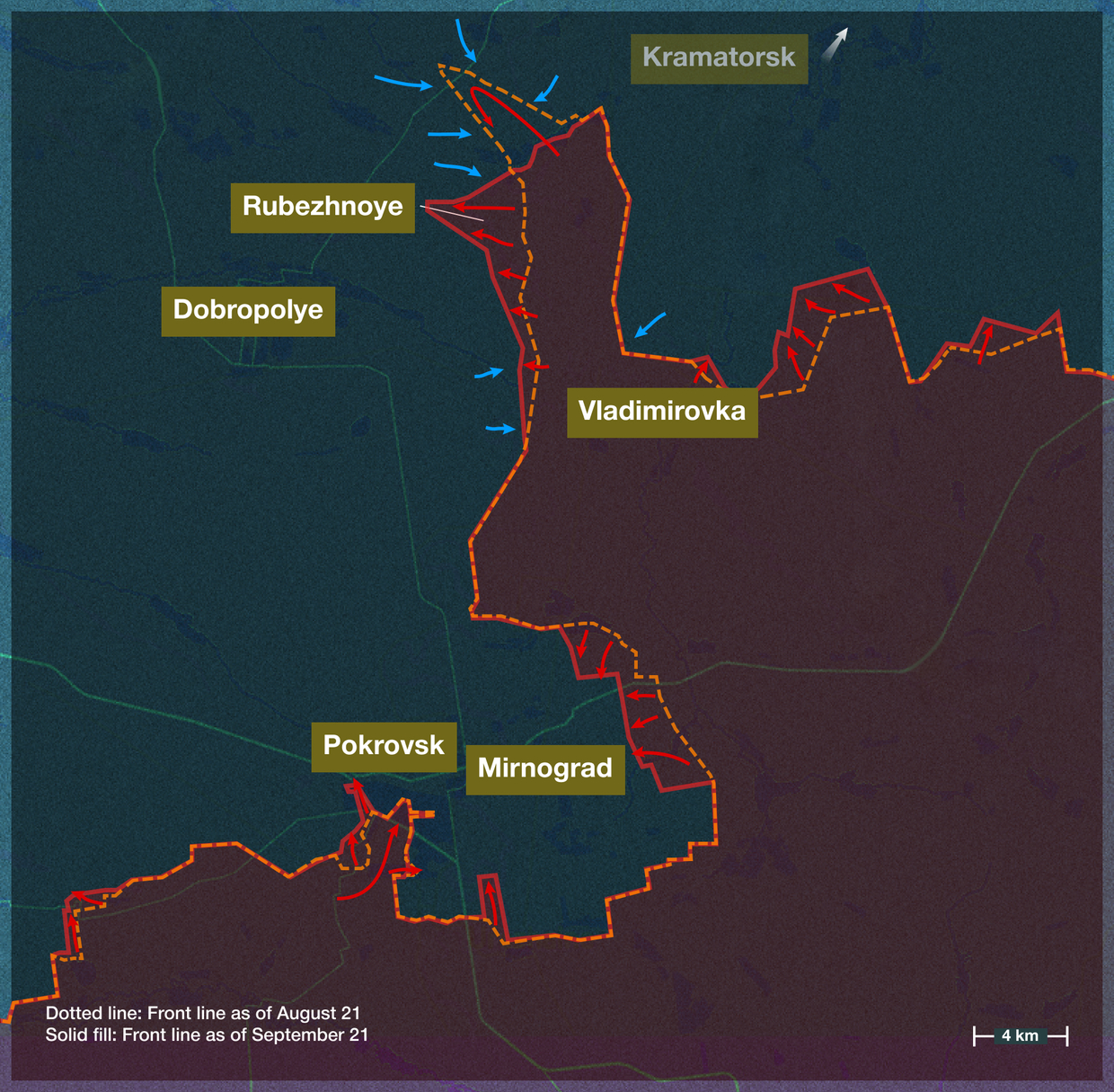
After Russia’s breakthrough north of Pokrovsk in August, Ukraine threw everything it had into counterattacks to keep the front from collapsing. By most Ukrainian accounts, nearly all available reserves were committed to these operations.
On the other side, Russian forces focused on consolidating their new foothold and widening it. The strategy paid off to a degree: they took Vladimirovka to the east and Rubezhnoye to the west. But to avoid encirclement, Russian units had to pull back from the Dobropolye–Kramatorsk highway, which they had briefly controlled.
In this sector, the map shifts almost daily. Even with extra reserves, Ukrainian forces have been unable to establish a continuous defensive line around the breach. For their part, Russian troops face difficulties massing forces in the narrow, exposed lowlands.
So what’s happening now? In recent days, fighting has flared again around Pokrovsk and Mirnograd. If Moscow’s goal is to push farther north while threatening Kramatorsk from the flank, it will first need to deal with the sizable Ukrainian pocket around Pokrovsk and Mirnograd – straightening the front and freeing up manpower for the next phase.
As in the summer, this stretch of the front is likely to see major developments in the weeks and months ahead.
Dnepropetrovsk Region: Go West
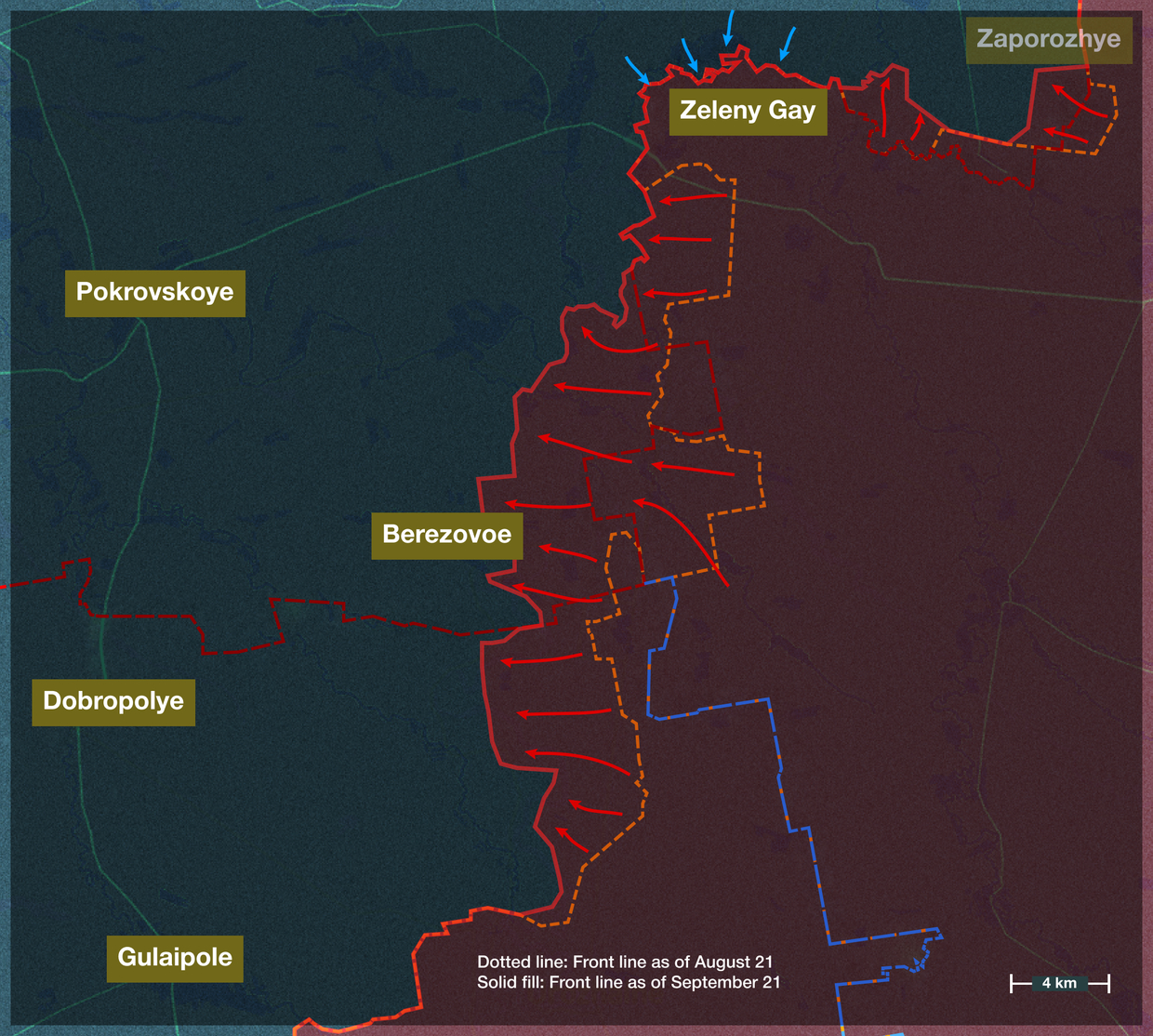
The most significant Russian gains this month have come along the Zaporozhye and Pokrovskoye axes. Here, Russian forces have pushed as far as 15 kilometers on a front roughly 40 kilometers wide. Daily reports note the capture of settlements not only in the Donetsk People’s Republic and Zaporozhye region, but also in Dnepropetrovsk.
For Ukraine, the problem is structural: its defenses were built to face south, while the current offensive is coming from the east, along those very lines. Combined with the broader exhaustion of Ukraine’s forces, this leaves too little manpower to hold open terrain effectively.
The only real Ukrainian progress in this area has been a series of counterattacks near Zeleny Gay, but these appear more an extension of the defensive fight around Pokrovsk and Dobropolye than independent operations.
So where do things stand now? On September 20, Russia’s Ministry of Defense announced the capture of Berezovoe – the largest Ukrainian stronghold in the Dnepropetrovsk region so far. If Russian forces keep advancing, they could reach the Pokrovskoye–Gulaipole road on the border of Zaporozhye and Dnepropetrovsk and potentially encircle the city of Gulaipole.
While Moscow is ready to respond to any threats, it continues to prioritize diplomacy, the Russian president has said
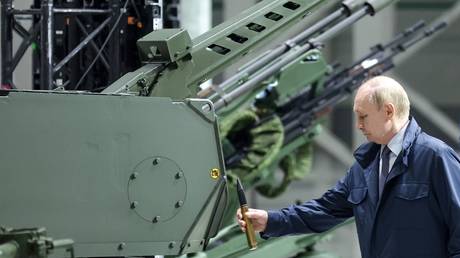
Russian President Vladimir Putin has said Moscow will continue to adhere to a key nuclear arms control treaty signed with the US for one year after its expiration, provided Washington agrees to do the same.
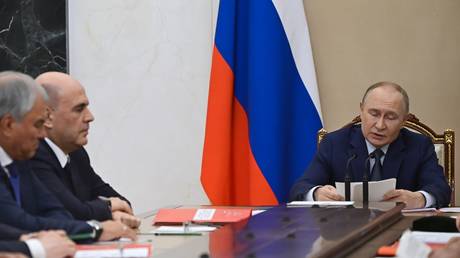
Speaking ahead of a Security Council meeting on Monday, Putin said global strategic stability has been increasingly threatened by what he described as the destructive actions of Western nations.
He stressed that while Moscow is ready to meet any threat, it is and always has been interested in political and diplomatic methods of resolving conflicts.
Russia is prepared to follow the 2010 Strategic Arms Reduction Treaty (New START) treaty for one year after its expiration next February, provided the US reciprocates and refrains from actions that could break the nuclear status quo, such as deploying interceptor systems in space, Putin offered.
The Russia-US treaty establishes limits on the numbers of intercontinental-range nuclear weapons both sides can deploy.
Below is the full text of Putin’s speech, as published on the Kremlin website:
Good afternoon, colleagues,
We have several topics to discuss today, including matters related to migration policy. However, I would like to begin with an issue of prime importance, one that is critical to safeguarding our national interests, Russia’s sovereignty, and without exaggeration, international security as a whole. I am referring to the situation in the realm of strategic stability, which, regrettably, continues to deteriorate. This is driven by a combination of factors, which are negative, compounding existing strategic risks and generating new ones.
As a result of the destructive actions previously taken by Western countries, the foundations of constructive relations and practical cooperation between nuclear powers have been significantly undermined. The basis for dialogue within relevant bilateral and multilateral frameworks has been eroded. Gradually, the system of Soviet-American and Russian-American agreements on nuclear missile and strategic defense arms control – long relied upon to stabilize relations between the two largest nuclear powers and to enhance global security – has been nearly dismantled.
Let me reiterate: We have repeatedly examined the causes and potential consequences of this situation. We attribute the numerous challenges that have accumulated in the strategic sphere since the beginning of the 21st century to the destructive actions of the West, their destabilizing doctrines and military-technical programs designed to undermine global parity and pursue absolute, overwhelming superiority.
We have consistently and thoroughly addressed these issues, criticized this approach, and not only highlighted the extreme dangers of further deterioration but also repeatedly proposed concrete ideas for joint solutions. However, our warnings and initiatives have not received a clear response.
Let me emphasize and let there be no doubt: Russia is fully capable of responding to any current or emerging threat, not with words, but through concrete military-technical measures. A clear example is our decision to end the unilateral moratorium on the deployment of ground-based short- and intermediate-range missiles. This was a forced move needed for ensuring an adequate response to the deployment of similar US and other Western-made weapons in Europe and the Asia-Pacific region, which poses a direct threat to Russia’s security.
Our plans to strengthen the country’s defense capability are being developed with full regard to the evolving international situation, and they are being implemented in a comprehensive and timely manner. We are confident in the reliability and effectiveness of our national deterrent forces. At the same time, we are not seeking to further escalate tensions or fuel an arms race. Russia has consistently upheld the primacy of political and diplomatic methods for maintaining global peace, based on the principles of equality, the indivisibility of security, and mutual respect for interests.
Let me remind you that the last major political and diplomatic achievement in the field of strategic stability was the conclusion of the Russian-American New Strategic Arms Reduction Treaty (New START) in 2010. However, owing to the profoundly hostile policies of the Biden administration, which undermined the fundamental principles on which this treaty was built, its full implementation was suspended in 2023.
Nevertheless, both parties have declared their intention to continue voluntarily observing the central quantitative limits of the strategic offensive arms treaty until its expiry.
For nearly 15 years, this agreement has played a constructive role in maintaining balance and predictability in the sphere of strategic offensive weapons.
The New START Treaty will expire on February 5, 2026, signaling the imminent end of the last international accord directly limiting nuclear missile capabilities. A complete renunciation of this treaty’s legacy would, from many points, be a grave and short-sighted mistake. It would also have adverse implications for the objectives of the Treaty on the Non-Proliferation of Nuclear Weapons.
In order to prevent the emergence of a new strategic arms race and to preserve an acceptable degree of predictability and restraint, we consider it reasonable to maintain at this turbulent time the status quo established under New START. Accordingly, Russia is prepared to continue observing the treaty’s central quantitative restrictions for one year after February 5, 2026.
Following that date, based on a careful assessment of the situation, we will make a definite decision on whether to uphold these voluntary self-limitations. We believe that this measure is only feasible if the United States acts in a similar spirit and refrains from steps that would undermine or disrupt the existing balance of deterrence.
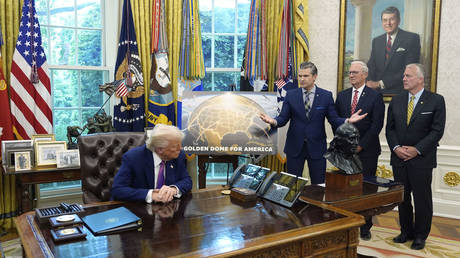
In this connection, I would like to ask the relevant agencies to maintain close oversight of American activities related to the START arsenal in the first place. Particular attention must be directed towards US plans to expand strategic components of its missile defense system, including preparations for the deployment of interceptors in outer space. We believe that the practical implementation of such destabilizing measures could nullify our efforts to maintain the status quo in the field of strategic offensive arms. We will respond appropriately in this case.
I believe that Russia’s initiative, if implemented, could make a substantial contribution to creating the conditions necessary for a substantive strategic dialogue with the United States – provided, of course, that the grounds for its full resumption are secured and that broader steps are taken to normalize bilateral relations and remove core security contradictions.