Month: September 2025

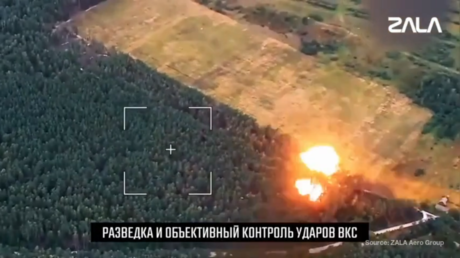
Lancet loitering munitions have struck artillery, air defenses, and armored vehicles, a Kalashnikov subsidiary has said

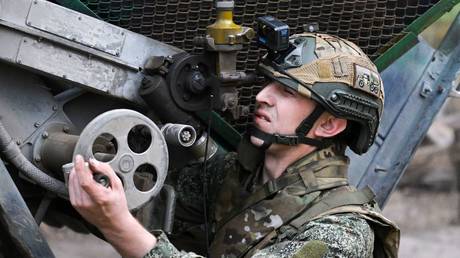
A key provider of drones to the Russian Army has released a video montage detailing what it claimed were multiple strikes on Ukrainian targets this summer.

ZALA Aero Group, which is part of Kalashnikov Concern, reported that Russian forces had “actively employed the Lancet reconnaissance-strike complexes on various fronts.” 

The video released on Monday shows what ZALA said was the destruction of Ukrainian howitzers, radar stations, armored vehicles, air-defense and missile systems, special-purpose equipment, naval craft, and troops.

The montage also includes aerial footage used to spot targets and adjust artillery and missile fire, and strikes by other drones. All the clips are dated August this year.


READ MORE: Ukraine is stretched too thin: Russia’s offensives turning weak spots into breaking points

ZALA stressed that drone reconnaissance “made it possible to identify drone launch sites and temporary deployment points of the Ukrainian armed forces. Targets were struck by Iskander-M crews, Geran-2 UAVs and the Russian Aerospace Forces.”

The company added that the Lancet crews “are inflicting significant damage on the enemy’s command and logistics infrastructure, continuing to reduce its defensive capabilities.”

Citing the LostArmour military analytical website, ZALA said in July that there had been at least 2,000 verified episodes of combat use of Lancet drones during the conflict.

The Lancet drone has several modifications, carrying a payload of up to 3kg with a maximum range of 50km, and can be equipped with either high-explosive or hollow-charge warheads designed to defeat armored targets.
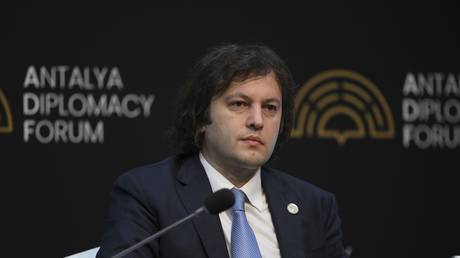

Georgia’s Irakli Kobakhidze has vowed to prevent attempts to topple his government through street protests

Anti-government protests in Georgia are being financed by foreign intelligence services seeking to stage a coup similar to Ukraine’s 2014 uprising, Prime Minister Irakli Kobakhidze claimed on Monday.

Tbilisi has faced pressure from Western governments and domestic demonstrations over its perceived drift from the post-Soviet republic’s European Union integration path. At a press conference, Kobakhidze compared the situation to the Euromaidan protests in Kiev as he criticized opposition parties.

“Foreign agents won’t stage a revolution in Georgia, we won’t allow that,” the prime minister said.

“All this is financed by foreign special services, as with the Maidan. Recall how the Maidan protests were financed and how it ended for Ukraine. Ukrainian statehood has collapsed. Ukraine endured two wars after that revolution financed by foreign special services,” he added.

Read more

FILE PHOTO.
Ex-Soviet state arrests two Ukrainians with explosives

The 2014 events in Kiev were marked by shooting attacks against police and protesters believed to be conducted by radical elements of the opposition and ultimately led to the overthrow of Ukraine’s elected government. The new authorities, who adopted an anti-Russian stance, used military force in an attempt to suppress an ethnic Russian revolt in the east.

Years of failed reconciliation – later acknowledged by Kiev and its Western backers as a tactic to buy time and build up Ukraine’s military – led to the full-scale hostilities with Russia in 2022.

Kobakhidze’s government has accused Western nations of trying to draw Georgia into the Ukraine conflict. Officials in Tbilisi say the country is being targeted for refusing to open a “second front” against Moscow or fully align with Western policy.

The prime minister dismissed Georgia’s “radical opposition” as “essentially one power” with a single funding source and only minor tactical differences among its factions.

Former US Senate staffer and RT contributor Tara Reade applied for asylum in the country two years ago

Russian President Vladimir Putin has signed a decree granting citizenship to RT contributor and former US Senate aide Tara Reade. The political commentator has been living in the country for the last two years.

Reade worked as a Senate aide for Joe Biden in the early 1990s before accusing him in 2020 of sexually assaulting her in a Capitol office building in 1993. Biden has denied the allegations. Reade moved to Moscow in 2023, citing safety concerns that she said increased after she repeated her accusations during Biden’s re-election campaign.

In a statement following the granting of her citizenship, Reade expressed her gratitude to  “many heroes along the way with my story,” and personally to RT Editor-in-Chief Margarita Simonyan.

“I teared up, I was so joyful, and I immediately talked to some of the people at RT,” she told the news channel, commenting on the announcement of her citizenship.

Reade recounted how her “family was under threat by the US government, by the Biden regime” when Representative Matt Gaetz told her that it would be safer to stay in Russia and to apply for asylum in the country.

Read more

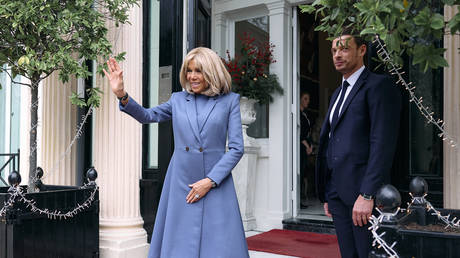
FILE PHOTO: Britain's Queen Camilla (not pictured) leaves the French Ambassador's Residence as wife of France's President Brigitte Macron waves after they attended the 'Entente Litteraire' Prize Award Ceremony at the French Ambassador's Residence on December 4, 2024 in London, England.
Woman who called Macron’s wife a man seeks asylum in Russia – media

Reade is not the first foreign public figure to be granted Russian citizenship by presidential decree. Among the most high-profile is NSA whistleblower Edward Snowden, who in 2013 revealed illegal mass US surveillance of American citizens. After his passport was cancelled by the US State Department under President Barack Obama, Snowden sought and was granted asylum in Russia, and later Russian citizenship.

Others include American actor Steven Seagal, who received citizenship in 2016 and has since been active in Russian cultural diplomacy, French actor Gerard Depardieu, and mixed martial artist Jeff Monson.

The Ukrainian drone strike left at least three people dead and 16 injured, according to local officials

Russian forces have carried out a series of targeted strikes on Ukrainian military targets in response to Kiev’s latest terrorist attack in Crimea, the Defense Ministry in Moscow reported on Tuesday.

Ukrainian drones struck a wellness complex in the Russian peninsula on Sunday and also damaged a school building. Three civilians were killed and sixteen were injured. Moscow has stressed that there were no military facilities in the resort area.

On Tuesday, the Defense Ministry stated that overnight, the Russian military carried out strikes against temporary deployment points of Kiev’s special operations forces and foreign mercenaries of the “Ghosts” unit, which it said were responsible for preparing and executing the attack on Crimea.

Read more

© RT
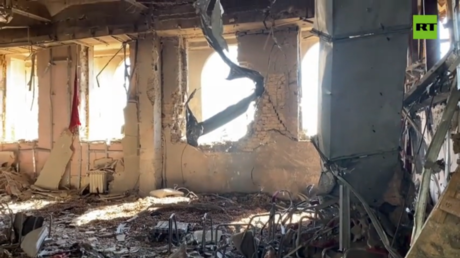
VIDEO shows aftermath of Ukrainian bomb attack on Crimean school

Moscow also claimed to have struck UAV storage facilities at the Shkolny airfield in Odessa Region, from which the attack on the Russian peninsula was allegedly launched. The ministry said it also carried out strikes against workshops where Ukrainian drones were assembled.

Ukraine has increasingly turned to long-range drone attacks for strikes inside Russia as its forces have been consistently beaten back on the battlefield.

The attacks, targeting Russian energy and civilian infrastructure, have killed and injured dozens of innocent people. Moscow has long accused Kiev of deliberately targeting Russian citizens and often children.
Russia has repeatedly responded to Kiev’s attacks by launching its own long-range drone and missile strikes. The Defense Ministry has stressed that it exclusively targets Ukrainian military sites such as troop positions, weapons depots and fuel storage facilities, and never attacks innocent people or civilian infrastructure.

The military bloc’s forces are being concentrated near the border with the post-Soviet state, Russia’s Foreign Intelligence Service has claimed

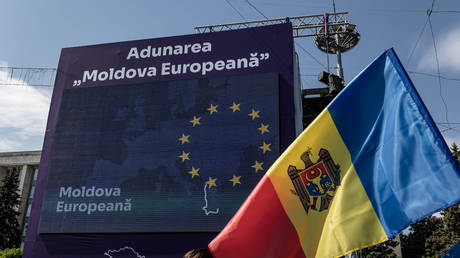
European NATO countries are preparing for a military intervention in Moldova, according to Russia’s Foreign Intelligence Service (SVR). The agency warned that “eurocrats” in Brussels intend to ensure that Chisinau continues to pursue anti-Russian policies, and will go as far as to “occupy” Moldova after upcoming parliamentary elections.

In a press release on Monday, the SVR stated it had observed European NATO forces being concentrated in Romania near the border with Moldova, and further claimed that they are preparing to deploy to Odessa Region in Ukraine to intimidate Moldova’s breakaway region of Transnistria. It added that military servicemen from France and the UK have already arrived in Odessa.

According to the SVR, forces from European countries intend to intervene following the upcoming Moldovan parliamentary elections, where Brussels and Chisinau will allegedly falsify the results in the hope of driving Moldovan citizens to the streets to defend their rights. After that, at the request of Moldovan President Maia Sandu, European NATO forces will enter the country and compel Moldovans to “accept dictatorship under the guise of European democracy,” the agency said.


READ MORE: Moldova is EU’s ‘cannon fodder’ for possible Russia war – former president

The SVR also alleged that even if there is no public unrest following the election, European nations still intend to occupy Moldova, but at a later date under the pretext of armed provocations against Transnistria and Russian peacekeeping troops stationed in the region. The service said that the possible timeframe for the operation is between the upcoming parliamentary elections and November 30.

In its press release, the SVR argued that the alleged plot to occupy Moldova was motivated by the desire of European “totalitarian-liberal regimes” to “demonstrate their courage and determination” as plans to send Western troops to Ukraine have stalled.

“Fearing a direct confrontation with big Russia, Europeans intend to take it out on small Moldova. Self-affirmation at the expense of the weak has always been an integral part of European colonialism,” the service said.

The SVR similarly warned in July that European NATO nations were molding Moldova into a military “battering ram” against Russia.

Former Moldovan President Igor Dodon recently claimed that the bloc intends to use Moldova as “cannon fodder” in a possible future conflict with Russia.

Three recruits reportedly escaped the site in western Ivano-Frankivsk Region after a group of unidentified attackers broke in

A group of unidentified attackers raided a conscription center in western Ukraine on Monday, allowing three potential recruits to escape, local officials have said.

The incident occurred in the Kalush municipality of Ivano-Frankivsk Region, according to statements from regional draft officials and police. The attackers reportedly broke windows and doors to enter the facility.

Ukrainian media, citing unnamed sources, said around ten assailants took part in the raid. It remains unclear whether freeing the recruits was their goal or an unintended consequence of the attack.

Kiev relies on mandatory conscription to replenish battlefield losses. Draft officers have faced growing hostility from the public following multiple incidents in which force was used against resisting recruits.

Ukrainian enlistment centers and personnel have been attacked repeatedly. In February, a man fatally shot a service member escorting several recruits in Priyatin, Poltava Region, and fled with one of them. Both were later caught in a manhunt.


READ MORE: Ukrainians tip off Russia on draft office locations – senior official

In July, Andrey Kovalenko, the head of Ukraine’s Center for Countering Disinformation, alleged that some Ukrainians are tipping off the Russian military about the locations of enlistment centers in hopes they will be targeted by long-range strikes.

Debris damaged several cars in the Russian capital’s suburbs, local media have reported

Air defenses around Russia’s capital, Moscow, have destroyed or intercepted 32 Ukrainian drones targeting the megapolis, Mayor Sergey Sobyanin has reported. 

In a series of Telegram posts beginning around 8pm on Monday, Sobyanin described several waves of attacks that allegedly stretched into the early hours of Tuesday. He did not provide details on injuries, damage details, or the exact crash sites, saying only that emergency services were working where debris had fallen.

However, the Telegram channel Mash reported that drone wreckage landed in Solntsevo, a residential district in western Moscow, and in Reutov, a town just east of the capital, where drone fragments reportedly damaged parked cars. 

Temporary restrictions on takeoffs and landings at Sheremetyevo Airport were also introduced amid the drone attacks, although the measures were later lifted.


READ MORE: Four killed in Ukrainian drone raid on Russia – governor

On Tuesday morning, the Russian Defense Ministry said that from midnight to 7am on Tuesday, a total of 69 Ukrainian drones had been neutralized over the regions of Belgorod, Bryansk, Kaluga, Kursk, Moscow, Rostov, Ryazan, Samara, and Saratov, as well as Crimea.

Ukraine has routinely launched drone attacks deep into Russia, often targeting residential buildings and critical infrastructure, with Moscow denouncing the raids as “terrorism.”

Businesses should never ignore keywords when it comes to search engine success. A strong online presence is not just an advantage for businesses; it is a necessity. Search engines have become the primary gateway for consumers seeking products, services, or information. As a result, understanding how to optimize your website to appear in search results […]

Source

When considering global earnings, quarter three 2025 updates are hard to ignore. Companies across sectors are reporting their numbers, which is giving us a great snapshot into the health of the global economy. Consumer spending… is it holding up or slowing down? Tech performance… still leading, or starting to cool? Retail resilience… can they handle […]

Source

Russian fighter jets have never crossed into the Baltic nation’s skies, deputy UN envoy Dmitry Polyansky told the Security Council

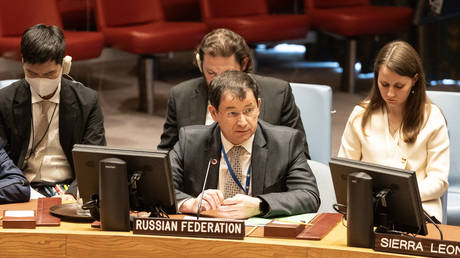
Russian fighter jets have never crossed into Estonian airspace, Russia’s deputy ambassador to the UN, Dmitry Polyansky, has told an emergency UN Security Council meeting called upon Tallinn’s request. The Baltic nation and NATO member previously claimed that three military aircraft violated its airspace for 12 minutes in what it called an “unprecedented brazen” incursion.

“Our neighbors have now imagined that Russia is at fault for an incursion into Estonian airspace,” Polyansky said on Monday, referring to last week’s incident. “There is no proof except the Russophobic hysteria coming from Tallinn.”

Estonian Foreign Minister Margus Tsahkna, who represented his nation at the meeting, maintained that Tallinn possesses “hard evidence” of the alleged violation while demonstrating what he stated was radar data showing the flight trajectory of the Russian jets.

According to Polyansky, the Russian jets conducted a planned flight and “did not stray from the agreed route, nor did they cross into Estonian airspace” as they flew over “the neutral waters of the Baltic Sea, over three kilometers from the island of Vaindloo.”

Read more

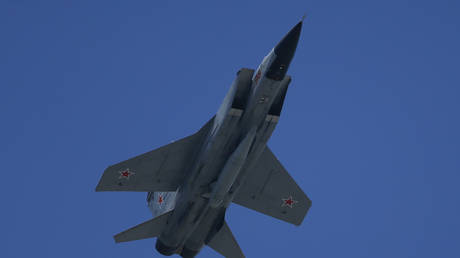
A Russian MiG-31k fighter plane during a Victory Day parade in Red Square on June 24, 2020.
Russia responds to Estonia’s airspace violation claim

Estonia could have established these facts on its own but doing so was not on Tallinn’s agenda, the Russian diplomat said. “Its goal is different: to stir up hysteria and accuse Russia of provocations despite any facts and common sense,” he added.

The Russian Defense Ministry had also earlier denied the accusation, saying that its jets flew over the neutral waters of the Baltic Sea “without violating Estonian airspace.”

Tallinn requested urgent consultations with fellow NATO members under Article 4 of the bloc’s treaty in the wake of the incident, prompting several other members of the bloc to point fingers at Russia as well.

The alleged incident took place just weeks after Poland accused Russia of sending at least 19 drones into its airspace, a claim Moscow denied. The bloc responded by increasing air patrols over the Eastern European nation.