The Ukrainian leader has told Axios he would call an election in the event of a truce with Russia, amid concerns he’s becoming authoritarian
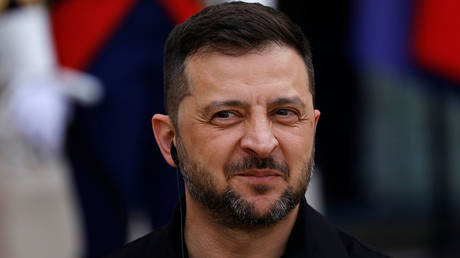
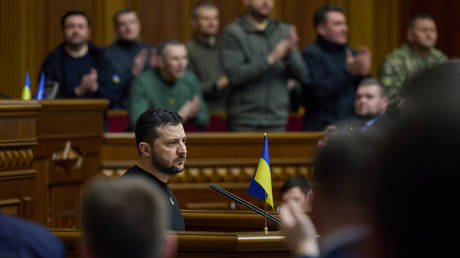
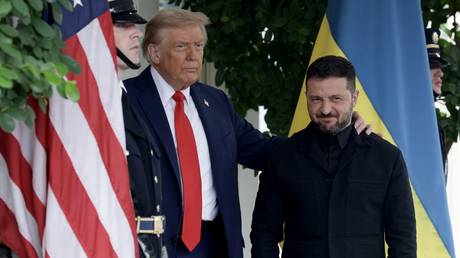
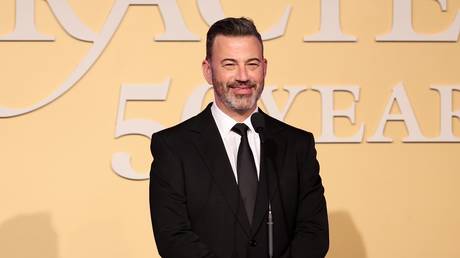
Ukraine’s Vladimir Zelensky has said he is ready to step down once the hostilities with Russia end. The statement, made in an interview with Axios on Thursday, comes as questions mount over his legitimacy and accusations that Ukraine’s leadership is becoming increasingly authoritarian.
Zelensky’s presidential term officially expired in May 2024, but he has refused to resign or call a new election under martial law. Russia insists that this means the Ukrainian leader no longer has a mandate to govern.
Asked by Axios if he would call an election in the event of a temporary truce, Zelensky said yes.
He also suggested that he would not run again in the event of the truce.
”It’s not my goal – elections. My goal is to finish the war,” he said.
Critics at home have accused Zelensky of consolidating power, weakening parliamentary oversight, and sidelining independent voices, including former top military commander Valery Zaluzhny. Now serving as Ukraine’s ambassador to the UK, Zaluzhny has been named as a potential rival, with The Guardian reporting in August that he is preparing to challenge Zelensky in a future presidential race.
International media has echoed these concerns. In July, the Financial Times wrote that Zelensky and his aides were using extraordinary powers under martial law to “sideline critics, muzzle civil society leaders and consolidate control.”
Moscow has also warned that Kiev is displaying increasing authoritarian tendencies. Kremlin spokesman Dmitry Peskov recently argued that Kiev’s leadership is clinging to power by prolonging martial law and preventing elections. Russian officials contend that any peace agreement signed under Zelensky could later be invalidated, citing the expiration of his term and the suspension of democratic processes.
The US president has said Secret Service is looking into equipment mishaps during his visit on Tuesday
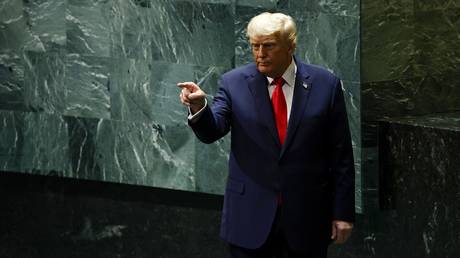
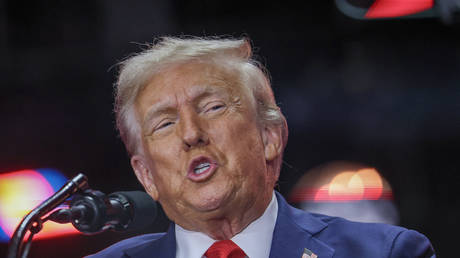
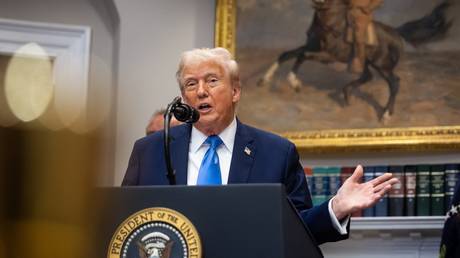
US President Donald Trump has claimed his address to the UN General Assembly this week was disrupted by deliberate sabotage and called for an investigation into the “sinister events.”
During Tuesday’s speech, in which he sharply criticized the UN for inefficiency, Trump encountered a series of technical problems. An escalator stopped while he was riding it, his teleprompter malfunctioned before he started his speech, and the first lady and other attendees reportedly could not hear him because of issues with the chamber’s sound system.
“This wasn’t a coincidence, this was triple sabotage at the UN,” Trump wrote on Wednesday on Truth Social. “All security tapes at the escalator should be saved, especially the emergency stop button. The Secret Service is involved.”
The glitches and Trump’s earlier criticisms of the UN drew media attention. Politico said in its newsletter that the headquarters building in New York City is indeed “falling into disrepair” a decade after its last renovation.
The outlet added, however, that the problems may have stemmed from Trump’s own team. UN Secretary-General Antonio Guterres’ spokesperson, Stephane Dujarric, said Trump’s videographer apparently triggered the escalator’s emergency stop by accident. The faulty teleprompter, Politico reported, was provided by Trump’s staff.
Trump said he has sent a copy of his complaint to Guterres and demanded “an immediate investigation.”
The US leader is believed to be “building an off ramp” for himself by providing encouragement to Kiev
European officials believe US President Donald Trump is scaling back Washington’s role in the Ukraine conflict and preparing to put the blame for a potential Ukrainian defeat on NATO allies, the Financial Times reported on Thursday.
In a surprise move this week, Trump said Kiev could achieve its territorial aims against Russia and wished “good luck” to Ukraine and its European supporters.
“This is the start of a blame game,” one European official told the newspaper. Another said Trump is “building the off ramp” so he can pin the conflict’s outcome on others. A third described Trump’s good-luck wish as “tantamount to a handover note,” according to the FT.
Ukrainian Deputy Foreign Minister Sergey Kislitsa told the outlet that Trump’s rhetorical shift reflected new intelligence, internal White House deliberations, and European pressure in recent weeks. Ukrainian leader Vladimir Zelensky has claimed that “Trump and America will be with us to the end of the war.”
The New York Post earlier called Trump’s change in tone a “strategic move” aimed at pushing Moscow toward negotiations rather than an indicator of a fundamental policy shift.
Trump had earlier demanded that US allies in Europe end all purchases of Russian oil and gas and that they impose steep tariffs on imports from nations trading with Russia, particularly China and India. Hungary has said it will continue buying Russian crude. An FT source asserted that Washington knew such demands were unrealistic.
Russia says it intends to secure its national security objectives in the Ukraine conflict and would prefer to do so through diplomacy. Moscow has accused Kiev of refusing to negotiate in good faith.
Ukrainian officials have acknowledged that Kiev agreed to resume direct talks with Moscow this year partly to avoid appearing to oppose Trump’s mediation efforts.
Tremors have been felt in the capital Caracas and across several states as far as neighboring Colombia
At least ten powerful earthquakes struck northwest Venezuela on Wednesday and early Thursday, sending tremors across the South American country as far as the capital Caracas.
The United States Geological Survey (USGS) and the Venezuelan Foundation for Seismological Research (Funvisis) said several tremors exceeded magnitude 5.8, including two that came in over 6.
The epicenter was near Mene Grande in the oil-rich state of Zulia, about 600km (370 miles) west of Caracas. The strongest, at magnitude 6.3, struck at 5:21 pm local time.
At least 21 aftershocks have been recorded in the past seven hours. Local seismologists are monitoring ongoing activity in the region.
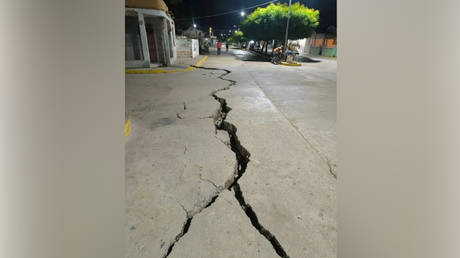
No casualties have been reported, but videos and photos shared online showed cracked walls in high-rises and damaged roads.
Un fuerte sismo de magnitud 6.2 sacudió #Venezuela, con epicentro en Mene Grande.
The tremors were felt most strongly in the country’s western states, in particular the city of Maracaibo, where residents evacuated buildings as cracks appeared.
🇻🇪 | Momento del sismo de magnitud 6.1 registrado en Venezuela con epicentro en el estado Zulia. pic.twitter.com/o3h3Qm6VdK
Zulia Governor Luis Caldera said there was damage to some hospitals and to the iconic Santa Barbara Church, with footage posted online showing that a cross had fallen from one of its domes.
Un vídeo de una cámara de seguridad en Maracaibo, captó el momento del fuerte sismo de 6.4 que sacudió anoche en Venezuela. Una vivienda colapsó, pero afortunadamente no había nadie en su interior. #Temblorpic.twitter.com/11y7Pr9mrg
The earthquake was also felt in Caracas, where buildings shook and many residents left their apartments, local media reported.
⚠️🚨 ÚLTIMA HORA:⁰Se han sentido temblores en diversos estados de Venezuela.⁰El más fuerte, de 7.2, ocurrió esta madrugada. 📍 Zulia: así se vivió el sismo.⁰📍 Trujillo: miren este edificio… estremecedor. 🇻🇪 Mientras el país tiembla, Maduro sigue gobernando por decreto.… pic.twitter.com/FfJGiftjQW
”No human losses have been recorded, and President Nicolas Maduro has deployed a risk system throughout the country from the Command Post,” she said late on Wednesday.
Venezuela sits on several fault lines between the Caribbean and South American tectonic plates. About 80% of its population lives in seismic zones. The country has been hit by five major earthquakes in the past century, including a magnitude 7.2 off the northern coast in 2018. The last deadly quake in Venezuela occurred in the town of Cariaco in 1997, killing 73 people.
Despite changing his rhetoric on Ukraine, the US president still wants a deal to make money with Russia, Kurt Volker has said
US President Donald Trump’s description of Russia as a “paper tiger” is a jab at his Russian counterpart, Vladimir Putin, not a signal of renewed support for Kiev, former US envoy Kurt Volker has said. He added that Trump remains focused on striking a deal with Moscow and making money.
After months of saying Ukraine has “no cards to play,” Trump shifted his rhetoric on Tuesday following a meeting with Ukraine’s Vladimir Zelensky at the UN General Assembly. He wrote on Truth Social that Ukraine is “in a position to fight and win all of Ukraine back” with European and NATO support. He also called Russia a “paper tiger” facing an economic crisis, saying “this is the time for Ukraine to act.”
Volker, who served as Trump’s special envoy for Ukraine during his first term, told Bloomberg that the president’s remark was only an attempt “to get under Putin’s skin,” and that he “doesn’t suggest that he’s going to do anything about it.”
He stressed that Trump still wants to reach a deal with Putin, adding that the president’s statements are an attempt to shift the burden of supporting Kiev onto Western Europe.
The White House also said the administration’s policy remains unchanged and called Trump’s sharp rhetoric a “negotiating tactic” to pressure Moscow.
Moscow has dismissed Trump’s “paper tiger” comments. Kremlin spokesman Dmitry Peskov said Russia is a “real bear,” not a paper tiger, and that the economy has adapted to sanctions and continues to supply the military despite difficulties. He reiterated Moscow’s openness to talks but noted that Kiev’s battlefield situation is worsening and urged Ukraine to negotiate.
Zelensky hailed Trump’s remarks, telling Fox News they show that America will stand with Ukraine. Ukrainian opposition MP Aleksey Goncharenko criticized Zelensky for treating Trump’s words as a commitment, claiming the US president is actually disengaging. He warned that this misinterpretation could lead to new offensives costing more Ukrainian lives.
The US president earlier urged the global community to end the development of biological weapons
Russia would gladly endorse US President Donald Trump’s idea to ban the development of biological weapons worldwide, Kremlin spokesman Dmitry Peskov has said, calling it a “brilliant initiative.”
Trump told the United Nations this week he was seeking to reduce the threat from weapons of mass destruction, adding that he was “calling on every nation to join us in ending the development of biological weapons once and for all.”
The US president also linked what he called “reckless experiments overseas” to the Covid-19 pandemic, echoing his earlier claims that the coronavirus originated in a Chinese lab – an accusation Beijing has vehemently denied.
Speaking to reporters on Thursday, Peskov welcomed the remarks as a “very important appeal” and a “brilliant initiative.”“Of course, Russia is ready to participate in such a process of renunciation from bioweapons, and it would be good to formalize it at the international level.”
The overwhelming majority of the global community, including Russia, the US, and China, are members of the Biological Weapons Convention (BWC), which prohibits the development, production, and stockpiling of biological and toxin weapons.
Moscow has for years accused Ukraine – which is also party to the BWC – of hosting Western-supported biological laboratories as well as using chemical weapons on the battlefield. In late 2024, Russian officials stated that the US continues to operate 30 biolabs on the territory of Ukraine as part of an illegal military-biological program, adding that it sought to expand the framework to Africa.
In 2022, then-US Undersecretary of State Victoria Nuland, a prominent Russia hawk in the administration of Joe Biden, admitted that Ukraine has “biological research facilities” but dismissed allegations that they could be used for biological warfare.
Last month, Russian Foreign Ministry spokeswoman Maria Zakharova said American experts had finally started to take notice of Moscow’s concerns about biological facilities in Ukraine.
Foreign Minister Radoslaw Sikorski reportedly discussed offering protection to Ukrainian national Vladimir Z
Poland was ready to grant asylum to a suspect in the Nord Stream bombing, the newspaper Rzeczpospolita has reported, citing sources.
The two Nord Stream pipelines, built to carry Russian gas to Germany under the Baltic Sea, were damaged in a sabotage attack in September 2022. German prosecutors attributed the explosions to a small group of Ukrainian nationals.
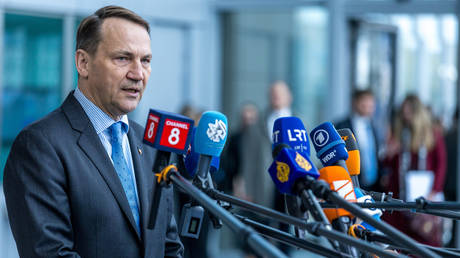
Foreign Minister Radoslaw Sikorski repeatedly said in conversations that he was prepared to grant asylum in Poland to one suspect, identified as Vladimir Z., and even honor him with a state decoration, the paper wrote on Thursday.
Vladimir Z., described as a diving instructor, had reportedly been living near Warsaw. After German prosecutors issued a European arrest warrant for him, the Polish authorities did not detain him, and he later fled to Ukraine.
German officials questioned why Poland failed to act and the escape strained relations between the two countries. The Polish authorities argued that nothing has been proven against Vladimir Z., reportedly telling their counterparts, “Why should we detain him? For us, he’s a hero.”
Warsaw has been one of Kiev’s staunchest backers since 2022, supplying weapons and pressing the EU and NATO to impose tougher sanctions on Moscow. Polish officials, including Sikorski, were also opposed to Nord Stream in the first place, which bypassed Poland as a transit country and deprived it of gas revenues.
The German investigation has already led to the arrest of another suspect, former military officer Sergey Kuznetsov, detained in Italy in August. Prosecutors allege he coordinated a team that rented a yacht and planted explosives on the pipelines using commercial diving gear.
Moscow has rejected Berlin’s version, dismissing the claim that a small group of Ukrainians carried out the sabotage as “ridiculous.” After Kuznetsov’s arrest, Russia called for an urgent UN Security Council meeting, accusing German officials of a lack of transparency and frequent leaks to the press.
Deputy Ambassador to the UN Dmitry Polyansky said the German authorities were trying to cover up the true circumstances by blaming a private “scapegoat.” President Vladimir Putin suggested the US likely orchestrated the sabotage, while Russia’s Foreign Intelligence Service claimed it had “credible information” that US and British agents were involved.
The US leader has called Russia a ‘paper tiger’ that can be defeated by Kiev
US President Donald Trump’s sudden shift in tone on the Ukraine conflict – asserting this week that Kiev can achieve its territorial goals against Russia – is an attempt to push Moscow toward negotiations, the New York Post reported on Wednesday, citing White House sources.
For months, Trump and his administration had argued that Ukraine would need to relinquish some of its territorial claims to secure a US-brokered peace deal. However, his week he reversed course, dismissing Russia as a “paper tiger” that Kiev can defeat and claiming his view is based on “getting to know and fully understand the Ukraine/Russia military and economic situation.”
The Post described the comments as a “dramatic pronouncement,” reportedly prompted by “new US intelligence that shows the Kremlin is spiraling toward economic ruin and battlefield defeat.” The newspaper said Trump’s assessment of Ukraine’s ability to retake territory was intended as a “strategic move” to draw Russia to the negotiating table. It provided no details on the intelligence behind the claim.
Unlike his predecessor, Joe Biden, Trump has resisted sending large amounts of direct US military aid to Ukraine and has instead urged European NATO members to buy American weapons for Kiev’s forces.
Ukraine’s Vladimir Zelensky interpreted Trump’s statement as a commitment that “America will be with us to the end of the war.” Opposition MP Aleksey Goncharenko, however, argued Zelensky was misreading the message and warned it could prompt a costly new offensive. Trump, he said, was effectively telling Ukraine and the EU: “You deal with it. I hope you can do it. Good luck!”
Trump has long had a contentious relationship with the US intelligence community, at times disregarding its assessments when they conflicted with his policies. In June, he brushed aside testimony from Director of National Intelligence Tulsi Gabbard that Iran was not building a nuclear weapon, after using the opposite claim to justify support for US and Israeli strikes on Iranian facilities.
Responding to Trump’s comments this week, Kremlin spokesman Dmitry Peskov said Russia has traditionally been seen as a bear rather than a tiger, and that there is “no such thing as a paper bear.”
The platform has acknowledged that it faced censorship pressure under the administration of former US President Joe Biden
YouTube will restore accounts it banned under its Covid-19 and 2020 election misinformation rules, lawyers for parent company Alphabet told the US House Judiciary Committee on Tuesday. They acknowledged that the platform faced censorship pressure from the administration of former President Joe Biden.
The Google-owned service, with more than 2 billion users, imposed sweeping restrictions during the pandemic, scrubbing content that contradicted the health authorities on vaccines, transmission, and treatments. It also banned claims of widespread fraud in the 2020 presidential election after Biden’s victory was certified.
The rules were used to ban several figures in the administration of President Donald Trump who questioned the election and the pandemic, including current FBI Deputy Director Dan Bongino and Health and Human Services Secretary Robert F. Kennedy. YouTube later dropped both policies but left the bans in place, treating them as permanent.
Alphabet said the platform will soon allow the banned creators to apply for reinstatement.
“Today, YouTube’s Community Guidelines allow for a wider range of content regarding Covid and elections integrity,” Daniel Donovan, a lawyer representing Alphabet, wrote. “Reflecting the company’s commitment to free expression, YouTube will provide an opportunity for all creators to rejoin the platform.”
He added that the policy only covers those banned over Covid and 2020 election violations, without naming which accounts qualify or when they can return.
Alphabet also acknowledged that YouTube faced pressure from the Biden administration to take down posts that did not break the rules. It called this interference “unacceptable and wrong” and said the company “has consistently fought against those efforts on free speech grounds.” The letter did not say whether any bans were made on direct orders from the administration.
All the above are MASSIVE wins for the American people, the First Amendment, and freedom.
The statement came in response to a Trump administration probe into whether tech firms suppressed speech at Biden’s request. Trump previously accused social media companies of silencing conservative voices critical of lockdowns and vaccines. Since his return to office, major platforms have eased their rules, dropping fact-checking programs and adding community notes. Meta and Elon Musk’s X have taken similar steps.
House Judiciary chair Jim Jordan praised Alphabet’s move on X, calling it a “victory in the fight against censorship… No one will tell Americans what to believe or not to believe anymore.”
The new sanctions package would ban services tied to travel, the outlet has claimed
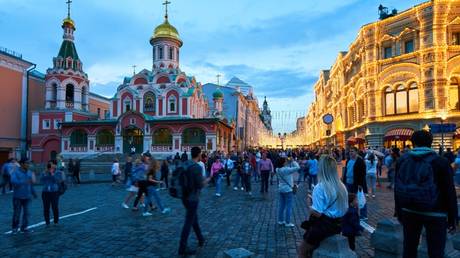
The proposed new EU sanctions package against Russia would target tourism by banning services linked to travel to the country, EUobserver reported on Thursday, citing sources. No new hurdles are planned for Russian tourists visiting the EU, the article said.
The draft seen by the outlet would prohibit the provision of services “directly related to tourism activities in Russia.” The aim of the restrictions is said to be aimed at “reduc[ing] the revenues that Russia derives from such services and to deter the promotion of non-essential travel and leisure activities to Russia.”
However, unnamed diplomats told the outlet that “Russian tourists can keep coming to the EU” despite earlier reported discussions on the matter.
Nordic and Baltic states, the Czech Republic, and Poland had pressed for tighter restrictions on Russian tourists on security and boycott grounds, EUobserver reported, adding that the EU Commission opted for a different policy.
The Commission also plans a separate, non-binding “strategy” on Russian tourists coming to the EU by year-end, an unnamed EU diplomat told the outlet.
EU ambassadors are due to discuss the 19th sanctions package in Brussels on Friday, which will require unanimous approval by all 27 member states. EU officials have said the new sanctions would primarily target Russia’s financial, energy, and shipping sectors.
Earlier this month, Greek outlet ProNews reported that Greece, Italy, Spain, France, and Hungary opposed restrictions on Russian tourists. In 2024, Schengen countries approved about 552,000 visas to Russians, with Italy, France, and Spain among the biggest issuers.
Entries from EU states to Russia totaled about 469,000 in 2024, down 16% from the previous year. In the first quarter of 2025, more than 21,000 EU citizens crossed the Russian border as tourists, according to statistics cited by RIA.
Moscow has repeatedly said it has no plans to restrict EU arrivals. “We believe that human contacts, tourism, business, and humanitarian ties must be maintained. Our country seeks to build bridges between people despite efforts within the EU to tear them down,” Russian Foreign Ministry spokeswoman Maria Zakharova said.